3 From Slave Ships to 9/11: Islam and the Long Struggle to Belong in America
Summary
Under the backdrop of our nation’s 250th anniversary, Our Seven Neighbors, season 5, explores the long, contested history of religious diversity in the United States—not as a feel-good celebration of pluralism, but as a hard-won achievement forged through conflict, exclusion, resistance, and moral struggle. Episode 3 features host Reza Aslan in conversation with Dr. Kambiz GhaneaBassiri.
Meet The Guest
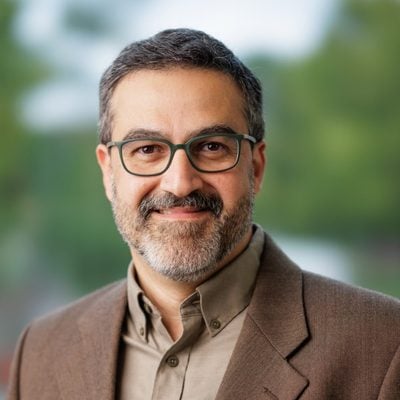
Dr. Kambiz GhaneaBassiri
Dr. Kambiz GhaneaBassiri is a scholar of Islam and American religious history. He is the author of A History of Islam in America: From the New World to the New World Order (Cambridge University Press 2010) and founding co-editor of the book series Islam of the Global West (Bloomsbury Academic).”
Transcript
Kim Schultz: Welcome to Our Seven Neighbors season five. Thanks for being with us. My name is Kim Schultz and I'm the Director of Interreligious Engagement at Chicago Theological Seminary and producer of this podcast. Season five is titled Religion and Resistance in America, and we are hosted this season by Reza Aslan. Reza, welcome back.
Reza Aslan: Thank you. This has been a great experience so far.
Kim: Glad to hear it. These conversations are getting better and better. I can't wait for our audiences to continue to hear them. And today we have another great one lined up. We are joined by Dr. Kambiz GhaneaBassiri who is a scholar of Islam and American religious history and author of A History of Islam in America from the New World to the New World Order. And we are so excited for this conversation. What do you have in store for us today?
Reza: Well, I think if you ask most Americans, they would say that Islam's presence in America is a relatively new thing, that it arrived primarily through immigration, primarily in the 20th centuries, between the 1950s and the 1980s, or maybe that Islam is something that only enters the public consciousness after moments of crisis, like for instance, the attacks of September 11th. But that framing, of course, is totally wrong. Islam has been part of the American story from the very beginning. And what we're actually seeing today is not a new presence, but a recurring pattern of visibility, erasure, and then rediscovery. And that's what today's guest, Cambiz Ganabasiri, has spent his entire career tracing. It's a history that he explores all the way from the very first Muslims who came here with Christopher Columbus, the Muslim African slaves who were brought here by force. He talks about the rise of the Black American Islamic Movement, and certainly the post 1965 immigration surge, and then of course the profound rupture that occurred after nine eleven and all that has followed.
And what emerges from this conversation is not just a history of a religion, it's more a history of how America decides who belongs
In its religious diversity, its religious pluralism. So today we're going to follow that arc quickly at first and then get right into the present in order to ask, why does Islam keep appearing in American life as if it's something new?
Kim: And
Reza: What does that tell us about the story that we keep trying to tell ourselves about the history of this country?
Kim: Yeah, so fascinating. I'm very much looking forward to this conversation, Reza.
Reza: All right, let's get to it. Kambiz GhaneaBassirii, thank you so much for joining us on our Seven Neighbors. I think many Americans think that Islam is something that arrived very recently in the United States through immigration or geopolitics, or certainly that's the impression that one gets from the last few decades of public debate, but your work tells a very different story that Muslims were present at the very beginning of what would become America, even before anything that would become America, and not just at the margins, but embedded in its earliest formations. So I want to walk through that history with you, not just to recover what was lost, but to ask what that erasure of the Muslim presence in America has allowed us to misunderstand about religion and race and belonging in this country. So let's start at the beginning. I think most Americans start the American religious story in New England with Protestants building a new society, but your work pushes that timeline back much further and in a completely different direction.
Can you tell us a little bit about Islam's role in the earliest explorations of the Americas?
Kambiz GhaneaBassiri: Yeah. I mean, one of the things that we often overlook is when Columbus was able to get the funding to be able to cross Atlantic, he actually made the pitch that I'll be able to regain Jerusalem for Christendom from the hands of Muslims. And so the whole project of actually trying to cross Atlantic had this element to it of regaining Jerusalem for Christendom, and also bypassing all the trade routes that Europe would use that would go through Muslim controlled territories around the Mediterranean. So the question of what you're asking is really interesting and something I've been thinking a lot about over the course of my career, the issue of whether there's a misunderstanding that's happening here, or whether there is a particular understanding of Islam that's fundamental to the way in which the modern West has come to understand itself. If we go back to early 20th century histories of the idea of the West, there's an argument that was made that because Europe and particularly Northwestern Europe was surrounded by Muslims, it didn't actually have any cultural connections with the rest of the world.
So the rise of European empires in the 19th century was something that was a completely autokines and routine resulted from the activities of Europeans themselves without any connection to the rest of the world. So if you want to understand modernity in so far as Western European empires have been at the forefront of establishing what's modern, you don't need to study the rest of the world. You don't need to think about the rest of the world. And a lot of that hadn't meant that you have to think about Islam in a particular way. You had to think about that Europeans didn't have relationships with Muslims. A way of thinking about Islam had been integral to the idea of the modern West.
Reza: And so how does that presence of Muslim culture, Muslim science, and indeed even the presence of Muslims themselves in the earliest explorations of the Americas, how does that change the story of America as it's been told?
Kambiz: So one thing that it does is integrates the story of America into world history much more, so that we come to see actually slavery and colonization as being coevil with one another, that they're happening around that. They're part of the same type of a project. That allows us to be able to think about a lot of the categories through which we understand modern history differently. So for example, if we take into consideration that the earliest people who came from Europe to populate Americas, parts of which became the United States, were very anxious about the presence of Muslims in these territories because they had just defeated the Muslims in the Iberian peninsula and they were worried about their religion coming into an area that they were going to Christianize. So there are all these laws being passed in the 1500s to excluding Muslims, or not even Muslims, people who had been of Muslim background who may have converted to Catholicism from coming into that country.
And there was a lot of anxiety about this. And those anxieties helped actually shape the ways in which people thought about race because they started thinking about like, well, these people are saying they're Catholics, they've converted, but have they really? We need to look at their physionomy to see how ... And this also happened with Jews. We need to think about how they look and things of that sort. We need to worry about those things. So ways in which people look and what their faith is and what their interiority is came to be tied to one another in a way that makes us think about race differently because we don't see it only as an external marker that's used to control people, but actually something that had to do with how people thought about the interiority of others who were different from them and how they tried to police that interiority for the sake of domination of a region.
So that's like one of the examples, I think, of the ways in which this story looks different. But the other way in which the story looks different is that it shows us that Western Africa, Western Europe and the Americas were part of a triangle that created that Atlantic world and Muslims were integral to that triangular relationship. And the story of taking that seriously and actually paying attention to how Muslims participated in the transatlantic world, shaped Atlantic world is a story that we still need to tell that everything has been fully explored.
Reza: You read about this fascinating character, Estevanico. Could you tell us a little bit about him and what his role was?
Kambiz: Yeah. So Estemaneco was a person who was likely nobody little about him. And the record he's mentioned not as a Christian in the record that Cabeza de Vaca had written about in which he's mentioned, he likely came from Portuguese controlled territories in West Africa and was part of as a slave on a ship that ends up in the Southeastern part of the United States. And there's a shipwreck, so they end up on the land and he ends up being a guide as a person who did not look white and learned languages quickly. He ends up being a guide for all of these Spanish colonizers. And there's a lot of myths about him. So I don't know how much of what we know is mythical and how much is real, but we know definitely that he was present among us a slave coming from this region as a Muslim background in the 1500s, was probably one of the earliest Africans who was in areas of Texas, for example, and Arizona and Nevada, Southern Nevada, serving as a sort of what some have called this a medicine man as a sort of a guide for these Spanish colonizers of the region.
Reza: Yeah. And it's a reminder that the first wave of Muslims to the United States came on slave ships, obviously. And the experience of slavery was so integral to the earliest Muslim experience in the United States. Talk to us a little bit about that, about the experience of Muslim slaves in the United States, the way that they kind of try to maintain elements of their practice, the way in which they often were forced to adopt the religion of their masters and just kind of that experience and how integral it was to forming the first American Muslim identity.
Kambiz: Yeah. So the earliest people that we know of who were practicing Muslims came on slave ships, as you said, certainly as the early 1700s in the 1730s. And they actually have left us a historical record of the writings in Arabic. That's a sort of precious in the sense that we have people writing in a language that we have African born people writing in a language that their masters couldn't read. So in sense that they left us this precious record. This is also one of the ways in which Muslims were involved in the transatlantic world that was created in the sense that the slave trade brought a lot of weapons into the region, which helped a lot of Muslim empires be able to gain control and greater control of a territory in that region. Often Muslims were in these countries were selling their war captives into slavery, and sometimes they themselves were being captured and being sold into slavery.
And then there was also, at the same time, a movement towards Christianizing the regions. So they were also involved in a world in which Christianizing and participating in an economy went hand in hand together. So the commerce of the country and missionary movements went hand in hand together. And because often Muslims were literate in this realm, they were seen not as quiet African, not as quiet as Black, because they could read and write. So they sort of challenged the assumptions that what Europeans had about Black people, but nonetheless, they were also not Christian and they were Black. So they occupied this sort of liminal space. They were seen as these liminal individuals that could help translate American interests and not just American, but also European interests because the French and the British were also involved in this interest in the region. And that's why we know about them.
That's why there was this no variety around them because they attracted attention for these reasons. And they were also involved, not them personally, but their presence was important for the abolitionist movement because the presence of blacks who could read and write, who had a religion that the Christians recognized as a religion being Islam, as opposed to the religions of West Africa helped develop this argument that, look, this is inhumane, that slavery is an inhumane practice.
Reza: It's interesting listening to you talk. I mean, it struck me that so much of the very earliest experience of Muslims in the United States involves not just loss, but adaptation. It's about navigating the sort of traditional Islam of their heritage with the Christian practices that oftentimes were forced upon them. And so that story of adaptation, of survival, of continuity, in a way that becomes the story of Islam in the United States, doesn't it?
Kambiz: Absolutely. Absolutely. And like you were saying, I think that's a brilliant astute observation that they're from the very beginning, because these slaves left us a record, we get a sense of how they actually thought about the world into which they emerged. And Muslims already had a view of Christianity because in the Islamic tradition, Jesus is considered a prophet. Moses is considered a prophet. These are religions that had come before Islam. And then the idea is that the people were followers of those religions moved away from them. So God needed to send a new prophet. And the prophet Muhammad is the final prophet that God sends to. So they already had a preconception about the people that they were encountering with. And we actually have some of them saying things like, these people don't have a religion, that if they actually were Christians, they wouldn't behave in the ways in which they do because they had conceptions about what a religious person, how a religious person ought to behave.
And then so the religion Islam became a way by which they actually adapted into the thought about the new realm in which they were participating in, which is, again, to think back about how the story of the United States would change is that one of the things is we can then think about assimilation as something that's unidirectional that people come and they're just changing according to their new environment in which either forcefully transported or immigrated into, but rather people are coming in with their own preconceptions and then those preconceptions end up shaping actually how they adapt and what a simulation looks like. It's a multidirectional force rather than a unique directional force. And if we take those lives seriously and we pay attention to them, we could also begin to see things like ... One of the people that I'm thinking about is Omar Absayet who left us this precious autobiography of himself.
He begins that autobiography by actually rewriting Surah Al-Mulk in its entirety from memory, and then he goes on to talk about how he's become Christian. And then he talks about how I used to pray like this, and he mentions the Muslim prayer, and then he says," Now I pray like this. "And then he mentions the Lord's prayer, all in Arabic. So one wonders, how much did he actually become Christian if he's beginning with Surah Almork? But if we think we understand that what he was doing was he was thinking about using Islam to think about the new circumstances he's in, thinking about how he should think about the people who he's living with, who are his masters, who he seems to have a very positive view of, because they're also religious and he mentions them as being religious people who read the scriptures like he does and want him to read the scriptures like he does.
We start seeing his sense of self-worth. A lot of the ideas that we associate with democracy, for example, like individualism, freedom, freedom of consciousness for him are all coming from his religious tradition because he couldn't actually get them in the state. So we could see that his sense of what it meant to be a resident in the United States, not a citizen, of course, but resident in the United States in this context is informed by his Islamic beliefs and the sense of his relationship with God is actually helping him understand how he should participate. And in that way, you could see he has his own distinctive worldview of who counts as a religious person and who doesn't, who's righteous and who's not, and who's a white person and who's not and so on.
Reza: Well, it's funny because you're talking about a population that was once so very visible and then kind of becomes invisible in the American narrative. So I guess that begs the question, what happened to Islam and America after slavery? Why doesn't that early Muslim presence translate into a continuous recognized tradition? And how much of that has to do with what you were mentioning about forced assimilation, forced conversion, and then how much of it is just the story that Americans choose to tell about their founding? It's a story that doesn't really have any room for Muslims really does it.
Kambiz: Yeah, no, absolutely. And so I'd be interested in how you would also think about this, right? That the story, part of it is the forced Christianization and the inability to be able to actually organize around religion. So we think about United States as the land of religious freedom, forgetting that actually a lot of people's religions wasn't considered to be religion, so it couldn't be freely practiced, religions of Native Americans, religions of slaves and so on. So they couldn't actually live according to their religious practices. So to be able to organize around them in any sort of ways to create institutions until new immigrants coming at the end of the 19th century and then in the beginning of the 20th century began to build mosques and community centers and so on. They couldn't do that. There was forced Christianization and there was also that lack of inability to be able to create their own institutions and build their own communities.
But at the same time, if you look, if you go back to the 1960s and 1950s, members of the Nation of Islam were actually retelling the story of the United States through these Muslims experiences. And this was not something that was just happening under the radar. We have actually the roots, right? Do you know Alex Haley's roots? Alex Haley being the person who helped write the autobiography of Malcolm X. He creates this thing that at the time was the most popular television program series of the nation. So everybody was watching this and that story began with Africans who were in Africa as Muslims who are brought into the United States. So that story has actually been told in a massive way for a very long time. Why does it not get integrated into the ways in which we understand things? Why do these become like quaint little figures rather than actually people who could tell us the sort of flows of economy and ideas and peoples and so on.
It's a thing that I've been struggling for a very long time. And when I even wrote my book on a history of Islam in America, the peer reviewers send me comments back saying like, "What history? What does he talk about? Dr. Gandhi, you should stick to what he knows and just talked about the post 1965 immigration story
To a point that I actually went to my editor and said like, Oh, I'm sorry, I want to write a history. The whole point is that this isn't new and that like, so I'm sorry, we can't work together. And she was like, hold on, hold on, just write a reply to the peer reviewers and you could write your book. And thankfully the publisher published it. But it's not a story that hasn't been told. It's been told in a variety of ways and in ways that had attracted attention, but it keeps going under the radar. And that's why I'm beginning to think that the issue is not so much that lack of information and misunderstanding, but the narrative that we need to go by, the ways in which we think about the way progress works, the ways that we think about what counts as modern and what counts as human and so on has been so enladened with an image of a Muslim as an enemy, a Muslim as the other, the eternal other as a foreigner, that people can't hear it.
Even if they've been told it and they have known it, they can't really hear it.
Reza: I'm curious because there's so much conversation about this, what do you think the founding fathers, people like Thomas Jefferson, people like George Washington, people like Benjamin Franklin, what did they know about Islam? How familiar were they, not just with Islam as a religion, but with the presence of Islam in the United States?
Kambiz: So we know now that Jefferson definitely knew that there were Muslims in the United States, even if he didn't know there were Muslims among the slaves that he held himself
Because he was in possession of a letter that was written in Arabic that he was trying to decipher from people who had been in the United States. So they definitely knew that there were Muslims in the United States and we know there's a story told about him hosting a Muslim ambassador at the White House as the first sort of Muslim ambassador who had visited the White House. And it's not until later in the 18th and 19th centuries that the presence of Muslims actually becomes noteworthy in some ways among people who are actually born in this land and this country who don't have that familiarity with the exchanges that had happened earlier on. There was actually like a forgetting that had to happen to create a new identity forgetting of the past experience stories had to be told.
Reza: And that forgetting wasn't accidental, right? That it was constructed really. And then you brought up the 60s a lot. I mean, this is kind of the next great wave of Muslim immigration, although it's weird to talk about slavery as immigration, but you know what I mean? The next great wave of Muslim presence in the United States, and it's where I think a lot of people think the story of Islam in America begins. We've already talked about how that's simply not just false, but it's deliberately false. But one thing that is very interesting about that second wave is that it came from a different part of the Muslim world, right? That it came primarily from South Asia, from the Middle East. And so you now have this kind of different Muslim population that begins to shape the vision, the idea, the perception of Islam in the United States.
And I guess there's sort of two really interesting questions about that. One is the way in which that first impression landed upon Americans. And I think it might be different than what a lot of people think it was because those first Muslim immigrants weren't necessarily sort of refugees or the poor people who could actually come to America. Often they were professionals, they were students, they were scholars, et cetera. But then also second to that is this other question about the tensions that start to emerge.
Kambiz: From like the 1920s, there was this sort of interaction among immigrant communities and African American communities that adopted Islam, but really Islam doesn't become a major presence in African American communities until the 1950s and 1960s as a result of, especially the work that Malcolm X did in the nation of
Kim: Islam.
Kambiz: So it doesn't get that sort of prominence. And at that time, there's a sort of tension between these immigrant Muslims and the nation of Islam because the nation of Islam was not teaching a form of Islam that Muslims in the rest of the world recognize as Islam. It's also important to remember that that wasn't the only presence of Islam among African Americans. Also in the 1920s, the Ahmadiyah movement had come into the United States and they started finding that the people that they were able to convert in America were mostly African Americans rather than white Americans. So they had also converted people to Islam. So there were these other Muslim communities that also existed that were different from the nation of Islam and extensions of forms of Islam.
Reza: So what happens over the next couple of decades is that you start to see this community really beginning to become institutionalized and visible. There are mosques and communities and institutions and even universities, schools taking root. You have this kind of really fascinating adaptation that we were talking about where American Muslims begin to define themselves, particularly in American terms, not necessarily in the terms of the cultures or the nation states that they came from. There's the creation of something distinctly American that is something new that we can truly call American Islam. And then of course, there is the rupture that changes everything, which is nine eleven. And can you talk about how that experience fundamentally reshaped what it meant to be Muslim in America, both externally in terms of the way that Americans viewed Muslims, but also in terms of the identity of this population that at this point had really embedded itself in every aspect of American society.
Kambiz: Yeah. I mean, from the perspective of Muslim history, nine eleven is the intensification of processes that had already been in place. So the sort of Iranian revolution, the Russia affair and all of these things- The war
Reza: In Lebanon.
Kambiz: Lebanon, the war in Lebanon, and also the first Gulf War, following Saddam's invasion of Kuwait, Iraq's invasion of Kuwait, those had also begun to raise questions about the presence of Muslims in the United States. And Muslims had noticed this sense of like, look, as we are also further integrating into American life and society, there's this sort of animosity and anxiety around us and they had begun to organize already in the 1990s around these things. So they started developing institutions for civil rights organizations and things like that. So today's like most prominent civil rights organization in the United States, the Council on American Islamic Relations was founded in 1994, and it became really prominent in 1997, I believe, when there was the bombing of the federal building by Timothy McQuay, which a lot of people attributed to Muslims and Muslims in America came under attack because of those things and the care sort of was gained prominence as responding to those types of attacks that Muslims were facing.
So when nine eleven happened, that just intensified this sort of animosity from the perspective of Muslims. And thankfully, because of the organizing that Muslims had done in the past, when nine eleven happened, they already had relationships often with local religious leaders and local civic leaders in their city halls and in their churches. So when you talk to Muslim leaders throughout the United States, they often talk about how the first person that they heard from after nine eleven was like a rabbi or a minister with whom they were in interfaith dialogue, who had known them, who had a sense of them. So in contrast to that, the government as a whole, the state as a whole has a completely different type of reaction. So we began to see all these surveillance, the visibility of Muslims in this way as being the people responsible for the attack of nine eleven helped the state push a lot of agendas through that they probably had pushed through much earlier because now they had a visible enemy to which they could point to and around which there could be a consensus.
Kim: So
Kambiz: I remember after nine eleven trying to have a teaching on the Patriot Act, and I was just naively thinking, "I'm just going to print this thing out and read it. " And I realized it's hundreds of pages long and none of it actually makes sense because it's like, unline this, remove this comma and add this sentence so you can actually read the text. So you realize this thing was written way before nine eleven and was passed very quickly after nine eleven. So nine eleven became the excuse through which these things could be pushed through. Similarly, with the US invasion of Iraq and the toppling of Saddam Hussein, you can come to see there were these plans already in place and now that there was an event that allowed us to be able to get public opinion to agree with us to things were being pushed through.
So then Muslims became, in terms of how Muslim life changed, the state's eye was on them in terms of surveillance and also for his history of the United States more generally, a lot of things changed fundamentally in the United States on the backs of Muslims, in relationship to Muslims. A great example of this is, I don't know if you have read Dave Eggers Zeitun where he talks about this Syrian man who marries an American woman who had converted to Islam and has this business in New Orleans and how you come to see that after Katrina, the flooding that happened in Katrina, he decides to stay in New Orleans and is arrested. No one knows what had happened to him, his family's looking for him, and this is all a true story. And the thing that they find out was that it was being held in these Guantanamo based style cages in the region because someone at one point had written a white paper about how if there's a natural disaster in the United States, this could be a time where we're attacked and subject to terrorist attacks.
And because we created after nine eleven through the Patriot Access Department of Homeland Security, which ended up putting FEMA under Homeland Security, ended up securitizing the nation's response to natural disasters, which resulted in these types of things, which resulted in what happened in Katrina in large risk because people were worried about security and national guard is coming in and all these other things. So the country fundamentally changed because of this boogeyman that was created among American Muslims. And so American Muslims on the one hand find themselves being surveilled, their actions being representing ideas larger than themselves, that every Muslim comes to see themselves as an ambassador for the Muslim world more generally. And at the same time, they end up getting a much wider platform in the United States in terms of what sort of policies are pushed forward, how the country ends up changing, how people think about what immigration should look like.
Reza: Even what American history looks like. I mean, we already talked about the deliberate erasure of Muslims before the creation of the United States and in the early years of America's founding. But I think post nine eleven, there's this very interesting attempt to rewrite American history and to create this idea that we've discussed already, which is that the Muslim presence in the United States is very, very new and foreign and exotic and obviously unwelcomed. And most of our conversations on this podcast, we've been talking about the way in which religious communities have navigated both the rights that the Constitution affords them as religious minorities and the sort of racism and bigotry and the attempt to erase them from the American religious landscape that the majority population often provides. In Islam, however, something very interesting happens post nine eleven, which is that rather than make the argument of how to fit this community that is seen as not just foreign and exotic, but also a threat into the American religious landscape, how to reconcile their otherness with the reality of their constitutional rights, you just reframe what Islam is.
And so the primary argument that you start hearing is that, well, but Islam is not a religion. Islam is an ideology and so therefore it's not protected that we don't have to have a debate over how to integrate Islam into our constitutional freedoms because Islam is not a religion. So therefore, it's excluded from those First Amendment rights, which is a very fascinating argument. It's a fascinating way to fully and completely otherize this community. But it also, I think, in a really interesting way, galvanizes something that really, I don't know if it truly existed before nine eleven, which is a muscular, distinctly American Islamic identity, right? So the attempt to force Muslims to say what it means to be Islam in America. I wonder if you have any thoughts about those two trends that I was just referring to.
Kambiz: We could do a whole episode just on what you were talking about. Yeah. I mean, so Muslims end up actually not just defining what it means to be an American Muslim. They end up trying to define what it means to be American, right? In so far as they're defending freedom of religion, they're also defining for Americans what it means to be American, right? That how integral freedom of religion is to have ... And we forget that actually the rights that democracies afford their citizens are defended by those who don't actually have them and want them and need them. So the ways in which this makes us rethink American history is partly that too. It's not that there were these brilliant founding fathers who had this idea and they were going to give these rights to everybody. Actually, the history of democracy is people trying to get these rights as a means of gaining access to the resources that are being controlled by the state that is giving those rights to certain people and not others.
And Muslims end up playing that role too. And the fact that we could see that in their integration, as you just nicely put right now, we could also then begin to look back and say like, "Actually, you know what? It's been working like that throughout American history." It was the blacks who understood what freedom means who were enslaved. It was women who understood what it meant to have equal rights and equal participation and equality because they didn't have them and it's them who are articulating these. And when we talk about the JudeoChristian nation, which is an idea that comes out in the mid 20th century, it was Jews and Catholics who were excluded from the American society that read themselves into this narrative. It was them who started writing about America as a nation of immigrants because they saw themselves how immigrants were excluded from these rights and how their participation actually meant a rethinking of those.
And then American Muslims are very much involved in this process right now. And this comes back to another, the question you were asking about the relationship between Black American Muslims and people of immigrant background too, because Muslims in the United States are so diverse and they're both like indigenous Muslims, Black Muslims and immigrant Muslims, and the United States has had this long tradition of assimilating people in two ways. One was to leave, you sing the praises of the nation and you come to, you see or present yourself as a patriot like America is the best nation. We have the freedoms and all of these other things. You could do that if you're white in this country and Catholics and Jews did that. And a lot of Muslims have tried to do the same thing if they were white passing.
If you are black, that's not what you did. You held the nation accountable to its sins. So your means of assimilation was to be able to say, "We need these rights and we hold you accountable to the fact that you fight for those civil rights." And American Muslims have had to do both of those things. And there are very different ways of actually assimilating or becoming part of American society. And America has not had a group before Muslims, a prominent group before Muslims through which they have had to deal with these types of issues. And so American Muslims are now left circling that square, square in that circle. And in some ways that, because celebrating America as this free nation is different from holding it accountable to say like, "Look, it's never been free. You need to do better," which is what Black Americans have always done in this country.
So American Muslim very much ... And it's really interesting to see in the contemporary period what sort of American Muslim politics is emerging. And I think Zohran Mamdani is a wonderful person to look at to see he's exactly the product. What do you do politically in these contexts? And what's beautiful, I think, in a lot of ways of what's happening with that movement is that you understand democracy not as a top down enterprise, but you understand it as people taking care of one another so that they could govern themselves.
Reza: Yeah, perfectly said. So your work, I think establishes pretty clearly that Islam has been a part of the American story from the very beginning, but that it has been repeatedly erased, rediscovered, contested, fought for, et cetera, all that stuff. Then in a way, it says something bigger about the country itself. And so just to kind of finish up our conversation, I wonder that if you fully integrated the story of Islam into the story of America, not as an add-on, not as something that comes later, but as foundational to the American story, how does it change? How does the American story change and how does it change the way we even think about religious freedom today?
Kambiz: That's a fantastic question. One thing is that I don't think it changes any one singular way. It changes in multiple ways. One, the result of which we've already seen is America does not seem to be so exceptional that what we come to see is actually the things that we cherish about America, whether it be political ideals or the resources or sources that are available, those things have always been developed in relationship with others and not just Muslims, but with other communities and other groups. The other thing is that we need to develop ways of thinking about America's story in the plural. I mean, if I was going to say there was one way to change about this, that we have to pluralize everything so that when we think about citizenship, we need to always think about it in terms of citizen who, like which citizenships, what kinds of citizenship?
There's cultural citizenship, there's political citizenship, there are people who could make a lot of money, but actually not be able to participate in the economy, in the politics, right? So that it needs to pluralize those things for us so that we're not thinking of a ... I mean, this is sort of like the cheap professor answer, that it shows us the picture is much more complicated and the picture is much more complex than there's a single story, there are multiple stories, and that the process of developing that single story is something that's constructed over time at the expense of some people for the benefit of others. And again, like what I was saying, American Muslims doing at the forefront of thinking about what American identity means today, part of it is whether they're going to also make themselves foundational to say America as an empire is the America we want to participate in or America as this complicated messy democracy is the one that we want to participate in.
They have to also decide what type of story of America they're going to integrate themselves into.
Reza: This was really fantastic. Dr. GhaneaBassiri, thank you so much. It's such a profoundly important conversation and it really does give us an opportunity to really reveal the notion that religious pluralism was not given to anyone at the founding, that it was always forged through contradiction, through coercion, through resistance. And certainly the story of Islam in America really solidifies that truth. Thank you for joining us.
Kambiz: My pleasure. It was wonderful talking with you, Dr. Aslan.
Kim: And that does it for another episode of Our Seven Neighbors. Special thanks to our host, Reza Aslan. As always, join us next time for another conversation around religion and resistance in America with the Interreligious Institute at Chicago Theological Seminary. Take care.
Straight White American Jesus
The flagship show examining Christian nationalism and democracy.
Listen Now
Axis Mundi Daily Brief
Short, focused analyses of the most important daily developments in religion and politics.
Listen Now