2 Soul Wounds: Indigenous Survival and the Limits of Religious Freedom
Summary
Under the backdrop of our nation’s 250th anniversary, Our Seven Neighbors, season 5, explores the long, contested history of religious diversity in the United States—not as a feel-good celebration of pluralism, but as a hard-won achievement forged through conflict, exclusion, resistance, and moral struggle. Episode 2 features host Reza Aslan in conversation with Dr. Farina King.
Farina King, a citizen of the Navajo Nation, is the Horizon Chair of Native American Ecology and Culture and Full Professor of Native American Studies at the University of Oklahoma. Her research centers on Native American oral histories, especially among her Diné relatives and connections in Oklahoma. She received her Ph.D. at Arizona State University in History. She is the author of various publications, including The Earth Memory Compass: Diné Landscapes and Education in the Twentieth Century; co-author with Michael P. Taylor and James R. Swensen of Returning Home: Diné Creative Works from the Intermountain Indian School; and author of Diné dóó Gáamalii: Navajo Latter-day Saint Experiences in the Twentieth Century. She is a co-editor of The Lyda Conley Series on Trailblazing Indigenous Futures with the University Press of Kansas; co-editor of the Palgrave Studies in Oral History; and Editor in Chief of the Oxford Research Encyclopedia of Indigenous Studies. She is the past President of the Southwest Oral History Association (2021-2022).
Meet The Guest
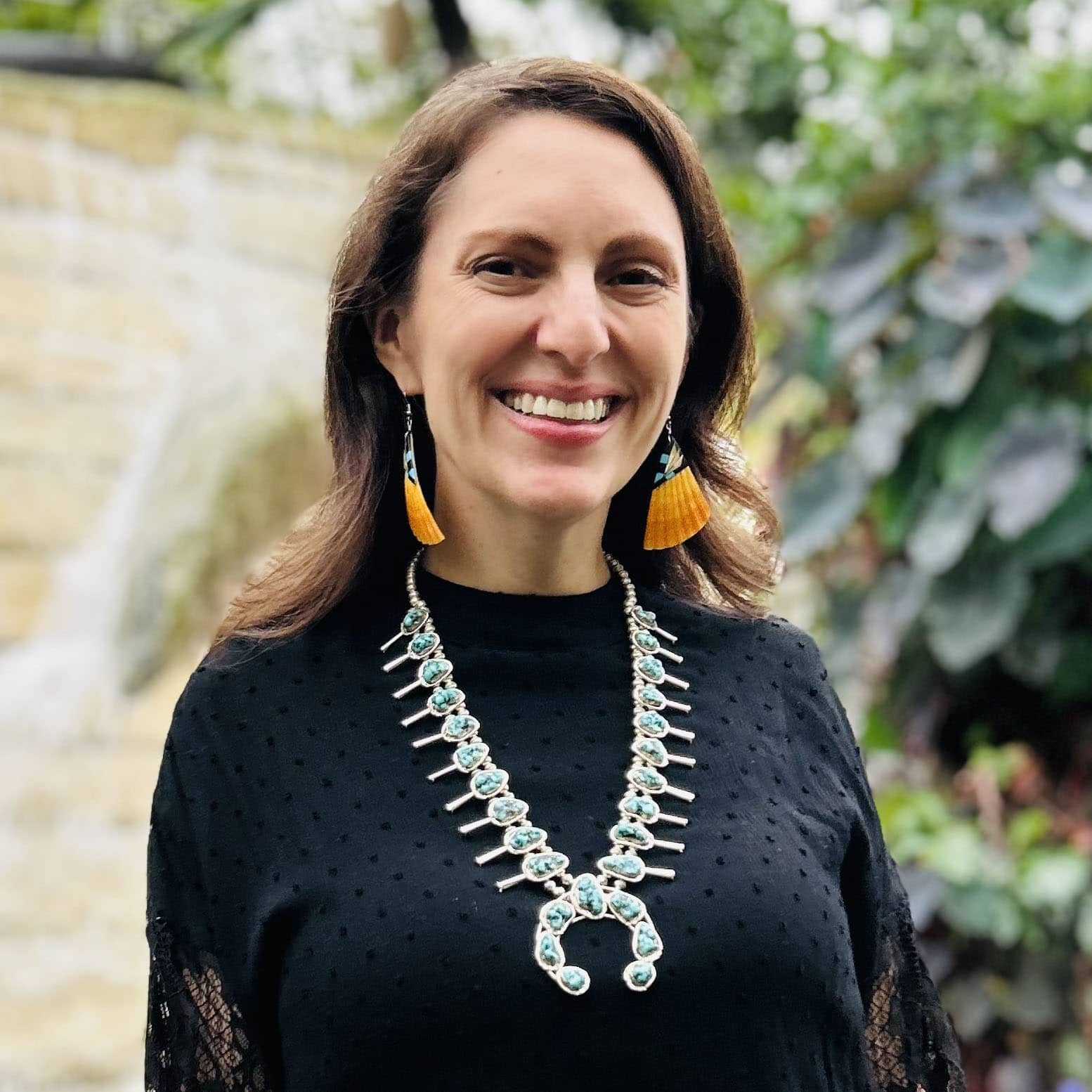


Dr. Farina King
Farina King, a citizen of the Navajo Nation, is the Horizon Chair of Native American Ecology and Culture and Full Professor of Native American Studies at the University of Oklahoma. Her research centers on Native American oral histories, especially among her Diné relatives and connections in Oklahoma. She received her Ph.D. at Arizona State University in History. She is the author of various publications, including The Earth Memory Compass: Diné Landscapes and Education in the Twentieth Century; co-author with Michael P. Taylor and James R. Swensen of Returning Home: Diné Creative Works from the Intermountain Indian School; and author of Diné dóó Gáamalii: Navajo Latter-day Saint Experiences in the Twentieth Century. She is a co-editor of The Lyda Conley Series on Trailblazing Indigenous Futures with the University Press of Kansas; co-editor of the Palgrave Studies in Oral History; and Editor in Chief of the Oxford Research Encyclopedia of Indigenous Studies. She is the past President of the Southwest Oral History Association (2021-2022).
Transcript
Kim Schultz: Welcome back to Our Seven Neighbors season five. We are so excited you're here with us. My name is Kim Schultz and I'm the Director of Interreligious Engagement at Chicago Theological Seminary and producer of this podcast. Season five is titled Religion and Resistance in America and we are hosted this season by the one and only Reza Aslan. Reza, welcome back.
Reza Aslan: Thanks Kim.
Kim: So on the last episode you spoke with a novelist, historian and museum curator Peter Manseau about the myth of a religious freedom. What stands out to you from that conversation, especially for any folks who may have missed this first episode and if you have go back, it's a good one and provides the arc and really the whole foundation for our whole season. But anyway, Reza, what stands out for you?
Reza: Well, I guess I would say what stands out for me is that this rhetoric about America being founded as a Christian nation is not so easily dismissable when you really think about the way in which the creation of this nation went hand in hand with the idea of it as a new Jerusalem. And so what does that mean now moving forward? Because I mean, we're not going to pretend that there were only Christians at the founding of this country and as we'll see as we move forward with these episodes that there was this constant conflict and negotiation and renegotiation about who really belongs and doesn't belong in the religious fabric of America.
Kim: Great. And to launch us into that deeper conversation and deeper dive, today you're talking with Farina King. Dr. King is a citizen of the Navajo Nation and full professor of Native American Studies at the University of Oklahoma. And what a beautiful place to start our series, speaking about how religious freedom has been used as a tool of indigenous dispossession and how indigenous families have historically survived amid all the horrors perpetrated on them. What do you hope for this conversation today?
Reza: Well, when we think about the story of America's religious freedom, we think about it as a story of belief. We talk about the right to worship, the right to gather, the right to pray, the right to belong to a church or a synagogue or a mosque or whatever the case may be. But the indigenous religions in America expose the limits of that story because what happens when your religion is not just a matter of belief, what happens when your religion lives in land, when it's a part of your language, when it's deeply tied to ideas of kinship or water conservation or mountains or songs or memories or any of those things. And for native peoples, the American promise of religious freedom often comes across as a contradiction. I mean, the same government that claimed to protect conscience also banned ceremonies. It also removed children from their families.
It punished native languages. It empowered Christian missions most importantly. It treated sacred land as federal property. And today's guest, Dr. Farina King, helps us understand that history a little bit more. In her book, Returning Home, she and her co-authors recover the poems, paintings, songs, and creative works of students at the Intermountain Indian School, which was the largest federal Indian boarding school in American history. And what emerges from that collection is not just a story of suppression, but a story of survival. It's a story of memory and art and kinship, a story of children carrying home inside of them, even when the institutions around them were specifically designed to make them forget that story. So in today's episode, we ask, what does religious freedom mean when your sacred places can simply be taken away from you and what survives when a people refuse to be severed from who they are?
Kim: So fascinating. I'm sure it will be a very layered conversation. I look very forward to it. Shall we get into it?
Dr. Farina King: Let's do it.
Reza: Dr. Farina King, thank you so much for joining us on Our Seven Neighbors this season.
Dr. King: Thank you. Thank you for inviting me.
Reza: For Indigenous peoples, religious freedom has often been less a protection than it's been a broken promise. Of course, we know that federal policy didn't just fail to protect the religions of natives people. It actually sought to suppress them. It actively sought to sever them from their land, their language, their ceremony, their sacred places. And what we love about your work is that it really shows that this policy was quite explicitly a Christianizing project, that it was a deliberate attempt to separate native people, particularly native children from the very sources of their religious life. And I think that's what we want to kind of focus our conversation around because we often talk about religious freedom in America in terms of churches or synagogues or mosques, temples. We talk about it in terms of denominations or private belief, but what happens when your religion is not confined to a building, right?
What happens when your religion can't be separated from the land and then that land is seized and controlled by the very government that's claiming to protect your rights? So what does religious freedom actually look like to the indigenous populations of this country at the birth of it?
Dr. King: Yeah. Thank you for that lead in and the questions you raise. I think it's really critical because what people conceptualize as religion and religious freedom, they have certain frameworks, their own positionality, lens, perspective on what they term, what they define and understand as religion. And I often tell people, I'm a Navajo nation citizen. My mother is white American settler and I'm born for the Kiyaani and Synigene clans of Dane. And that's how Navajo we call ourselves. And that's the point is we have our own terms and language. People think of that as worldview, but it's who we are through generations. And yes, people are dynamic. We change and we learn and are introduced and appropriate or embrace or reject what we come across in life and in our experiences. But one thing I do circle back to and talk about is that in the Navajo language that I'm now trying to learn, my own father went to a Indian boarding school as they're known and was immediately shamed, punished for speaking the only language he knew.
And in that language religion, there wasn't really a word for the way that Euro Americans or many white Americans define religion. It's just word. You are. And that spiritual ways of life and being and the relationality with kin more than human kin, rocks, animals, spirits, all things around you, those are a part of who you are and shape who you are as Dene. And so I tried to explain that to people that there wasn't this sense of, oh, people decide on a particular denomination and they go to church on a certain day of the week and they go do that. No, like being those ceremonies, ways of life, the way that you relate to all beings and that's inanimate, animate, that is who you are as. So I had to delve into that. My own grandfather was. That's how Dine call our healers and that he knew ceremonies and practiced that and had a real knowledge and understanding of the land.
And that's my own paternal grandfather as we call our paternal grandfathers. But my father was introduced to Christianity in boarding schools actually in schools. And in many ways, those schools, as you mentioned, designed to assimilate, they also had an explicit agenda to eradicate, destroy indigeneity to be quite direct because it was in writing. It was very clear and Christianity sadly, though people learn the teachings of Judeo-Christianity, these different religions, ways of being, they teach love and love one another or freedoms, like you said, these are supposed to be great, great ideals and such, but those were applied, co-opted, used to justify the eradication and destruction of indigenous peoples, their peoplehood and the banner as you were mentioning of the boarding school system really came under Richard Henry Pratt's idea that he encapsulated with Kill the Indians, saved the man in them, that there were these people like him and it went over generations.
It didn't just happen in the late 1800s. I mean, this didn't happen in a vacuum. As soon as Europeans started invading, encroaching on indigenous lands, even with Columbus, the bearer of Christ in his own name, immediately they were using religion and religious terms to conquer, to pursue conquest. I mean, that is the doctrine of discovery embedded there of creating that binary of civilized, civilized are deemed a certain sense of Christian and religion and quote, savage, uncivilized. And that quote savage uncivilized did not have any claims to land. When as you mentioned, land is so integral, like indigeneity means to be indigenous to a place that your very identity and being is inseparable from that place and the ecology that for many indigenous peoples is multi-layered, even metaphysical, right?
Reza: There's so much to unpack in what you just said and I'm really excited to do so. But I do want to pause for one minute because you were talking about the boarding schools. And I think that sometimes when Americans hear the words boarding school, they think, "Oh, education." Oh, it was like when they took these native children and they educated them. But that's not what was happening in these boarding schools at all. These were specifically designed, as you suggested, as tools of religious suppression. Can you just unpack that for us for just a minute before we move on?
Dr. King: It's a lot because again, when you say boarding school, it's a triggering term for indigenous peoples since I see it and describe it as a constellation, you have so many, many native nations, many individuals within that hundreds countless of all these different peoples and their cultures and their contexts and then these different schools that are called referred to as boarding schools. So there were boarding schools, these kind of residential lived in schools as early as 1600s and they were tied to Christian missions, prostalization. And then what most people are focused on is the system that was funded and supported by the federal United States government really beginning in the late 19th century. So that's that difference and that was a design system that opened up several boarding schools throughout the United States, such as one of the most known is the Carlisle Industrial Institute in Pennsylvania founded by Richard Henry Pratt, who I referred to as one of the architects of that system to create that model of having an off-reservation boarding school that was meant to separate Native American children, youth from their families, their communities and really in that way ceremonies, the teachings of their lands and home to pipeline them away and try to assimilate, rewire them.
And in many ways I see it as a hijacking. I know we talk a lot about dispossession of land, but I also see that as a hijacking of land because possessing land is already a disconnect from indigenous ways of knowing and understanding and relationships because you don't really possess that land. You're stewards of that land. The land is a part of you. It's not that ... I think people romanticize those relationships to, yes, natives did change their landscapes or alter for livelihoods and such, but the way that they view it, it's not this individual property. And this varies depending on the specific context, but I see a lot of that, those kinds of similarities among many indigenous peoples. And the idea with the boarding schools is to teach, to reeducate Native peoples to sever those kind of understandings and connections between indigenous peoples and their lands and their ecologies because that would dissolve the claims or that resistance to hijacking where non-natives are coming in and staking claims on those landscapes, waterscapes as well and affecting it, changing them, including with extractive kind of activities, mining, what have you, even if it's not necessarily settler colonialism as well.
So this is what's happening and that's where you get arguments like David Wallace Adams, really well-known book, Education for Extinction, because if you take away and separate people from their lands, their homelands, it's a form of trying to terminate. I mean, there's a number of words for annihilate that people, they're very peoplehood. I did want to point out really quickly that these boarding school systems changed over time and there's still some boarding schools that are open to this day. So there's some sensitivity around talking about it because individuals have gone to different boarding schools as late as the late 20th century and there's some schools like the Riverside Boarding School that's still open and it was founded during that assimilationist drive, high drive of the late 1800s, but it really changed over time. So I just wanted to point out because some people say not all the boarding schools and every time period and whatnot are the same to be careful not-
Reza: No, no, of course not.
Dr. King: But
Reza: It's not just about education. I mean, it's funny because I think most Americans, when they think of the First Amendment, they think of it as the federal government's way of protecting religious practice. But for Native peoples, federal law was often designed to do the exact opposite. So I'm thinking specifically about the 1883 Code of Indian Offenses, it's sometimes called the Religious Crimes Code. Could you talk about that code and what it was specifically designed to do when it came to thinking about Native religions, about the way that non-Natives thought about what Native religion actually was?
Dr. King: Yeah. I don't think it's a coincidence that that's about the convergence of the boarding school system and 1879 is when Carlisle is opened and then 1883, you have the code of Indian offenses and then the courts of Indian offenses and basically what is the drive, an effort again to suppress indigenous ways of being and to quote sanitize or filter and mold and control indigenous peoples to rewire them. And that's often in terms of assimilation. But to me, again, I see it as a kind of hijacking, hijack memories, hijack the teachings. Even with my own father when he's five years old, dropped off at a boarding school and he went much later in the 1950s. So I mean, people have to think about this. They think, "Oh, that's the late 1800s." But all those codes that were banning dances, ceremonial dances, like the sun dance, ghost dance- Morning
Reza: Rituals.
Dr. King: Yeah. And attacking our medicine people. Medicine practices,
Reza: Exactly. Yeah.
Dr. King: Yeah. Like my grandfather, Hetafle, and they were practices with crystal stargazing different things that they would view as that being-
Reza: The core of religious ritual. I mean, just the idea that you could pass a law banning the very foundation of religious rituals is what we're talking about here.
Dr. King: Yeah, that's what happened. And people had to go and hiding resist that if they were caught, the punishments were severe such as withholding of their food rations that again, in the onslaught, I mean, people need to understand the broader context of all this too. This is an onslaught and outright attacks on indigenous peoples. These are forms of genocide. And people don't want to use those words, don't want to say that, but trails of tears, death marches, forcing people out and then doing everything to control and eradicate who they are as a people and rewire that. But there's lots of forms when we talk about this of also resistance and navigating that, what people did to continue their lifeways and traditions, but they would also be imprisoned and leaders and knowledge carriers doing that. So we have to think about as well what people did to survive in such terrible times.
And it's an ebb and flow as well. I think there was that heightened tension, especially at the turn of the century, late 1800s, early 1900s. And it wasn't really until the American Indian Religious Freedom Act of 1978 that there's a tension though it's seen as more symbolic, but the words matter of acknowledging, recognizing indigenous ways of life as religion though, like I said, in many indigenous languages and in their own terms, they wouldn't describe it as that, but that's what indigenous people have to do even with the fights for sovereignty talking about sovereignty is like the right to exist to be, to just exist is to resist all that.
Reza: It's truly remarkable because one of the major themes of this season is that religious freedoms in this country did not apply equally. And we're going to go through a number of examples of that through American history. But in this particular case, it's not that religious freedoms didn't apply equally, it's that they just didn't apply at all. And even you talk about the American Indian Religious Freedom Act 1978, which is remarkable, which no question was an achievement. You're absolutely right. But even then, the productions that it offered were quite weak, weren't they? Talk about the limits that it provided with regard to practices, with regard to land and ceremonial materials, sacred sites. I mean, it was something, but it wasn't that much.
Dr. King: I think it's always an issue of how do you enforce, how do you actually follow through on those kind of protections and the recognition of indigenous ways of life and being because I know people, they refer to religion, spirituality and such, but really like these are indigenous ways of being, like the very being and existing. And I also think of NAGPRA, for example, the Native American Graves Protection and Repatriation Act and similar questions here of, okay, that's been passed decades ago now, these kind of initiatives and laws, but we still have so much work to do and it was very slow like a slug inching along because there's not really the follow through or the teeth to these laws to ensure. And there's also what's most sad and frustrating is lack of understanding that affects everyday people who are out and about and maybe even someone on their own lands or their relationship to land, they don't know Native Americans, they don't understand Native American ways of being and they don't recognize these ways of life.
So some big cases where this has come up to hone in on that is bears ears, for example, why all the contestation over bears ears. And we really believe in those values of religious freedom and it's not just, "Oh, this religion is protected, but not that because they're not viewed as a religion or something." I mean, it reminds me all the way back to inboarding school studies, children through so many generations were forced to select to pick a religion that they were a part of, but there were only a set of this religion that, and then they would be required to go to that certain activity, go to participate in that specific church. But there never was Dene, you're Dene, right? They wouldn't acknowledge that. So coming back to recent tensions, debates over Bears Ears, for example, there are communities and now the Bears Ears Intertribal Coalition, which is remarkable doing incredible work with bringing that awareness and understanding to so many people.
So strongly recommend, look up their resources, reach out. They're doing great work, but they had to bring the light that this is our sacred land, this bears ears and these spaces, this is a part of "religion." If you have to try to come to that ground of the kind of protections that they need and seek. And there's a lot of contention because others who see the land differently and want to do different things with that and that has gone into all these fights over should this be protected by the federal government in what ways and on all those disputes. And then Oak Flat, for example, a lot of attention there, especially recently of the land being sacred to, and I will say certain Apache groups, because again, not all Apache and all Native Americans are not the same, but if it is sacred to any people, that's important to acknowledge and recognize.
And that's frustrating too in these debates is sometimes groups, they'll go talk to one native and be like, "Is this land sacred to you? " And it may not be to that specific Native American and that's even used against the community and group that the land is sacred to. So I think the relationships between lands peoples, as you were mentioning earlier, people conceptualize religion has to be tied to a church, a cathedral, a mosque, but what if the land itself, like as my own uncle Albert Smith would say, "The mountain is my church." He had to try to reiterate that and explain that. So that's not what is protected or there's that fight. There's a struggle to protect that right now. And it's really frustrating that that's still not understood because for many, they see that land as a resource to extract Iranian, hole, whatever it's from.
And that is another wave of destroying indigenous peoples because our very being and who we are are tied to these sacred places.
Reza: Yeah. Honestly, if there's one thing that listeners really get from this episode, it's precisely that because as a scholar of religions, I'm fascinated by sacred space and the way that a sacred space connects with worshipers and individuals. But I think it's so difficult not just for Americans, but I think for honest, compassionate people of faith to understand exactly what you are talking about. If I said to someone that people were forcibly removed from a church and the church was turned into a saloon and sold to someone, people would be horrified. But if I said the same thing about the mountain, I think it's very hard for, again, well-meaning people to wrap their minds around it. And so when we use terms like genocide, it is an appropriate way to discuss the attempt to root out and deny native religiosity as a form of oppression. So it brings me obviously to a pretty horrific part of American history.
You've mentioned it already, the long walk of the Navajo and certainly I think we can understand the political and humanitarian ramifications of that, but we don't talk about the spiritual ramifications of it enough. So if the land is the church, how should we understand the horror of the long walk in spiritual terms?
Dr. King: Yeah, absolutely. Thanks for referring to that. I had previously, people are more familiar with language like Cherokee, Trail of Tears, but there were waves of these kind of death marches where so many indigenous peoples, including my own ancestors, my relatives of past generations, they had been attacked by a full scorched earth campaign, that's also a part of debilitating and pulparizing of people. Their crops destroyed, their waters poisoned and rounded up like animals, cats Battle and pushed away from their homelands. And so for example, like I said, many Native nations and indigenous peoples were different. We're not all the same, but I can say from we have teachings a. And that has been roughly translated as walking beauty, but it really is about harmony and happiness in all things and especially that relationality that I'm referring to. And that life has a lot of disorder and we seek to restore that order.
And I see that with these relationships between people's ecosystems, lands. And for that time in the late 1800s, well, it was 1864, 1868 primarily when Dine were forced on a death march to Aute, which was called the land of suffering as Dene called it. They were pushed out of our sacred homelands that we see the four sacred mountains, the Dien sacred people, the holy people placed for us and that we were taught that's our refuge. It in many ways is a church, our sanctuary of where we can prosper and grow. And so when my ancestors were forced on the death march where many died on that and to Fort Sumner Aute, many were dying rapidly and suffering there and the people petitioned and really fought, did what they could to besiech the United States government and come to the treaty of 1868. And in those pleas, I know one of the Natani, Barbencito, he expressed, I'll say, that our need to be back in our homelands.
We need to be within the four sacred mountains and that's where we can prosper. Just think about that because even though I don't live there, I'm in many ways in exile myself, many of us, my Dine relatives now live in cities or suburban spaces. That's where my ancestors are. And when I shared my clans that I'm Sinajini and Kiyaani, well, actually first Kiyani and Sinejini, people know where my people are, where we come from and our origins. So that space, every time I go back to our homelands, Dene Pekeya, I see Zodzith, which is our sacred mountain, turquoise mountain. And I know that's home and I know that's where our people are, where my relatives are and many of them are and that's who we are for the past today and the future. So when there's these plans to just rip apart and decimate these mountains for drilling, mining, what have you, that is more than just turning it into a saloon.
It's destroying our very sacred space, but also who we are.
Reza: And obviously there was a very clear and explicit economic motivation for this genocide,
But it wasn't presented in those terms. It was openly presented as Christianization, right? That that was the moral cover for the seizure of the land, for the force removal of the populations, for the literal remaking of native identities, that it was presented very much in the way that colonialists always present their project as a civilizing mission, by which they meant explicitly a Christianizing mission. When you think about that, that this horror that was forced upon your ancestors was done in the name of another religion, what does that feel like? I mean, what does that do to you? I mean, as a person of faith, as a native American and as a scholar
Dr. King: I think about it a lot because we still face it today. People do all kinds of things and justify it in terms that they'll feel some kind of false sense of peace I will call it because it's not real. It's a lie and truth will rise of when there's that cognitive dissonance, it's a disconnect between what people say are the virtues, the values. I mean, it's always been in the language of benevolence, even the boarding school system to save, to save the natives from themselves or some kind of a benevolent experiment is how it was referred to. The progressives were the ones in that late 19th century to be pushing these ideas, including the Indian offenses code and courts. And then they were even installing Native agents to enforce that. And we also have to navigate that many Native Americans did join these churches. My dad shares a story of how he was actually comforted when he was crying his first night in the boarding school by a woman singing about Jesus and that's what he still thinks about.
So it's messy, it's complicated, but I think what helps me to navigate this in the present past and the uncertainties of the future of what people do is you really know them by their fruits. You know by the fruit, I know I pluralize that by the fruit. Okay, what is happening here? What is actually happening here? And truth telling is so important for people to pause and think, and this is why it's so important even when I have a good intention and I have what I think are good ideas, it is so critical for people to listen, learn how to listen and constantly be learning how to listen before ramrodding through and rushing in, really try to understand and embrace empathy and that coming together and understanding because we are in this earth together, whether we choose it or not somehow we're in these circumstances that even if someone says, "I'm not in this world, I'm not there, this isn't happening." We want to block out a lot of the bad things, terrible things that are happening in the world, but to really see and acknowledge that even when the least of these are suffering, it affects everybody.
And I'm using these terms that were introduced and that people tainted and marred with doing terrible things in the name of Christianity and the name of certain values when it was hypocrisy, it was contradictory and people will see that and know that. I think you can't ever really bury the truth. The truth are seeds and they will grow. Lies will dissolve in the end. And I think there's a lot of lies that are spewed half truths, they call them, that's not such a thing. It's a lie when it's disported. So that's what I think about in navigating and it's really tragic as well when victims become perpetrators through cycles of vengeance or the hatred that is sowed and fueled when peace and happiness and joy, that's what I'm getting at about. It's about constantly restoring that harmony that we can and we never really can fully translate that.
Every indigenous people, the teachings that we have, but restoring is so important and that's really through relationships that we call of love, of care, respect that's important.
Reza: Yeah. Of course, this isn't just a story about suppression, it's a story about survival. I mean, I think that's what's really wonderful about your book, Returning Home, is that it really shows that the key to maintaining that connection with the indigenous spiritual life came through poetry, it came through paintings, it came through songs. It survived through creative work. What is it about indigenous spirituality that expresses itself so beautifully and permanently through art and poetry and music?
Dr. King: It's interesting you asked that because when I said that I descend from what that translates to is singer. We call our healers, singers and our healers are spiritual leaders, ceremonial leaders for lack of translating the best term, but that's the point of for many indigenous peoples, I can't speak for all of them or each, but I have thought a lot about that of the teachings that I hear from elders, from community members saying, even knowing one song, one song is what we need. And in those songs are encapsulated the teachings like I was saying of their stories of after the long walk when our people were able to negotiate the treaty of 1868 to return home, they sang a song of in beauty, we happily walk as they're returning. And so seeing time in that cyclical way to the circle and the cycles and the connections in disorder to restoring restoration, that is often what we express even in baskets.
It's not just a basket, or pretty art, what we call art, but these are embodiments of indigenous ways of being in our teachings and ways of knowing as well.
Reza: In 2024, President Biden became the first sitting US president to formally apologize for the Indian boarding school system that we talked about. And okay, we can talk about what does an apology mean when the institutions that caused the harm are still with us, but okay, it was a start. At least the federal government is starting to recognize the role that it played in the deliberate erasure of native life, indigenous spirituality. But at the same time, we are in this place now when more and more Americans are boldly proclaiming this country to be a Christian nation. And we understand the reasoning for that kind of rhetoric and it is unquestionably an attack on the enormous religious diversity that was present in this country before it was a country. So we all understand that. But when it comes to native peoples, there is something even more pernicious to this claim because if America is quote unquote a Christian nation, well, we've already talked about that Christianity was a moral cover for land seizure and force removal and all of those things that we've talked about.
And so in a sense, for Native Americans, when they hear their politicians say, "America is a Christian nation," how is that not an active attack, a reminder of the genocide that your ancestors experience? It's not just a political statement, it is a reminder of death and destruction.
Dr. King: People will often say history repeats itself, but I see it as a continuum. And again, in that cyclical mindset that many of my ancestors and many indigenous people see the world through and that's again, what we're facing, it never fully went away where all these legacies and the impacts because as you said, just in 2024, that was an apology when so many Americans and people throughout the world just, they have a lot of misinformation and misunderstandings about Native Americans. I mean, even in the state of Oklahoma where I'm based home to 39 Native nations because of that horrific history of multiple death marches, forced marches, and I'll say that because they would push them in the dead of winter and not stop for elderly women, children who were at gunpoint, forced to walk in such difficult conditions and the spread of disease and such that all the people who did not make it and then having to rebuild in lands that were so different to them and all these peoples coming from what's now considered the Northeast of the United States, the Southeast, even as far as California, they all are coming to this region that became Indian territory promised by treaties that they would be able to stay in these lands as long as the grass grows and the water flows and ongoing struggles and fights to uphold those treaties and acknowledge those lands as indigenous lands and the rights to self-governance and self-determination.
So these are still ongoing, but they are hidden or silenced efforts to erase that in histories. If it doesn't make the United States look great and good, nope, don't talk about it. That's the attitude towards that because of feeling threatened, that knowing the truth brings accountability and responsibility. And when you then put Christianity or a big umbrella, big banner on that and use that to justify and entangle patriotism, nationalism with particular ideas and sense of, as you said, religiosity, beliefs, rather than thinking, "Okay, let's disentangle this. How do we unpack this to lived realities and experiences, as you mentioned before, of the beauty of diversity of many different peoples more than human kin, and that this is our reality." And it never in history went well when a people are trying or a certain group are trying to impose violently forcefully their own ideas in a world time and time again that never turns out well.
And that's what I hope people understand when we tell our stories, speak to each other, really come to know each other. That's what I hope for my children and for the generations ahead.
Reza: Yeah. Final question. If the story of America's religious freedom were rewritten, but from an indigenous perspective, what would it look like?
Dr. King: Oh my gosh, that's a big question. You want me to answer that in five minutes?
Reza: Yeah. Well, I'll give you 30 seconds. (laughs)
Dr. King: I think it would be hard in the sense of when you tell the truth, you see soul wounds is what we often talk about with the traumatic histories of Native American boarding schools, or should I say yes and what has been difficult for many Indigenous peoples is we have teachings to not dwell on negativity or talk about dark things because they cling to you and they can consume you. So you have to approach that very carefully with care is what I mean and that takes a certain kind of strength even on spiritual levels that people may talk in terms of yet most importantly to focus on resilience and as on student really articulated well for me, because I'm very fortunate to work with Native American students from many nations, Kayawah, Cheyenne, Oto, Cherokee, just all these beautiful peoples that are so different. Like I said from my background as Dine and Beligana, white American, student once said it's intergenerational strength that we have to focus on, don't lose that.
That is empowering even through a lot of the harsh and difficult truth telling. And you mentioned the Biden's apology. There's also ongoing efforts for truth and healing legislation, a commission that I hope people pay attention to spearheaded from the work of the National Native American Boarding School Healing Coalition. So there are so many different groups, Native nations that are speaking out. They are standing up showing we are still here. Our ways of life are still here. We're not the same as yesterday. We're not the same as our grandparents or great-grandparents, all that, but we continue as indigenous people.
Reza: Dr. Farina King, we are so grateful for your voice and for the education that you've given us. Thank you so much for being a part of this program.
Dr. King: Thank you.
Kim: What a powerful and moving conversation that was. I sure learned a lot. Hope you enjoyed the conversation and I hope you will join us again for another episode of Our 7 Neighbors brought to you by the Interreligious Institute at Chicago Theological Seminary. Thanks for being with us.
Straight White American Jesus
The flagship show examining Christian nationalism and democracy.
Listen Now
Axis Mundi Daily Brief
Short, focused analyses of the most important daily developments in religion and politics.
Listen Now