Gunfire, Death Squads, and the Origins of Sanctuary
Summary
The memories of gunfire and death squads were never far from their minds. The unforgiving desert heat, however, was their primary concern. Who could Central American asylum seekers turn to when they arrived at the US-Mexico border, seeking refuge but finding none from the American government? In episode 2, Barba and González uncover the roots of the 1980s Movement. They begin with the pre-history of the Sanctuary Movement in Tucson, examining how legal aid workers and religious organizations responded to a rise of Latin American migrants who hailed from countries beyond Mexico arriving at the border. These migrants faced a harrowing journey through the desert, only one more step in a perilous journey that had begun in El Salvador and Guatemala. The hosts then turn to Central America, analyzing how clergy and laity inspired by the teachings of Liberation Theology sought to respond to widespread violence in the region. As more Central Americans crossed the treacherous desert, arriving in southern Arizona, Tucson-based activists made public the work they had already been doing clandestinely: offering sanctuary to those in need.
Additional Resources:
- UTV Studios, Boderlands (2023) (Dora Rodriguez’s Story)
- AJ+, I Survived Five Days In One Of The U.S.'s Deadliest Deserts (2023) (Dora Rodriguez’s Story)
- PCUSA Digital History Sanctuary: A Question of Conscience (1985)
- The New York Times, Killed in El Salvador: An American Story | Retro Report | (2014)
Transcript
Media Clip (Speaker 1): It appeared that, like millions before them, they wanted to leave a land of violence for the political security of the United States, but what the group of Salvadorans found instead was treachery that left at least 13 of them dead in the scorching heat of the Arizona desert. 13 survivors were found in that parched wasteland. Another dozen turned up the day in a Mexican border town. Perhaps the darkest side of the story, as Barry Peterson reports, is that it is the only the latest chapter in a continuing tragedy.
Media Clip (Speaker 2): The smugglers who had promised to lead them to this country, took their money, robbed them of jewelry, and then abandoned them in the desert. That was three days ago. 13 died, but at least 13 lived. Rescuers, using horses and helicopters, said the lost aliens begged for water when they were found, officials said as many as 20 other people in the group may have found their way back to Mexico. The search for more victims is continuing. Officials learned of this when a woman was found wandering near Arizona highway 85. A county sheriff in the area said incidents of smugglers abandoning aliens are common in the area, and those people are not often found alive.
Media Clip (Speaker 1): The governor of Arizona calls it outright murder the apparent abandonment of illegal aliens from El Salvador in the desert just across the border from Mexico, searchers again scoured the vast expanse of sand, but said they did not expect to find any more survivors. 13 known dead apparently died of dehydration in a desert where temperatures have reached 150 degrees this weekend.
Dr. Lloyd Daniel Barba: In July, 1980 national press outlets carried a story that would shock the nation. Amidst the unforgiving heat of the desert separating Arizona and Mexico, 13 Salvadorans had been found dead at Organ Pipe National Monument. Border Patrol agents, meanwhile, had rescued 13 other migrants who they found struggling to stay alive under the strain of the basking Sonoran sun, while the US Mexico border had long been a site of surreptitious crossing, the death of so many people who weren't Mexican, struck even the Border Patrol as eerily different.
Dr. Sergio M. González: Why did this happen? What had compelled 26 Salvadorian men and women to attempt to cross over the border during the worst possible month of the year, a time when temperatures routinely reached well over 120 degrees. How could conditions in the home country of these people have been so severe that they would risk their lives crossing the rugged and relentless desert? The 13 who survived had a story to tell, and not only were the border patrol officers who had found them listening, so was the nation.
Dr. Barba: Among those who had made the perilous journey was Dora Rodriguez.
Media Clip (Dora Rodriguez): My name is Dora Rodriguez. I migrated in 1980 when I was 19 years old, I came fleeing from the war in El Salvador.
Dr. Barba: Rodriguez had been a youth leader in El Salvador when civil war erupted in the country in 1980. The anti-communist government quickly began to crack down on any signs of dissent or subversive behavior. Rodriguez's friends began to disappear before turning up murdered by military forces. Afraid for her own life, she made the decision to flee northward.
Dr. González: Rodriguez made her way through Mexico before arriving at the US-Mexico border. There, she joined with 25 other Salvadorans who had hoped to cross into the United States. The migrants hired coyotes, or smugglers, to take them across one of the most dangerous sections of the Sonoran Desert, an area notorious for its high temperatures and unforgiving terrain. Today, some refer to this stretch of the desert simply as The Devil's Highway. From the start, however, the journey was doomed.
Media Clip (Dora Rodriguez): They hired two smugglers from there. It was very, very remote, the area where they took us to cross. They separated the mothers and the children. And thank goodness they did that, because, my God, those children would have not survived. So they left 26 of us with my group in that area. Well, immediately, when we started walking, we got attacked by cholla cactus. I had never seen a cactus or the area. There is rocks and there's ditches, and you fall and then you don't know what's next ahead of you. And all this is happening just with the moonlight, dark as can be. They gave us one gallon of water each. They told us that within a couple hours, the airplane will pick us up.
Dr. Barba: Despite the purported expertise in crossing the border, the coyotes quickly got lost in the desert night. Here, Rodriguez explains the panic that quickly set in among the migrants.
Media Clip (Dora Rodriguez): The guy announced that he didn't know where we're going, so he said, I'm going to go look for help. He left, and he never came back. So we started walking. And we heard screaming and then silence, and the first woman died. And she had a heart attack due to the heat. We start crying and begging God to protect us and to show us the path. Show us the way. Don't, don't leave us here.
Dr. Barba: Having lost their guides, the migrants wandered through the desert searching for anyone to provide water or aid.
Media Clip (Dora Rodriguez): We walked almost four days, nonstop. We ran out of, completely, of any water. So we start looking for perfume that we had in our luggages. So we start drinking that. It was so hot that you couldn't even breathe. So, it was no relief, day or night, it was not.
Dr. González: Suffering from dehydration and seeing her fellow travelers dying in agony around her, Rodriguez began what she thought was her transition into death.
Media Clip (Dora Rodriguez): I am sure I was dying, because I remember seeing the sky, and it was noon, but seeing the sky, blue, blue, blue, blue, the most amazing blue I ever seen, and millions of stars. So, I think that that was my crossing.
Dr. González: And then, suddenly came relief.
Media Clip (Dora Rodriguez): And I remember waking up to the arms of Border Patrol screaming in my face not to go to sleep. And I kept asking for water. He'd say, 'no, no, no, just don't go to sleep on me, don't die on me.' And then they flew us from that area where we were found to a hospital in Ajo, Arizona.
Dr. González: The survivors had been spotted by a Border Patrol helicopter. They were rescued and treated for severe dehydration and heat prostration.
Dr. Barba: The startling story of the deaths and rescue of these Salvadorans were splashed across every national newspaper and led the evening news for every outlet over the next few days. The grueling circumstances of these people's time in the blazing Sonoran Desert were enough to leave any listener of these media reports shaken. But perhaps just as alarming were the stories they shared about what had brought them to the United States in the first place. Now, most Americans might have assumed that these people were just like the hundreds of thousands of other Latin American migrants: mostly men, who made their way northward every single year. They must have been looking for good-paying American jobs, making them, in the parlance of the day, "economic migrants." So common was the migration of Mexicans and so uncommon that of Central Americans during this period that the arrival of Salvadorans and Guatemalans earned the desert crossers a new label used by the Border Patrol: OTM, short for Other Than Mexicans.
Dr. González: But that wasn't the case, however. These people arrived searching not for economic opportunity, but political asylum. People like Dora Rodriguez were fleeing death and destruction of their home country, currently ravaged by guerrilla war and government repression.
Media Clip: The countryside of El Salvador, where over 35,000 civilians have died in the past three years, victims of civil war and political violence that has left no one untouched. These families are on their way to becoming a statistic, joining the estimated 1 million Salvadorans who live on the run, uprooted, exiled, scattered across Central America, Mexico and increasingly, the United States.
Dr. González: People like Rodriguez risked it all in hopes of finding safe harbor in the United States. Here, they hope to find asylum, the same type of asylum that millions of migrants, immigrants and refugees, had found before them.
Media Clip: Miss Liberty celebrates her 76th birthday and, for her, Emma Lazarus' words still hold. "Give me your tired, your poor, your huddled masses yearning to be free. Send these that tempest-tossed, to me. I lift my lamp beside the golden door."
Dr. González: Those Salvadorans arriving at the US-Mexico border hoped that the Golden Door was still open. They expected, specifically, that the US government would live up to its obligation under international and national refugee laws, those same laws that we learned about in our last episode.
Dr. Barba: The reality for Central Americans like those Salvadorans, however, was much different. During the early 1980s, an increasing number of Central Americans like Rodriguez and her compatriots, who died in the Sonoran Desert, arrived at the US-Mexico border hoping to avail themselves of the country's asylum process. Instead of Safe Harbor, however, they overwhelmingly found their applications for asylum summarily denied. Often being left without full access to the hearings promised by international and American law. These people were, according to the federal government, 'economic migrants,' people merely seeking better jobs. They didn't qualify for political asylum, or so said the State Department. For those who survived the border crossing in 1980 a similar fate awaited. After just a few days in an Arizona hospital where they received immediate care to alleviate their dehydration, they faced the prospect of immediate deportation.
Dr. González: Now, most Americans across the country, perhaps initially intrigued by these stories, probably turn to the next page of their newspaper after reading about the deaths and apprehension of the Salvadoran migrants. Along the border, however, a growing number of people tracked with concern would appear to them to be a new problem in a region that was used to border crossings. The growing number of Salvadoran and Guatemalan arrivals who were, quote, 'other than Mexicans,' the method of entry of these people, through the most treacherous parts of the desert, and their lack of access to legal proceedings for political asylum, all of it seemed, well, off. And then, when border residents, many of them members of religious communities with long histories of social activism, began to talk with these migrants, and they saw how some of them arrived, as they said, 'half dead' or with bullet wounds and evidence of torture and harm, all of which seemed to be qualifying factors for political asylum. Well, then these residents felt that they had to do something to help the new arrivals.
Dr. Barba: The stories that these migrants brought with them, and the encounters migrants had with border dwellers, catalyzed faith communities in places like Tucson to get creative about finding solutions to provide safe harbor for these newcomers, who were so obviously in need. And they decided to do so, even if it meant acting in defiance of their government, which was doing worse than nothing. They were sending Salvador and the Guatemalans back to their home countries, where they face the potential of violence and death. These people seem to meet the textbook definition of a refugee, and if the government refused to acknowledge that, congregations across the country would offer protection, with or without the government's approval. The revelation of the 26 Salvadorans who risked it all signaled the extent to which Central Americans would go in order to flee the violence of the US proxy wars that uprooted them in the first place. And communities of faith, in turn, stepped in to fill the role that the federal government refused to occupy.
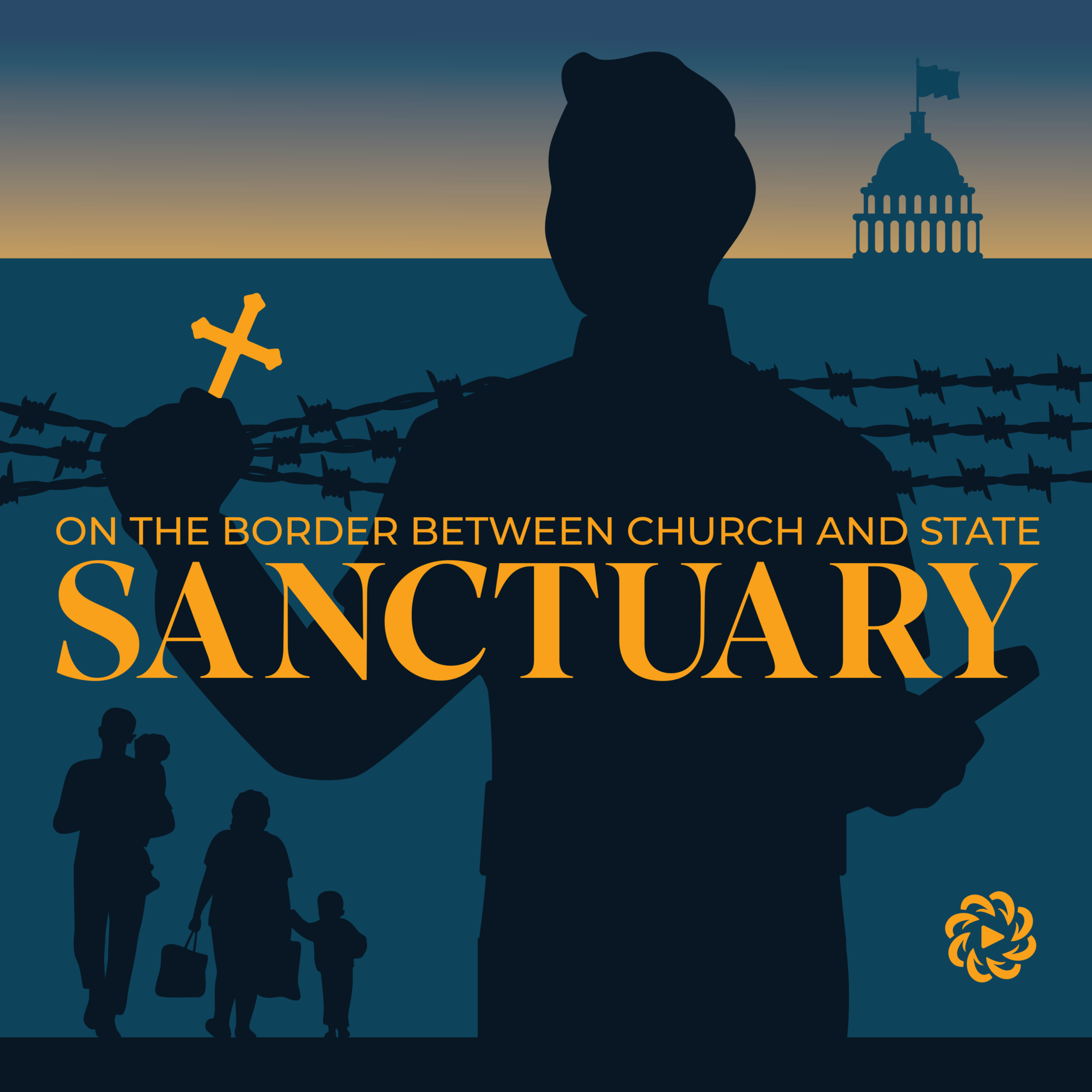
Dr. González: And in a hemisphere of vulnerable people suffering, state backed violence, threats to human lives, and migrants risking a grueling death in the desert. Here, in the unforgiving desert of Arizona, lies the genesis of the Sanctuary Movement. Welcome to Sanctuary, a limited podcast series about immigration, faith and the borders between church and state. Sanctuary was created by me, Dr. Sergio González,
Dr. Barba: and me, Dr. Lloyd Barba.
Dr. González: In conjunction with the Institute for Religion, Media and Civic Engagement, and Axis Mundi Media.
Dr. Barba: Sanctuary was produced by Dr. Bradley Onishi and engineered by Scott Okamoto. Kari Onishi provided production assistance. Sanctuary was made possible through generous funding from the Henry Luce Foundation and with support from the religion department at Amherst College.
Dr. González: Additional support was provided by the American Academy of Religion. And before we get started, we just want to warn listeners that this series contains infrequent depictions of violence and sexual assault that may not be suitable for all listeners.
Dr. Barba: As we'll hear in today's episode, religious communities play a central role in the origin of the sanctuary movement.
Dr. González: But we'd be remiss, Lloyd, if we didn't take this history even further back and discuss how the movement developed out of a long tradition of Latino immigrant advocacy. It's a tradition that has deep roots in the US-Mexico borderlands, particularly in the state of Arizona and just below the border in Sonora, Mexico. To understand this longer history, we need to put these developments in the context of larger regional, national and even transnational developments. And as we'll learn today, the 26 Salvadorans found in the desert in July 1980 were subject to a form of hemispheric violence, or rather, violence that spread across borders and nations. It was a pattern of violence so vicious, so pervasive, and so systemic, that a broad cast of activists and organizations would build a cross-border network to respond to it.
Dr. Barba: That's right, Sergio. Long before the traumatic deaths and recovery of Salvadorans at Organ Pipe, Tucson had been an important crossing point for migrants for decades. According to historian Geraldo Cadava, for much of the 20th century, there was regular commercial and migratory traffic between Arizona and Sonora. The 1970s and 1980s, however, heralded significant changes in the dynamics of migration in this region. Cadava says that "global, hemispheric, and national economics and politics" led to shifts in who was coming into the United States in this area, why they were coming and how they entered the country. Behind this was a series of interconnected events. First came the end of the Bracero Program, a guest worker program that had brought millions of Mexicans to the US. That ended in 1964. The following year brought the passage of the 1965 Immigration and Naturalization Act, which accelerated the migration of Latin Americans to the US. Then, within the same decade, Mexico witnessed a boom in the establishment of maquiladoras, or exploitative factories along the border with the US. And shortly thereafter, a series of financial crises wreaked havoc in Latin American nations. That, as you might imagine, forced a lot of people to make the hard decision of leaving their home country to find better prospects northward.
Dr. González: That's right, Lloyd. That's an enormous amount of change in a very short amount of time. And together, all of these macro forces spurred a large push of both documented and undocumented migration into the US. Tucson became one of the central receiving points for all of these new arrivals. I mean, this is a really wild number. Consider that in the 1970s Arizona's foreign born Mexican population doubled.
Dr. Barba: Exactly. And the arrival of so many people in such a short amount of time created friction among locals, some of whom blamed incoming immigrants for the region's economic malaise. A general sense of distrust of newcomers permeated the area in the mid to late 1970s, leading to a series of violent interactions. One horrific event in 1976 brought international attention to the region. That year, three white ranchers kidnapped and tortured three undocumented Mexican workers.
Media Clip: Federal authorities say a serious crime was committed on the Hannigan Ranch almost four years ago. Three Mexicans had crossed the border seeking work when they were stopped at gunpoint by armed white ranchers, taken down this road, hog tied, dragged through the brush, burned and shot in the back as they fled toward Mexico. One man had 125 shotgun pellets dug from his back. All were battered. Patrick and Thomas Hannigan were tried in state court for kidnapping and torture. An all white jury acquitted them.
Dr. Barba: US and Mexican newspapers detailed how these ranchers encountered a group of men seeking work and had proceeded to coerce them into their trucks and rob them of $36. The ranchers then beat them while yelling racist invectives before dragging them across the desert and finally suspending them from a tree. The men escaped and crossed back into Mexico, where they received medical care. It took three trials before the white ranchers were finally held accountable, but only then was one of the perpetrators actually forced to serve time in prison. For many border dwellers, this incident magnified the growing animus towards migrants and the general lack of protection for the civil and human rights of undocumented newcomers. They recognized that between these incidents and so many others, sentiments in the borderlands weren't simply anti-Mexican, but more broadly, anti Latino.
Dr. González: It's such a sad history of violence developing in this area. And it's within that bubbling violence and tension that we arrive at the home turf of two key players in what we might refer to as the pre-history of the Sanctuary Movement: the Manzo Area Council and the Tucson Ecumenical Council, or TEC, as we'll refer to it. During the early 1980s, the majority of Americans remained uninformed about events in Central America, much less about their own country's refugee policies. I mean, quite honestly, most Americans would have probably struggled to identify Guatemala or Salvador on a map! That certainly wasn't the case for Manzo or the TEC, both well-versed in the regional politics that were spurring so many Central Americans northward. The Tucson Ecumenical Council, as its name might give away, was a coalition of 60 churches and faith groups in the Tucson area that was engaged in social service and community outreach. They began working with the Manzo Area Council in the early 1980s. Manzo was an agency that had been providing legal aid to undocumented Mexican immigrants since the early 1970s. On the day that a Salvadoran woman walked into the Manza Area Council with a bullet lodged in her rib cage, recalled Isabel Garcia, the group's work with Central American refugees really began. And by early 1981, the Manzo Area Council was taking on an increasing caseload of Central American clients as the number of new arrivals rose every year. Here's public defender Margo Cowan, a key Manzo member, describing that demographic transition in a recent documentary.
Media Clip (Margo Cowan): Central American refugees began to walk into Manzo. And so, the character of the folks that were coming to talk to us was no longer just the people in the neighborhood, but it was people who were fleeing the war.
Dr. González: Now, at first, Manzo attempted to work within the confines of the law to assist arriving Guatemalans and Salvadorans. They set them up with lawyers, help review their casework, anything they could do to help. And it was women like Isabel Garcia and Margo Cowan, as well as activists and professors like Guadalupe Castillo and Raquel Rubio-Goldsmith, who did the heavy legal lifting and constituted the leadership in Tucson's early immigrant rights advocacy.
Dr. Barba: That's right, Sergio. The conversations that Manzo workers, like Garcia, had with incoming Central Americans made clear, at least in their eyes, that these people would qualify for refugee status in the United States. As you might recall from our last episode, the Refugee Act of 1980 defined a refugee as a person who could demonstrate a "well-founded fear of persecution." This definition aligned with that of the United Nations' conventions and protocols, all of the hashing out of what constituted a refugee in the post-World War II period. And testimony from people like Mariana, a Salvadoran woman who fled her home to Mexico, who you'll hear next, seemed to fit a textbook definition of someone with a "well-founded fear of persecution."
Media Clip (Speaker 1): Mariana fled to Mexico two years ago. She was afraid to be seen on camera, but she wanted to tell her story.
Media Clip (Mariana's Translator): After raping me, they took a needle and pushed it into my eye over the mask they made me wear. On my hands I have scars from where they burned me with acid. They also burned me on other parts of my body.
Dr. Barba: Testimonies like these were heartbreaking, but in the late 1970s and early 1980s most of these stories didn't make their way past places like legal aid offices of the Manzo Area Council.
Dr. González: However, escalating violence in Central America, and the appalling murder of church people in the region, began to change things. And in the process, Americans began to connect the dots between the civil wars in places like Guatemala and El Salvador, and the growing number of migrants arriving at the US-Mexico border. Reports of the grisly murders of prominent clergy and American missionaries in El Salvador provoked citizens to question their country's military engagement in the region. In 1977, Father Rutilio Grande, a Jesuit priest who had advocated for his peasant congregants and called for land reform in El Salvador, became the first priest assassinated by government security forces. Grande's murder radicalized one of his best friends, the Archbishop of San Salvador, Oscar Romero. The archbishop became a vocal critic of the nation's leaders, using his pulpit to denounce a corrupt government that seemed more preoccupied with enriching themselves than helping the country's poor and downtrodden.
Media Clip (Oscar Romero translated by Sergio): I always believe that the cause of this is social injustice. They cling to privileges that they can no longer have, because the people are very aware, and they must realize that they must change the entire system. They maintain this system with the power of money, and they can also pay for military forces.
Dr. González: As his denunciations became more strident, however, Romero himself became a target. And on March 24, 1980, the archbishop was killed by a government assassin as he preached Sunday Mass. Just the day before, Romero had delivered a sermon calling on Salvadoran soldiers to lay down their arms and stop killing their countrymen. While not an active proponent of this tradition himself, Romero's words evoked one of the most vibrant theological strains in Latin America during the second half of the 20th century: liberation theology.
Media Clip: "We as dedicated Christians, know our cause is not only just, but holy," he says. "As the cause Christ fought for the cause of a new world and a new heaven without war and killing. All of us here have testified with our own eyes and ears, of the machine gunnings, of the decapitations of our children, of mothers captured and killed with babes in their arms."
Dr. González: In the post war years, clergy critical of the institutional Church's disconnection from Latin America's people, mostly poor, often disenfranchised, had begun to call for realignment of the church's priorities. Emboldened by the reforms of the Second Vatican Council, a growing cohort of theologians, clergy and laypeople called for a sea change in how the church engaged with the secular world. They developed liberation theology, a teaching that seeks to offer a theological and biblical critique of inequitable systems of economics and power and one that maintains that Jesus in the gospels demonstrated a preferential option for the poor.
Dr. Barba: There's a lot to dig into here. Adherents of liberation theology offered a critique of both the church and the secular world. Because this strain of religiosity so boldly challenged those in power, it made its followers targets of Latin American governments that wanted nothing to do with wholesale societal changes. This critique of standing economic and societal structures led right wing military juntas, and the death squads they controlled, to paint a red target on the backs of devout Christians and devoted liberationists, all of whom they called communist subversives.
Media Clip: Death squads are believed to be responsible for more than half of the political murders committed.
Media Clip: In the aftermath of this bridge being blown, irate army commanders launched a sweep in the surrounding hills and claimed to have killed 130 guerrillas. But the Catholic Church shortly afterwards, published the names and ages of 45 children, 19 women, and 14 men, who it says were the real victims of the Army's operation.
Dr. Barba: In this clip, we hear Jon Sobrino, a Salvadoran Jesuit and a leading liberation theologian, describing the interplay between Salvadoran Christians' effort to fulfill the gospel mandate to serve the marginalized, and government repression.
Media Clip (Jon Sobrino): The people of El Salvador, the 5 million people, have understood, maybe for the first time, that the church belongs to them. Why? Because what has happened to the church has been the destiny of these people to be killed, either slowly through unjust structures, or violently through repression. So the credibility of the church, in general, has increased a lot. In my opinion, persecution has had very good and decisive consequences for the Church. To put it in one word, persecution has made the Church a Christian Church, a church of the poor, and in the last analysis, the Church of Jesus Christ.
Dr. Barba: North American church people were also inspired by the message of liberation theology, especially those who engage in missionary work in Central America. Here is sister Maura Clarke of the Maryknoll Order, who served in El Salvador:
Media Clip (Maura Clarke): In my work, it has been very much trying to help people to realize their own dignity, to realize the great beauty that they have.
Dr. Barba: As they made their way to the region and sought to live out the Gospel mandates, however, they also found themselves in the crosshairs of repressive governments. Missionaries enter these spaces aware of the risks that they were taking. As Sister Ita Ford of the Maryknolls describes here:
Media Clip (Ita Ford): In my estimation, there's a state of war. It's a civil war, and the people just feel that there is no defense, there's no place to go.
Dr. González: And as was the case in the killing of Father Grande and Archbishop Romero, governments were willing to make examples of anyone who spoke out against their power, including clergy and people of faith. In December of 1980, just months after the murder of Romero, Salvadoran paramilitary forces struck again, this time, however, their targets were Americans. Members of the military abducted, brutally violated and killed four US missionaries: Sisters Maura Clark and Ita Ford of the Maryknoll Order, who we just heard from, Sister Dorothy Kazel of the Ursuline Order and lay missionary Jean Donovan.
Media Clip: El Salvador continues to be plagued by human rights abuses. The kind of violence that turns the stomach.
Dr. González: The murder of the four church women stunned Americans.
Media Clip (Singing from Memorial Service for church women): (Singing)
Media Clip (Speaker from Memorial Service for church women): 9000 plus people have been killed. Have been tortured this year. Killed. Thousands are homeless. Thousands can't cross to Honduras because they'll be driven back or killed. And it takes four American women to wake up even a little bit of America to do something about this. We hope it won't stop. That's what we're afraid of. This will all die down in a week or so, people will have forgotten. We cannot forget. That's really the big message. Do not forget the people in El Salvador.
Dr. González: Public outrage in the US led to congressional investigations and a temporary suspension of aid to El Salvador. Many religious communities laid these women's deaths at the feet of the country's right wing military dictatorship. They also began to ask, however, what role their own country was playing in propping up death squads that were killing innocent civilians.
Media Clip (Speaker 1): El Salvador has been drenched in violence for years, and Catholics close to the slain women maintain that American arms aid has been instrumental in creating the atmosphere in which such killings take place.
Media Clip (Speaker 2): By giving arms, you keep indicating to the government there that perhaps a military victory is possible, by the government getting more aid than the opposition, seeks more aid outside the country. So what you're doing is escalating the violence.
Dr. González: Historian Amanda Izzo suggests that the ghastly murders of clergy like Romero and the missionaries quote, "provided a symbolic touchstone" for Americans. Many of whom, for the first time, began to question their country's involvement in the region. In Tucson, meanwhile, organizations like the Manzo Area Council and the Tucson Ecumenical Council began to connect the dots between this growing violence and the rising number of Central Americans arriving in the United States.
Dr. Barba: Tucson sits about an hour from the border, separated from Mexico by the cruel Sonoran desert that claimed those 13 Salvadorian migrants. In early 1981 several people of faith ventured into the desert, seeking to help these newcomers. They had their own chance encounters of Central Americans desperately seeking refuge in the United States. Among them was a man named Jim Corbett. Corbett was a goat herder, a philosopher, and a Quaker, and he had heard about migrants dying in the Sonoran Desert. He was friends with fellow Quaker, Jim Dudley, who had a chance encounter with a hitchhiker who turned out to be a Salvadoran badly in need of assistance. Dudley had tried to help the hitchhiker find aid, but the two were detained at a border patrol checkpoint. Dudley, as an American citizen, was promptly released, but the Salvadoran man was kept in custody and arrested. Dudley then visited Jim Corbett and his wife, Pat, at their home to discuss this disturbing encounter. Trying to find and help the migrant man, Dudley and Jim Corbett called the local Immigration and Naturalization Service offices. Their inquiries, however, were met with resistance. Border Patrol agents were picking up so many Salvadorans, and the INS was deporting them so swiftly and frequently that neither agency could keep track of individuals. Both Dudley and Corbett were well aware of the violent civil war in El Salvador. They reasoned that their chance encounters in the desert were with individuals who may very well be refugees. If that were the case, however, why were border officials so quickly sending these people back to their home countries? Shouldn't Salvadorans have the chance to apply for political asylum? Dudley and Corbett felt that they had to investigate.
Dr. González: Yeah, and here's where the story acquires more actors, Floyd. First, Dudley and Corbett turned to Father Richard Elford, a Catholic Redemptorist priest in Tucson who worked with the Manzo Area Council. Elford and Manzo had also begun to track these disturbing deportation patterns. Manzo, in fact, was already working a case with a Salvadoran man found near an Indian Reservation, working to get his asylum case in order before he could be shipped off back to his war torn country. Elford's work with the Salvadorans, meanwhile, had begun in earnest a year earlier, when he joined area clergy to provide support for the survivors of the horrible incident at Organ Pipe National Monument. To begin to formulate some type of coordinated response, the Tucson Ecumenical Council joined with the Manzo Area Council to form the Tucson Ecumenical Council Task Force on Central America. Elford began leading public vigils in front of Tucson's Federal Building to continue raising public awareness of the many dead and dying in Central America. Corbett, meanwhile, kept on the case of the missing hitchhiker. Where had INS taken him? Elford recommended that, if he were to find him, Corbett should have the man sign a G-28 form. This official form would allow the migrant to seek legal counsel. Its signing would, at least, delay an otherwise inevitable swift deportation. Corbett finally found the man in border patrol custody, and learned that he was being held with two other Salvadoran men. He left to retrieve two more G-28 forms to help the whole group. But by the time he returned, however, the two men who hadn't had a chance to sign a form had already been removed, and in all likelihood, were already in transit for deportation.
Dr. Barba: Sergio, you can imagine: Corbett's anger waxed hot. He felt duped, like the federal government was trying to pull a quick one on him, but here the stakes were people's lives. His most immediate reaction was to visit as many detention centers as he could in Arizona and Southern California. He wanted to get as many detainees as possible to sign the G-28 form. And then bail out as many as possible with any money he could raise. Soon, the Corbetts housed over 20 Central Americans bonded with donated funds in their home and converted garage. With space running low and resources waning, Corbett knew he needed a more permanent solution. The stakes he believed were simply too high.
Media Clip (Corbett): If I don't do it, they really do die, they really do get tortured. There's a full-scale holocaust going on in El Salvador and in Guatemala. And the terror, the same terror that pursues them in El Salvador and Guatemala, goes right after them, right through Mexico, and is hunting them down right in our streets, right among us.
Dr. Barba: Corbett reached out to the Tucson Ecumenical Council and their leader, Pastor John Fife of Southside Presbyterian Church. Together, Corbett hoped, they could increase the spaces needed to house the asylum seekers and to provide them with more robust immediate legal and social assistance. Corbett drew inspiration from organizations in California who had been providing legal aid to incoming Salvadorans for some years. These included El Rescate, the Central American Resource Center, and Centro de Refugiados Centralamericanos. Both were led by Central Americans who arrived with a great deal of organizing know-how.
Dr. González: At the same time, Corbett began making connections with clergy in Mexico who were engaged in their own efforts to support the growing number of Central Americans fleeing northward. Here, let's hear from Corbett in this 1982 60 Minutes special on the sanctuary movement:
Media Clip (Corbett - 60 Minutes Special): We are in a so-called safe-house in Mexico near the Arizona border. Jim Corbett is plotting to smuggle into the United States some people from Central America. This is Antonio and his wife, Yolanda. They came here from Guatemala after Antonio was marked for death by the government, he says, for running an unlicensed pharmacy that gave medical aid to the poor. And this is Pedro who owned a restaurant in El Salvador and decided to leave after a friend in the army told him his entire family would be killed because his son belonged to a student organization. Pedro's family is already in the US. Tomorrow, Pedro, Antonio and Yolanda will try to enter the United States illegally.
Dr. González: Chief among those new acquaintances was a Catholic priest, Father Ramon Dagoberto Quinones of El Santuario Nuestra Senora de Guadalupe in Nogales, Mexico. Over the previous few years, father Dagoberto Quinones had transformed his church into a well-known place of respite for migrants seeking to make the treacherous border crossing. The Mexican priest had even extended his work into local prisons, where some of his congregants ended up, rammed into cells as they awaited deportation back to Guatemala and El Salvador. Corbett was at the point where he was developing somewhat of a hare-brained idea. He wanted to build a clandestine network to facilitate the safe travel of Central Americans into the United States. And here he found a willing partner in Father, Dagoberto Quinones. Beginning in the summer of 1981, Corbett began accompanying the Catholic priests to Mexican prisons dressed in black trousers and a white shirt. Registering as Padre Jaime of the Sociedad de los Amigos, Corbett would interview detained Salvadorans and Guatemalans, while Dagoberto Quinones offered mass. Together, the two men established what they refer to as a "border ministry" to move Central Americans into the US and help them find legal representations to apply for asylum.
Dr. Barba: Within months, Corbett and Dagoberto Quinones were moving migrants across the border and placing them in secret refuge at Southside Presbyterian Church. Congregations, meanwhile, began to fundraise at a breakneck pace to collect bail money to spring Central American migrants from immigration detention. Some congregants went as far as refinancing their homes to gather the funds needed for this work. These mobilizations, clandestine and otherwise, didn't go unnoticed by the federal government. Before the close of 1981 the FBI sent a letter to Pastor John Fife, Southside Presbyterian, and the Tucson Ecumenical Council. In it, they let them know that they were well aware of their illegal activities. The FBI warned the Task Force that anyone involved in helping bring Central Americans across the border could face indictments for being in violation of immigration law, which prohibited smuggling and sheltering undocumented immigrants.
Dr. González: Corbett, Fife, and their organizations now had some decisions to make. Would they continue their work, doing so potentially in violation of federal law, or would they bow to the FBI pressure and cease and desist? Would they, in other words, be willing to stare down the federal government in the name of Christian hospitality? Now, Fife was no stranger to having to make these types of decisions. Even before he'd become the pastor of Southside Presbyterian he'd been engaged in civil rights activism for Black and Latino communities in Arizona. His congregation, meanwhile, leaned heavily into a theologically robust understanding of justice and human dignity. Defying the federal government, however, would posit a whole different set of challenges. Southside Presbyterian engaged in months of discernment meetings, debating what their next steps should be. They kept coming back to one central question - what did their faith call them to do? They believed their government was contributing directly to the violence that was forcing Central Americans northward. Without US funding and military training, they reasoned, dictatorships and death squads in the region wouldn't have the backing they needed to continue the political persecution. And they believed that those fleeing El Salvador and Guatemala were refugees, not economic migrants, regardless of what the US government said. If the federal government wouldn't live up to their obligation to offer these people asylum would this religious community be willing, in other words, to shelter Salvadorans and Guatemalans, even if it meant breaking the law? Ultimately, the congregants at Southside Presbyterian decided that their faith required them to take action. Here's Pastor John Fife in a 1983 interview on that decision:
Media Clip (John Fife): We tried to discover what it meant to be the church in that kind of situation. We extended help, food, clothing, housing to people who had been bailed out of detention while awaiting asylum proceedings. And then we discovered that the church was required to go beyond that because despite our best efforts in legal defense, people were still being shipped back in enormous numbers, 16,000 last year back to El Salvador alone. And so we extended the hospitality of the church. The congregation voted by secret ballot to declare the church a public sanctuary for these refugees, to extend the hospitality of the church to them, and found ourselves in violation of the law...
Dr. Barba: Exactly. They chose March 24, 1982 as the day to begin this work, marking the second anniversary of Archbishop Romero assassination. And the way they inaugurated sanctuary became a model for future churches and synagogues that would join what would soon become a national movement. The opening was a strategic mix of revealment and concealment. First, the declaration service was held on the steps of Southside Presbyterian. The congregation invited more than 40 news and media reporters to cover this historic declaration. The church invited Alfredo, an undocumented Salvadoran man using a pseudonym, and his family, into sanctuary. With Fife and other congregants at their side, the adults sat at a microphone-covered table with their faces obscured by bandanas and baseball caps. They concealed their faces, fearing retaliation if deported. And they also feared for their families back home while the civil wars raged on.
Dr. González: On either side of the assembled congregants and asylum seekers hung two large banners flanking the entrance of the church. The one on the left read: "LA MIGRA NO PROFANA EL SANTUARIO" ("Immigration Officers will not Profane the Sanctuary"). The other declared, "ESTES ES EL SANTUARIO DE DIOS PARA LOS OPRIMIDOS DE CENTRO AMERICA" ("This is the sanctuary of God for the oppressed of Central America"). The banners made clear the sacred boundaries of the House of Worship while acknowledging who sanctuary was for the oppressed of Central America. The day before the public declaration of sanctuary, meanwhile, Fife had sent a letter to US Attorney General William French Smith, informing him of the church's decision to declare sanctuary. Now, Lloyd, why don't you read us some excerpts from that letter?
Dr. Barba: Sure, here are some bits: "We are writing to inform you that Southside Presbyterian Church will publicly violate the Immigration and Nationality Act section 274(a). We have declared our church as a sanctuary for undocumented refugees from Central America. We believe that justice and mercy require that people of conscience actively assert our God-given right to aid anyone fleeing from persecution and murder. The current administration of US law prohibits us from sheltering these refugees from Central America. Therefore, we believe the administration of the law to be immoral as well as illegal."
Dr. González: The Tucson community pledged to offer sanctuary to Central Americans until the government granted what was referred to as "extended voluntary departure" to asylees and refrained from extralegal detention and deportation.
Dr. Barba: The way that Southside Presbyterian opened sanctuary in Tucson, so publicly and so brazenly, became a model for the hundreds of congregations that would soon join them. But why go public? Well, on a practical level, by going public, law enforcement authorities would not be able to come into the church like a thief in the night and snatch away sanctuary seekers. In this move toward public sanctuary, sanctuary organizers hoped to shield participants from potential retribution from law enforcement. And with a spotlight shining brightly on their temple doors, they hoped to test the limits of sanctuaries' historic veneration of religious spaces, as well as the federal government's respect for the separation of church and state. Southside Presbyterian also wished to alert the American citizens of their country's complicity in creating the violent conditions that had forced Salvadorans and Guatemalans northward in the first place. Sanctuary advocates also sought to indict the federal government for not living up to the obligations under the Refugee Act of 1980 and international law. Most Americans were assuredly unaware of those distinctions before 1982. Here's Fife speaking in 1983 on those very points:
Media Clip (John Fife): Three years ago, began to discover that large numbers of refugees from El Salvador and from Guatemala were beginning to come across our border because they were truly refugees fleeing the murder, oppression, torture, terror of Central America, and had no place to go, and were simply fleeing until they found some safe haven. When they crossed the border, our Border Patrol and Immigration Service were hunting them down, using the latest technological means, were detaining them, separating families, and as expeditiously as possible, in some cases, using physical abuse, psychological abuse, deporting them back to the people who were killing the people of El Salvador and Guatemala in the first place and turning their names over to their governments.
Dr. Barba: This was then, fundamentally, a strategy in public education. Sanctuary organizers sought to raise awareness and build political consciousness among everyday Americans.
Dr. González: Now, this referred to the Immigration and Nationality Act of 1952, which stipulated that anyone who, quote, "willfully or knowingly conceals, harbors, or shields from detection, or attempts to conceal, harbor, or shield from detection in any place, including any building or any means of transportation; or willfully or knowingly encourages others or induces, or attempts to encourage or induce, either directly or indirectly, the entry into the United States shall be guilty of a felony."
Dr. Barba: That's some serious legalese, Sergio.
Dr. González: Yeah, it sure is Lloyd. But it's some legalese that has some pretty dramatic consequences. Or, as Fife put it, in 1983:
Media Clip (John Fife): ...and found ourselves in violation of the law ourselves. The United States government makes it a felony to extend the hospitality of the church to people whose very lives are being threatened every day. And so we found ourselves having to decide whether we serve God or whether we serve the government. And in that dilemma, we decided that Jesus Christ was our Lord and we had to serve God.
Dr. González: In other words, the congregations clearly knew they were about to break the law. But from their perspective, they did so as a form of civil disobedience. Recall the words of Reverend William Sloane Coffin Jr., from our previous episode:
Media Clip (Sloane Coffin Jr.): What we are protesting then, is not a bad law. But the government's bad interpretation of a good law. And that makes us feel that what we're doing is not illegal because as Thoreau said, 'they are the lovers of Law and Order who uphold the law when the government breaks it.' And it seems clear that the government is breaking the spirit of the law if Congress would pass legislation to allow Guatemalans to stay...
Dr. González: Now in a few episodes we'll dig further into the critical distinctions at hand. Were sanctuary movement members breaking the law or just pushing the federal government to live up to a law that it was breaking? Was this, in other words, illegal activity and civil disobedience or something else?
Dr. Barba: What's clear from now is that Southside Presbyterian also wished to publicly register and hopefully inspire other congregations by appealing to Scripture and morality. By taking their message beyond the walls of their temple, they could speak with a "prophetic" voice. The moral teachings of their faith emphasized justice and mercy. This compelled Southside Presbyterian as people of conscience to assert their God-given right to aid anyone fleeing from persecution and murder. Even if it placed them in the crosshairs of law enforcement. Broadcasting the prophetic voice and imparting the moral teachings entailed extensive media campaigns. Even the country's most important media began to pay attention.
Media Clip (60 Minutes): What you are about to see is not a repeat. It's a brand new story about the Underground Railroad we first reported on in 1982. At that time, the underground railroad was a loosely-knit group of perhaps no more than 100 religious Americans willingly breaking the law to help illegal immigrants from El Salvador and Guatemala escape war and oppression and find sanctuary in this country. Today, entire congregations in some 200 churches and synagogues are doing much the same thing.
Dr. González: As it turned out, it wasn't just religious communities in Tucson that were willing to take this dramatic and drastic step. That same day, five churches in Berkeley, California joined the Tucson coalition in declaring themselves sanctuaries, while faith communities held solidarity services in Boston, New York, Texas and Ohio. One week later, congregations in San Francisco, Los Angeles, Washington, DC and Long Island opened their congregational doors as well.
Dr. Barba: That March 24th declaration served as a linchpin for what would soon become one of the most potent challenges to state power in the country's history. Within a year, 45 communities followed suit. By the end of the decade, approximately 500 congregations had declared sanctuary. Their movement would offer a radical form of hospitality to thousands of Central Americans desperately in need of refuge.
Dr. González: One of the most important developments would be far removed from the border, in the Windy City. In Chicago, activists created the structure necessary to move thousands of asylum seekers across the Americas. Join us for our next episode, when we'll move our search for faith-based immigrant and refugee justice beyond the borderlands and into America's Heartland.
Dr. Barba: That's it for this episode of Sanctuary. Thank you so much for listening. I'm Dr Lloyd Barba,
Dr. González: and I'm Dr. Sergio Gonzalez.
Dr. Barba: Remember, sanctuary saves lives
Dr. González: and strangers are neighbors you just haven't met yet.
Straight White American Jesus
The flagship show examining Christian nationalism and democracy.
Listen Now
Axis Mundi Daily Brief
Short, focused analyses of the most important daily developments in religion and politics.
Listen Now