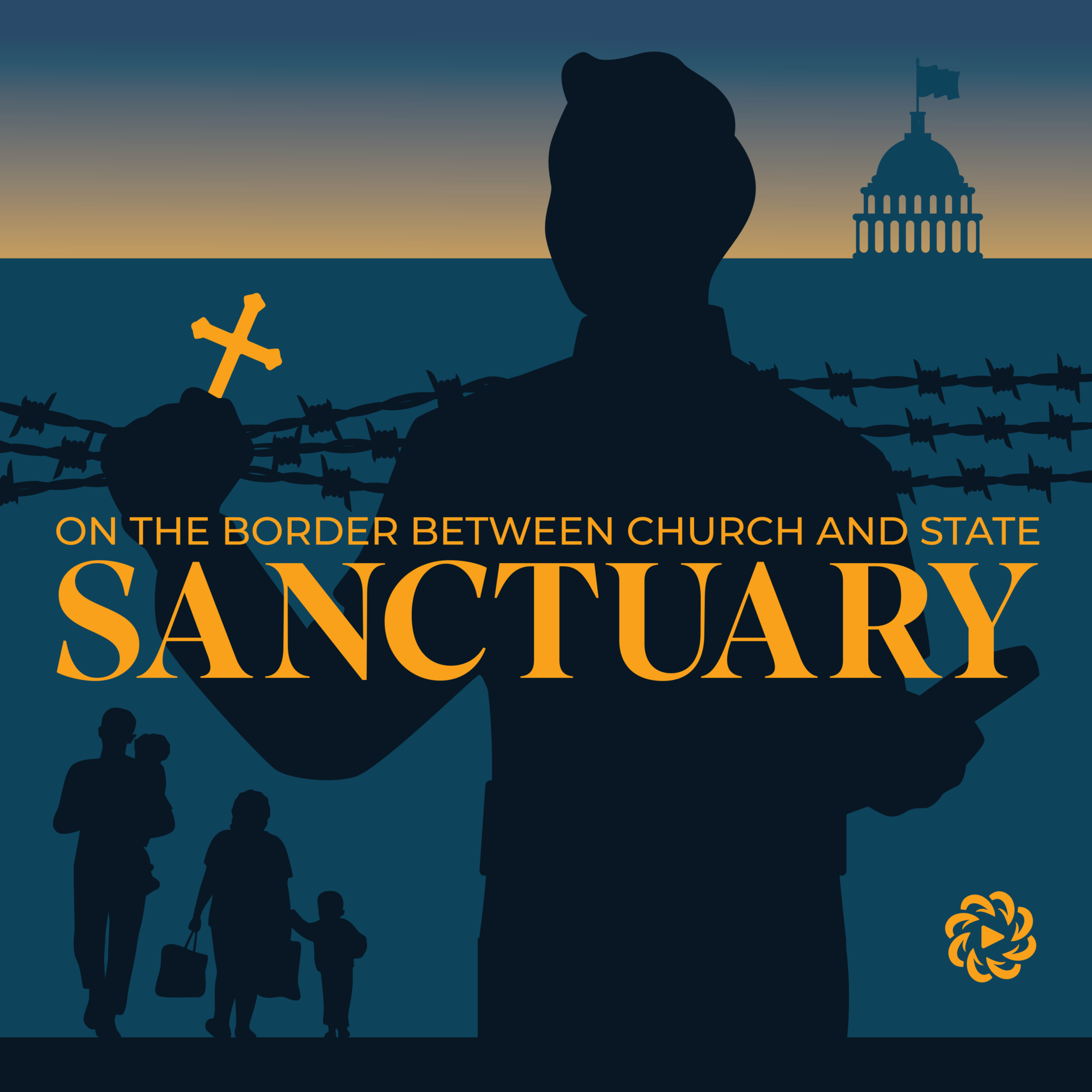
Sanctuary in America
Summary
What if we told you that one of the biggest movements to protect migrants in the history of the United States was led by people of faith? What if there was a movement that has been cultivated within religious spaces, dedicated to a radical hospitality - to live out the Gospel by welcoming the stranger?
In this first episode, Dr. Lloyd Barba and Dr. Sergio M. González, historians of Latino migration and religion, introduce this movement - one in which churches and synagogues transformed the way Americans understand the relationship between faith and politics. They explain how organizers deployed “usable sacred histories” in their development of the sanctuary movement, drawing upon scriptures and a centuries-old tradition to create and justify their protests and mobilizations. They also provide important context for understanding the violent Central American civil wars that created hundreds of thousands of asylum seekers and led congregations to summon up the ancient idea of sanctuary in the 1980s.
Additional Resources:
- Benedictine Monks of Weston Priory - Sanctuary Page
- Refugee Act 1980
- Amherst College Sanctuary Website
Transcript
Media Clip (Trump): We're going to build the wall. We have no choice. We have no choice. (chanting) Build that wall, build that wall, build that wall, build that wall, build that wall, build that wall. Build that wall. Build that wall.
Dr. Sergio M. González: Over the last eight years, Americans have become accustomed to calls from the political right to build a wall along the US Mexico border. From the moment he announced his run for president in June, 2015, Donald Trump has centered his politics around restricting immigration to this country. He does so not only by calling for the construction of physical boundaries, but by leaning on dehumanizing language and racist tropes to depict newcomers to this nation as nothing more than criminals and parasites.
Media Clip (Trump): When Mexico sends its people, they're not sending their best, they're not sending you, they're not sending you, they're sending people that have lots of problems, and they're bringing those problems with us. They're bringing drugs, they're bringing crime. They're rapists, and some, I assume, are good people. But I speak to Border Guard,
Dr. Lloyd Daniel Barba: Perhaps Americans have gotten used to calls to build the wall coming from the political right, but one group that has taken up that charge as of late has begun to transform not just politics, but also faith in this nation, joining Trump and his followers over the last few years, have been religious leaders and influencers who readily echo the calls for hardcore immigration policies. Take, for example, Robert Jeffress, a nationally syndicated televangelist and pastor of First Baptist Church of Dallas, who has been one of Trump's staunchest allies. In 2018, he took the Fox News to bless the President's call for stricter border enforcement. Quoting the book of Nehemiah, the pastor proclaimed that walls are as about as Christian as you can get.
Media Clip (Jeffress): You know, I had the privilege of preaching the sermon before President Trump's inauguration, and I chose the Old Testament story of God telling Nehemiah to build a wall around Jerusalem. And I said, Mr. President, God is not against walls. Walls are not unChristian. The Bible says even Heaven is going to have a wall around it, not everyone is going to be allowed in.
Media Clip (Speaker 2): Pastor, what do you think of the larger...
Dr. González: These mixings of hardline immigration policy and religion didn't end with Trump's tenure in the White House in early 2024 a convoy of protesters made their way from Virginia to the US Mexico border. Their goal? Expose a supposed migrant invasion that was going to overrun the nation, and do so in the name of the Lord. Calling themselves God's army the motley crew included Christian nationalists, qanon conspiracy theorists and paramilitary groups. They repeated claims made by far right pundits and political leaders who weren't of a quote, Great Replacement of white Americans by non white migrants.
Media Clip: I believe the invasion has, you know, they're trying to I believe there is a die off happening, and in order to cover that up, I believe that they're bringing more people in to replace Americans. when you put out a message...
Dr. González: At each of their "take our border back" rallies held in border towns, meanwhile, religious rhetoric and practice was ever present. In Quemado, Texas as people rallied against this so called migrant invasion and the subsequent GreatReplacement of white Americans, organizers held baptisms as onlookers, praised the Lord.
Media Clip: Baptize you in the name of Jesus.
Dr. González: Attendees, however, didn't just join these protests to be born again. They were also there to prepare to protect the country's borders, even if it meant taking up arms. The stakes are too high, they argued, for anything but the most drastic of measures.
Media Clip: We're in a crisis in this country. I actually believe it's going to eventually get to a shooting war. Our government's ignoring the rule of law. They're weaponizing the FBI to go after Trump, to go after everyone else. They're ignoring the laws that they want to ignore, and they're allowing millions of illegals to cross the border, probably just because they're hoping they're going to vote Democrat.
Dr. González: The message from these instances is clear, God and faith are intricately connected with a nationalistic approach of Trump and his followers, all of whom want to build physical barriers to keep out newcomers, and because they view the stakes as being so high, some of them are willing to go to great lengths, even enacting violence, if it means protecting the Christian America they know and love.
Dr. Barba: But what if I told you that one of the biggest movements to protect migrants, to help them find a place within this country for those people who are fleeing violence or are simply looking to create a better life in the United States was led by people of faith? What if there was a movement that has been cultivated within religious spaces dedicated to a radical hospitality, to live out the Gospel by welcoming the stranger, to offer safe harbor to those who have journeyed 1000s of miles and braved unspeakable violence, crossing into the United States and doing so under threat of detention and deportation. My name is Dr Lloyd Barba,
Dr. González: and I'm Dr Sergio González,
Dr. Barba: and we're historians of Latino migration and religion. We are here to share the story of this movement, one in which churches and synagogues transform the way in which Americans understand the relationship between faith and politics. We'd like to tell you about a phenomenon that has helped jumpstart one of the most important immigrant and refugee justice movements in the history of the United States, doing so from houses of worship all across the nation. In short, we'd like to tell you a different story about faith, politics, and the borders that separate us and the spaces that unify us join us for Sanctuary: On the Border Between Church and State.
Dr. González: Welcome to Sanctuary, a limited podcast series about immigration, faith, and the borders between church and state. Sanctuary was created by me, Dr. Sergio González
Dr. Barba: and me, Dr Lloyd Barba
Dr. González: in conjunction with the Institute for religion, media and civic engagement and access moody meeting,
Dr. Barba: Sanctuary was produced by Dr. Bradley Onishi and engineered by Scott Okamoto, Kari Onishi provided production assistance. Sanctuary was made possible through generous funding from the Henry Luce Foundation and with support from the religion department at Amherst College.
Dr. González: Additional support was provided by the American Academy of Religion. And before we get started, we just want to warn listeners that this series contains infrequent depictions of violence and sexual assault that may not be suitable for all listeners. Lloyd, our time together today begins not on the border, but in the green mountains of Vermont
Media Clip (Speaker 1): A family of Guatemalan refugees, illegal aliens in this country, has just completed a journey to a religious sanctuary in Vermont. They were escorted by a convoy of American supporters in open defiance of the US government. Harold Dowell has more.
Media Clip (Speaker 2): Felipe Ixcot and his family are afraid to show their faces. In this country,
Media Clip (Speaker 3): We have to hide our identity because our relatives are still in Guatemala.
Media Clip (Speaker 2): They are afraid their relatives may be killed if their true identities are known.
Dr. González: On March 24, 1984 a Guatemalan family completed a 7000 mile journey that had begun in the Central American Highlands and ended at Vermont's Western Priory Monastery. Accompanied by a 28 car caravan of conductors, Felipe and Elena Ixcot and their five children, disembarked from a self-styled Freedom Train in the cold Vermont winter. With clanging bells ringing from the priory tower, an eager crowd of Benedictine monks and over 500 supporters welcomed the Guatemalan family. That day, the Ixcots entered into sanctuary, making the monastery the 100th congregation to join the growing transnational faith based movement in support of Central American asylees. The Ixcots, indigenous Mam Indians, and Catholics were fleeing war and persecution in their home country. Felipe had been a religious educator or catechist, but had been forced to leave Guatemala after 17 of his coworkers had been assassinated by government forces. Their crime? Spreading literacy among their countrymen. The family had first made contact with American clergy at the northern border of Guatemala. There, a US Maryknoll priest sent the family northward on the lower half of the sanctuary network. The Maryknoll priest placed the Ixcots in the care of church workers in Mexico, who then helped transport the family into the waiting arms of border activists in Arizona.
Dr. Barba: And here's where things got really tricky. The network helping the Ixcots flee their home country knew that the Guatemalans had little chance of getting political asylum in the United States. More on that in just a bit. So with access to legal asylum denied to them, the Ixcots came into the country as undocumented migrants. The family entered the US and then clandestinely made their way from the borderlands to Chicago. They did so with the help of an intricate network of churches and safe houses that had come to call itself the New Underground Railroad. The name paid honor to the pre-Civil War Underground Railroad used by Harriet Tubman and other abolitionists to help enslaved people in the south pursue freedom in the north. The Windy City became the launching point for what the Chicago religious Task Force on Central America, CRTF, the coordinating body of the budding Sanctuary Movement referred to as the Romero Refugee Express. The endeavor was named in honor of the slain Salvadorian Archbishop Oscar Romero, who exactly four years earlier, had given his life fighting for his country's poor and disenfranchised.
Dr. González: Now perhaps our listeners can imagine, Lloyd, as the caravan left Chicago and sped across the country. At each of the eight cities in which the convoy stopped, the Ixcots and their US companions met with members of the local and national media and church supporters
Dr. Barba: In each of these press conferences, the asylees and their supporters sought to raise the national consciousness of North Americans, as well as shine a light on the United States complicity in Central America's violent wars. One conductor in explaining people of faith's obligation to walk with the Ixcots as they sought safe harbor in the US, told newspaper reporters, "Let this be the first of 1000s of confessions we have willingly and knowingly conspired and confederated to protect refugees from deportation back to their war torn homelands."
Dr. González: It's a really stunning procession to imagine, Lloyd. And by the time the Ixcots arrived in Vermont, they came with an entire network of people of faith and houses of worship behind them. Their arrival at the monastery proved a dramatic event and a transformative one for everyone involved. Each of the Ixcots, except for seven month old baby Inez, got out of their car with their faces shielded by bandanas. As the monks led a ceremony of song and prayer into a repurposed barn large enough to hold the assembled crowd, the family sat at the center of a semicircle. With the help of a translator, they recounted the atrocities they had suffered at the hands of the Guatemalan government.
Dr. Barba: So, in opening their monastery to the Ixcots, the Benedictine monks at Weston believed that they were making a religious and moral declaration. Five monks from the order had visited refugee camps in Mexico the previous year, where they met with Guatemalan refugees. In a prepared statement issued a few days before the Ixcots arrival, the brothers proclaimed that they had been inspired by the biblical injunction to shelter the oppressed and the homeless. Before voting to open their doors to the Ixcots, the order's leadership had posed this question to their members: "What are we as Christians and as monks called to do, as our sisters and our brothers are hunted down and deported to certain torture and possible death?"
Dr. González: And that central question, Lloyd, how are we to respond when the state threatens to round up and deport hundreds of 1000s of people? Couldn't feel any more relevant than it does today. But hearing this clear statement of hospitality, coming from a monk, of all people, might seem foreign to listeners in our current political climate. Now we're both historians, so we do care a great deal about accurate portrayals of the past, but the Sanctuary Movement and this series is much more than that, as we'll see, sanctuary is a history and a practice that confronts us time and time again.
Dr. Barba: Exactly, Sergio. For starters, the history of the Sanctuary Movement offers an important vantage point from which to assess the intersections of faith, political activism, race justice and transnational solidarity. Sanctuary, according to historian Christina Scholl, is the largest mass mobilization against immigration detention in US history, and that means that the 1980 Sanctuary Movement is the most significant precursor to the modern immigration justice movement. Although often overlooked in the historical record, sanctuary also stands out as the most confrontational progressive religious social justice movement in the US since the heyday of the civil rights movement.
Dr. González: And here's the wild thing, Lloyd, most histories of religion and politics in the 1980s still jump immediately to the rise of the religious right under Ronald Reagan. In fact, when thinking 1980s and religious politics, a widespread progressive religious movement might be the last thing that comes to mind. Such a view of the past, however, is short-sighted and wrong. What we find in the Sanctuary Movement is one of the most dramatic and successful challenges to state power, perhaps in the history of the United States. Throughout the 1980s the movement ushered in a collision between church and state, especially with elected officials and many church leaders who professed to be deeply Christian yet set and supported unwelcoming and politically motivated refugee policies.
Dr. Barba: And, Sergio, I think it's safe to say that we are at such a crossroads today. While many members of the Sanctuary Movement may have not considered themselves politically liberal, they did understand their mobilization as a direct rebuke to the influence of the ardently conservative religious right that had captured the imagination and power of those affiliated with the Reagan administration. Sanctuary activists challenged the movement's refugee and foreign policies, as well as the country's obligation to protect Central American migrants, doing so by centering Jewish and Christian traditions of welcoming the stranger. The movement ultimately sought to provide a counterbalance to the religious right's ideological force and support within the Reagan administration. Does any of that sound familiar? Their work went beyond merely injecting the sense of morality into the debate on Central America. In the words of the Chicago religious Task Force on Central America, sanctuaries practitioners sought to deny the US government the "moral high ground" it desired as camouflage for its military actions in the region.
Dr. González: But we want to dig a bit deeper here to show that the history and the future of sanctuary goes well beyond Reagan's 1980s. The 1980s Sanctuary Movement provided a template for 21st century immigrant rights supporters to tap into the historic and hallowed principle of sanctuary in the mid 2000s the New Sanctuary Movement was born. But again, in very recent memory, Sanctuary has become a flashpoint political and cultural term. As a country, we all witness in the weeks and months following the election, not even the inauguration of Donald Trump, religious congregations, college campuses and cities across the nation invoking the symbolic power of sanctuary as a way to stand with undocumented immigrants at risk of deportation.
Media Clip: At 3pm several dozen Florida International students gathered outside the library to protest President Elect Trump's stance on immigration. Protesters said this was part of a national movement to make universities and colleges "sanctuary campuses" and that schools should not release information on undocumented students.
Dr. Barba: Declarations of sanctuary were also a clear and public rebuke of the Trump administration's draconian immigration policies. These policies include those he instituted quickly, such as when in his first week in office, he signed the executive order known as the Muslim ban. In later months and years, he worked towards other exclusionary goals, such as the zero tolerance policy and a highly touted but never completed border wall. As we have seen in the last decade, conservative politicians and pundits, meanwhile, have invoked the concept of "sanctuary" as a catch-all term to criticize policies that seek to welcome and integrate immigrants, refugees and asylum seekers, and some politicians have willfully misconstrued definitions of sanctuary to justify political ploys. None are more notorious than the governors of Florida and Texas, who have filled buses and airplanes full of migrants to what they call "sanctuary cities."
Media Clip (Speaker 1): And Florida Governor Ron DeSantis is taking credit for flying two planes carrying dozens of migrants to Martha's Vineyard.
Media Clip (Speaker 2): That's right. The Massachusetts Island, just south of Cape Cod, is home only to about 15,000 people. Migrants on the flight say it originated near San Antonio, Texas. Florida State lawmakers set aside $12 million as part of a program to transport migrants to states like New York and California, which DeSantis refers to as "sanctuary states."
Dr. Barba: Now, we'll dig deeper into the political stunts like these later in the series, but for now, it's important for us to note that places like Martha's Vineyard are in no way "sanctuary cities," and most places that have declared themselves sanctuary states and cities don't offer the services that politicians like DeSantis even claim that they do.
Dr. González: Sanctuary, Lloyd, has really been all around us over the last few years. During the Trump presidency, a dozen states outlawed sanctuary jurisdictions for immigrants. While religious congregations could still invoke the ancient practice, cities, counties and such were forbidden from doing so. Some were indeed following on Trump's effort to dismantle sanctuary jurisdictions under the threat of withholding federal funds. Listeners might remember that in the first week in office, on the same day he signed the Muslim ban, Trump also signed Executive Order 13768, an order intended to penalize so-called sanctuary cities.
Media Clip (Trump): Our order also does the following: cracks down on sanctuary cities.
Dr. González: He further sued the state of California when they passed legislation meant to protect undocumented residents,
Media Clip (Trump): The State of California's attempts to nullify federal law have sparked a rebellion by patriotic citizens who want their families protected and their borders secured.
Dr. González: Over the last few years, meanwhile, people from across the political spectrum have appropriated the term for their own ends. Some municipalities have invoked the practice of sanctuary in service to other issues we might consider progressive, including for creating spaces of safe harbor for trans youth and for those seeking abortions. And yet, other municipalities, including those led by leaders of the political right, have invoked the term for a new slew of issues. They include sanctuaries for the Second Amendment as a way of protecting gun rights, as well as sanctuaries banning abortions, or rather, as they might call them, sanctuary for the unborn. The expansion of sanctuary into other areas of American life beyond immigration and refugee justice speaks to its cultural currency and lasting power as an organizing ethic within social movements. Now here we can hear Pastor Nelson Rabell-González at St. Paul Lutheran Church in Lodi, California, talking about sanctuary's deep reach into his church's Immigrant Justice Ministry during the COVID 19 pandemic.
Media Clip (Rabell-González): The Sanctuary Movement also advocates for comprehensive immigration reform at the political level, it also promotes the well-being of migrants at the workplace. During this pandemic, we have seen, for example, the lack of water and soap for the migrants who wash their hands, the lack of the usage of masks so the masks are not provided or expected by those who are in charge of leading the supervising the workers. So we have seen a lot of irregularities that the government has not been able to keep up and protect essential workers.
Dr. Barba: Today, Sergio, I don't think it's a stretch to say that sanctuary is one of the most controversial political terms and ideas in our country, and in the coming episodes, we'll examine some of the ins and outs of sanctuary with respect to the immigrant rights movement and the misuses of the term by opponents of immigrant communities, undocumented or otherwise. But while we'll offer insights into the broader world of sanctuary organizing, its religious dimensions and the story of sacred resistance will be our focus. So in this series, we take up what sanctuary was then and what it'll be moving forward.
Dr. González: Now, Lloyd, we know that the story behind sanctuary is not new.
Dr. Barba: That's right, Sergio. Sanctuary, in fact, bears deep religious and historical roots across the globe and in various civilizations. We can detect a fairly robust record of sanctuary and asylum types of practices from ancient times to the modern day. In the 1980s sanctuary organizers consciously tapped into these historical and scriptural traditions, believing that in declaring and practicing sanctuary that they were continuing this long and ancient practice. Rabbi Balfour Brickner of the Stephen Wise Free Synagogue in New York City described sanctuary as "an historic and hallowed principle in religious life." Similarly, a 1985 denominational wide resolution passed in support of sanctuary by the disciples of Christ contended that sanctuary represented an age-old expression of the biblical tradition of our faith.
Dr. González: So Lloyd, what are these historic and hallowed traditions that sanctuary supporters sought to resurrect?
Dr. Barba: Well, let's take it from here. We have Reverend Allison Harrington, a South Side Presbyterian in Tucson. She summarizes this biblical mandate.
Media Clip (Harrington): My scriptures command me, don't ask me, but command me to stand with those who are being persecuted, those who are being oppressed. My scriptures mandate me to work for justice. My scriptures mandate me to put my faith into action. Otherwise, my faith is dead.
Dr. Barba: The way that sanctuary supporters invoked history, scripture, tradition and morality by using precedence is something we can call usable sacred histories. "Usable sacred histories" can best be described as a series of sacred historical traditions that sanctuary supporters imagine to be connected by practice across time and geography. Admittedly, the connections from one form of sanctuary to the next, sometimes, at least for the historian, appear to be tenuous, where, you know, an academic might take issue with linking a tradition of say, Ptolemaic Egypt and Hawaii, but that criticism matters little here. The utility and force of "usable sacred histories" lie in how past examples of sanctuary inspire people to take action and see themselves continuing a tradition that could be hundreds if not 1000s of years old, we see congregations, theologians, pastors, rabbis and people in the pews invoking this long history across a wide array of materials and sources, in the 1980s and especially in Sanctuary resolutions to publicly declare a house of worship a sanctuary for Central Americans.
Dr. González: Alright, let's get into specifics, Lloyd. What were these histories? Maybe we can provide listeners with some examples that sanctuary organizers often tapped into.
Dr. Barba: Sure thing. I mean, first they turn to the cities of refuge, described in the Hebrew Bible / Old Testament in passages such as Numbers 35. Now, these are designated cities where one accused of manslaughter could flee to save their life from the blood avenger. The blood avenger was usually the closest of kin of the slain, and they would seek to slay the accused. Some in the 1980s drew the parallels between Central American refugees being pursued by people intent on killing them. This language caught on. Even the cities of Oakland and San Francisco, when adopting sanctuary city resolutions in the mid 1980s took on the "City of Refuge" label. Beyond this, the Hebrew Bible passages further provided a basis for the language of "welcoming the stranger" and the language of the "exile."
Dr. González: That's right, Lloyd. Now we're getting into some of the greatest hits that our listeners might be familiar with, and this is going to be foreign to many of them. Many also turned, during the movement to the New Testament in early Christianity, in search of examples of the refuge tradition. The opening pages of the New Testament describe the Holy Family's flight to and refuge in Egypt. Their example compelled many to draw parallels between Jesus, Mary and Joseph and the Central American refugees. One of my favorite examples of this comes from Tucson, Arizona, which we'll talk about in future episodes, the birthplace of sanctuary. There, in 1981 congregants of Southside Presbyterian Church had been deliberating for months whether the church should publicly declare itself a sanctuary. On the Christmas Eve service, a Salvadoran refugee family was reunited, prompting Pastor John Fife to tell his congregation quote, "I'm supposed to say something about the Gospel text tonight, but I think there is no doubt that we have seen the gospel tonight. This is what the Bible calls a sign. Christ is present in the refugees and in Sanctuary." But of course, the most popularly cited passage from the New Testament was, and this might be familiar to faith activists listening in today, Matthew 25 in which Jesus states, "I was a stranger and you welcomed me."
Dr. Barba: And the history continues beyond that, though not quite as timeless as ancient sanctuary, medieval sanctuary also proved a favor for those wishing to tap into, let's say, more recognizable templates and concrete examples of church refuge. The 1000 year period of sanctuary in the medieval times from 400 to 1500 thoroughly anchored the practice in Christian history. For this period, we simply know much more about sanctuary, such as names ,one's length of staying sanctuary, and the location of sanctuaries. Again, lots of more details here. Sanctuary from this era fills a popular imagination, even in ways you might not suspect. Reverend Michael T. Sniffen at the Cathedral of the Incarnation in New York, shares one example
Media Clip (Sniffen): in the Hunchback of Notre Dame, even in the Disney version, you have people saying, you know, sanctuary, please give us sanctuary. And, you know, banging on the doors of the church. And that's a set, in a sense, because that's our theology, that God is our refuge and our safety, and that's where we hope to live our lives. But also, because of that, the followers of God in Jesus Christ, are meant to offer that sort of sanctuary to others, to their neighbors, to fellow human beings.
Dr. González: Now, American sanctuary supporters also turned to the Americas in somewhat more vague terms. They cited ideas such as the Puritans fleeing tyranny, the founding of colonies, like New Haven, where it's obviously in the name and the Statue of Liberty's embrace of immigrants, but as mentioned earlier, Americans also tapped into the underground railroad as a source of inspiration. Books, pamphlets and other sources, commonly dubbed the sanctuary movement, the "New Underground Railroad," because the network moved Guatemalans and Salvadorans across a series of safe houses and congregations in the US. John Fife, the pastor at Southside Presbyterian in Tucson, one of the co founders of the 1980s Sanctuary Movement, recalls how his co founder, Quaker rancher Jim Corbett, compelled him to open up his church. Here is Fife describing the conversation he had with Corbett.
Media Clip: Reverend Fife says he was motivated by a Quaker friend who said church leaders had no choice but to help refugees.
Media Clip (Fife): He pointed to two times in history, one was the abolition movement, when he said some church folks helped runaway slaves cross state lines safely and moved them through an underground railroad to safer and safer places.
Dr. Barba: Activists like Corbett and Fife, however, also had examples of failed hospitality to draw upon, most dramatic and important the way in which the international community had been unable to prevent the Holocaust just decades before they engaged in their own form of sanctuary. Again, here's Fife:
Media Clip (Fife): And then he pointed to the almost total failure of the church in Europe in the 1930s and 1940s to protect Jewish refugees. And he said that's one of the great historic failures of the church to be faithful.
Media Clip: Tonight's TVI contains explicit scenes of life and death in El Salvador today, a country no larger than Wales, is torn by civil war and terror. The reporter Julian Magnus:
Media Clip (Speaker 2): The morning rush hour in the city of San Salvador, and while the drivers hoot impatiently to get to work, an unburied corpse lies ignored by the roadside, brutal evidence of the Civil War to which the United States is now committing weapons and advisers. El Salvador is now a textbook guerrilla war, a tunnel of violence with no apparent exit. The army moves cautiously through the streets. The Left wing has failed to spark a mass uprising, but in their strongholds in the poorer districts of the capital, the junta soldiers are hated and feared. Night in San Salvador is when the terror rarely starts. There's a curfew at nine o'clock, but that's still two hours away when the ambulances are called to the first scenes of violence.
Dr. González: The rise of the Sanctuary Movement, of course, needs to be understood in the context of the time in which it grew. That means we need to dig into the Cold War, Latin American Revolutions, and the broader transnational Central American Peace and Solidarity movement that developed in the 1970s and 1980s
Dr. Barba: Absolutely, Sergio, awareness of human rights violations in Central America catalyzed a vast movement seeking to put an end to US intervention in Central America. By the time we get to the 1980s the US government and market forces, largely regarded Latin America through the lens of a so-called "dependency theory." US officials feared that as largely economic dependent nations, Latin American countries could fall under the influence of communism. No other scare could so quickly draw a reaction from Cold War. America as the red threat. Revolutions throughout Latin America, but specifically Central America, spurred a massive out-migration. This is directly linked to a century long history of US intervention in the region.
Dr. González: Yeah, that's exactly right. And as any student of Latin American US history knows, since the early 1900s US capital interests had dictated interventionist policies throughout Latin America. To maintain those interests, the US launched both covert and open military and political operations in the affairs of Central American nations. They backed leaders and dictators who would maintain capitalist interests. Political revolutions threatened some of those US interests in the post war years. Revolutions in Guatemala from 1960 to 1996, Nicaragua from 1961 to 1990, and El Salvador from 1979 to 1982, pitted military dictatorships against leftist rebellions. These arenas served as proxy battles between the United States and its primary Cold War adversary, the communist Soviet Union.
Dr. Barba: And as violence and human rights abuses in the region escalated through the late 1970s, many in the US moved to publicly condemn the regimes of El Salvador, Nicaragua, and Guatemala, and their reliance on military force to subdue political opponents. This backing proved antithetical to the very foundations of democracy. President Jimmy Carter reduced military and economic assistance to these nations as a means to force political leadership to alter their policies. But Carter grew increasingly concerned with the success of leftist political and military coalitions. He then gradually increased aid and support of military juntas that promised to bring stability to the war-torn region.
Dr. González: And that brings us to Ronald Reagan. Arriving to the White House in January, 1981, President Reagan hardened the country's anti-communist stance in Latin America. Here's Reagan addressing Congress in April, 1983, placing the region near the top of the foreign policy priority list for the United States.
Media Clip (Reagan): El Salvador, for example, is nearer to Texas than Texas is to Massachusetts. Central America is simply too close, and the strategic stakes are too high, for us to ignore the danger of government seizing power there with ideological and military ties to the Soviet Union.
Dr. González: And why should Americans care so much about this region? Well, according to Reagan, communism was creeping into every inch of Central America, threatening to make its way northward into the United States. He swiftly instituted policies that bolstered military forces, vowing to stymie the spread of leftist political power. Throughout the decade, the US supported the autocratic regimes of Salvadorian President Jose Napoleon Duarte and Guatemalan presidents José Efraín Ríos Montt and Óscar Humberto Mejía Víctores, with over $6 billion in military and economic aid,
Dr. Barba: Right, and the infusion of US military backing extended the scope of violence and bloodshed in the region. During the 1970s and 1980s, casualties of war, both military and non combatant, included the deaths of more than 140,000 Guatemalans, 70,000 Salvadorans and 60,000 Nicaraguans. The conflicts also generated immense northward migration. During the second half of the 20th century, nearly 2 million fled their homes in El Salvador, Guatemala and Nicaragua for safe haven in Mexico, the US and Canada. Between 1980 and 1984 alone, more than half a million Salvadorans and Guatemalans entered the United States by crossing into the border states of Texas, Arizona, and California, Yeah, and by the end of the decade, more than 1 million exiles had settled across the United States. The gruesome details are nearly too much for us to describe here, but take it from the words of one asylum seeker who sought safe harbor in the US.
Media Clip: It makes me very sad to remember the reason why I left. I didn't wish to leave my family. Neither did my family wish me to abandon them. I thought that I was going to be crazy when I heard how my father had died four days after an army operation had taken place in my hometown.
Dr. Barba: The arrival of 1000s of Central Americans to the US coincided with shifting legislation dictating asylee admittance into the country. Modern international refugee policy had developed in the aftermath of World War Two as a response to the atrocities of the Holocaust and the growth of large populations of displaced persons. These procedures were crafted through the newly formed United Nations. They emphasized the principle of non-refoulment law, which forbade countries from returning asylum seekers to a country in which they would likely be persecuted because of their race, religion, nationality, or membership in a particular social or political group.
Dr. González: In the United States, however, tensions over whether policies should affirm humanitarian aid or foreign policy interests regularly influenced asylum procedures. Cold War considerations ultimately dictated who was considered a refugee in the post war US. State Department officials prioritized for asylum those migrants arriving from communist nations are those in danger of, quote, unquote, "going Soviet." William Sloane Coffin Jr., pastor of New York City's Riverside Church, put it plainly in a press conference just before his church declared sanctuary in October 1984:
Media Clip (Sloane Coffin Jr.): In 1980, the Congress passed a very good Refugee Act. But since that time, this good act has been badly interpreted by the Immigration and Nationalization Services, so that if you come from the Soviet Union or from Afghanistan or from Cuba, you are automatically a political refugee. If you come, however, from El Salvador, or as our family does come from Guatemala, you are automatically an economic refugee and therefore subject to deportation. And there is much evidence available that the hundreds who have been returned to these countries have already suffered persecution. What we are protesting then is not a bad law, but the government's bad interpretation of a good law. And that makes us feel that what we are doing is not illegal, because, as Thoreau said, they are the lovers of law and order, who uphold the law when the government breaks it. And it seems clear that the government is breaking the spirit of the law. If Congress would pass legislation to allow Guatemalans to stay here until the conflict in Guatemala was over, we wouldn't be here tonight, and I hope that Congress will take on its responsibilities and eliminate the need for this kind of sanctuary.
Dr. González: By the late 1970s, however, scrutiny from the global community forced the US into line with international policies on how to determine who was actually a refugee, at least according to the law.
Dr. Barba: Exactly, Sergio. The Refugee Act passed by Congress in 1980 promised individualized assessment of asylum applications to align with international standards. It conformed with the 1967 United Nations protocol relating to the Status of Refugees, and was supposed to remove considerations regarding national origin and political ideology that had guided prior federal policy. The law instead required individuals seeking political asylum to show that they had been victims of political oppression or had "well-founded fear of persecution on account of race, religion, nationality, membership in a particular social group or political opinion." The vagueness of the term "well-founded fear" supplied federal screeners with the flexibility to continue to prioritize the entry of refugees from communist controlled regions. And that, as Sister Darlene Nicgorski, a key sanctuary activist from the 1980s describes here, became a real problem for Central American asylum seekers.
Media Clip (Nicgorski): If the 1980 Refugee Act, that states that any refugees who have a well-founded fear of persecution for religious, political or racial reasons can deserve political asylum, we know from the statistics, and I know from my own experiences having been present in court here in Phoenix as an expert witness on Guatemala, that the court seldom might give political asylum to Central American refugees.
Dr. González: And here, the numbers are really stunning, Lloyd. In the final decades of the 20th century, over 90% of refugee admissions continued to originate from communist or leftist nations. Migrants fleeing US supported regimes in El Salvador and Guatemala, however, found limited haven in the United States. While the overall approval rate of asylum applications for refugees in the 1980s stood at 24%, US immigration officials only accepted 2.6% of Salvadoran and 1.8% of Guatemalan claims throughout the decade. In addition to denying them asylum, Immigration and Naturalization Service, on average, deported 1000 Salvadorans and Guatemalans every month in the 1980s
Dr. Barba: And here's the main issue, Sergio. If the Reagan administration were to have recognized Salvadorans and Guatemalans as refugees, it would therefore implicate the very same regimes they were backing. Here's Eileen Purcell, a co-founder of the Sanctuary Movement in San Francisco, explaining that cognitive dissonance,
Media Clip (Purcell): It's our belief that the contradiction between a foreign policy, which on the one hand, supports the governments that forced Monica to leave for homeland, and an immigration policy that acknowledges Monica would be so sharp that it would undermine one or the other. So that to the extent that our government continues to support repressive governments in Guatemala in El Salvador, they cannot acknowledge that the people are fleeing from those very same governments. That's very interesting.
Dr. Barba: Addressing this contradiction, what sanctuary members saw as a form of hypocrisy, became a central goal for the sanctuary movement. Here we return to Reverend William Sloane Coffin Jr. to spell it out:
Media Clip (Sloane Coffin Jr.): Let me say that it is clear why the government makes this interpretation. Were the United States government to grant political asylum to Federico and Ana or to any refugee from El Salvador, the implication would be clear that the United States government is backing a brutal regime which produces refugees fleeing persecution. That happens to be the case, as we all know. So, we have reluctantly to conclude that the United States government would rather protect an image based on deception than protect the innocent lives of Guatemalans and Salvadorians fleeing persecution. For that reason, then it's clear that the churches and synagogues have to get into the business of sanctuary. Sanctuary has an order.
Dr. González: It was because of these restrictive asylum policies that families like the Ixcots were forced to turn to clandestine ways of entering the United States. So when the Ixcots finally found relief in Vermont, they did so because of the initiative of people of faith across Mexico and the United States. These were people of faith who aimed to hold the American government to their word and to make true the country's commitment to serve as a place of refuge for those seeking safe harbor. And when that 100th sanctuary opened in Vermont in 1984, it joined a growing network of houses of worship that were ready to potentially break the law if it meant they could live out their faith and welcome the stranger.
Dr. Barba: In the next episode, we'll examine the birth of the Sanctuary Movement in Tucson, Arizona, and we'll dive deeper into how these histories of hospitality served as a framework for a movement that would, by the middle of the 1980s, include upwards of 500 declared sanctuaries across the country. That's it for this episode of sanctuary. Thank you so much for listening. I'm Dr Lloyd Barba
Dr. González: And I'm Dr Sergio González
Dr. Barba: Remember, sanctuary saves lives
Dr. González: and strangers are neighbors you just haven't met yet.
Straight White American Jesus
The flagship show examining Christian nationalism and democracy.
Listen Now
Axis Mundi Daily Brief
Short, focused analyses of the most important daily developments in religion and politics.
Listen Now