Sanctuary in the Pews and in the Streets
Summary
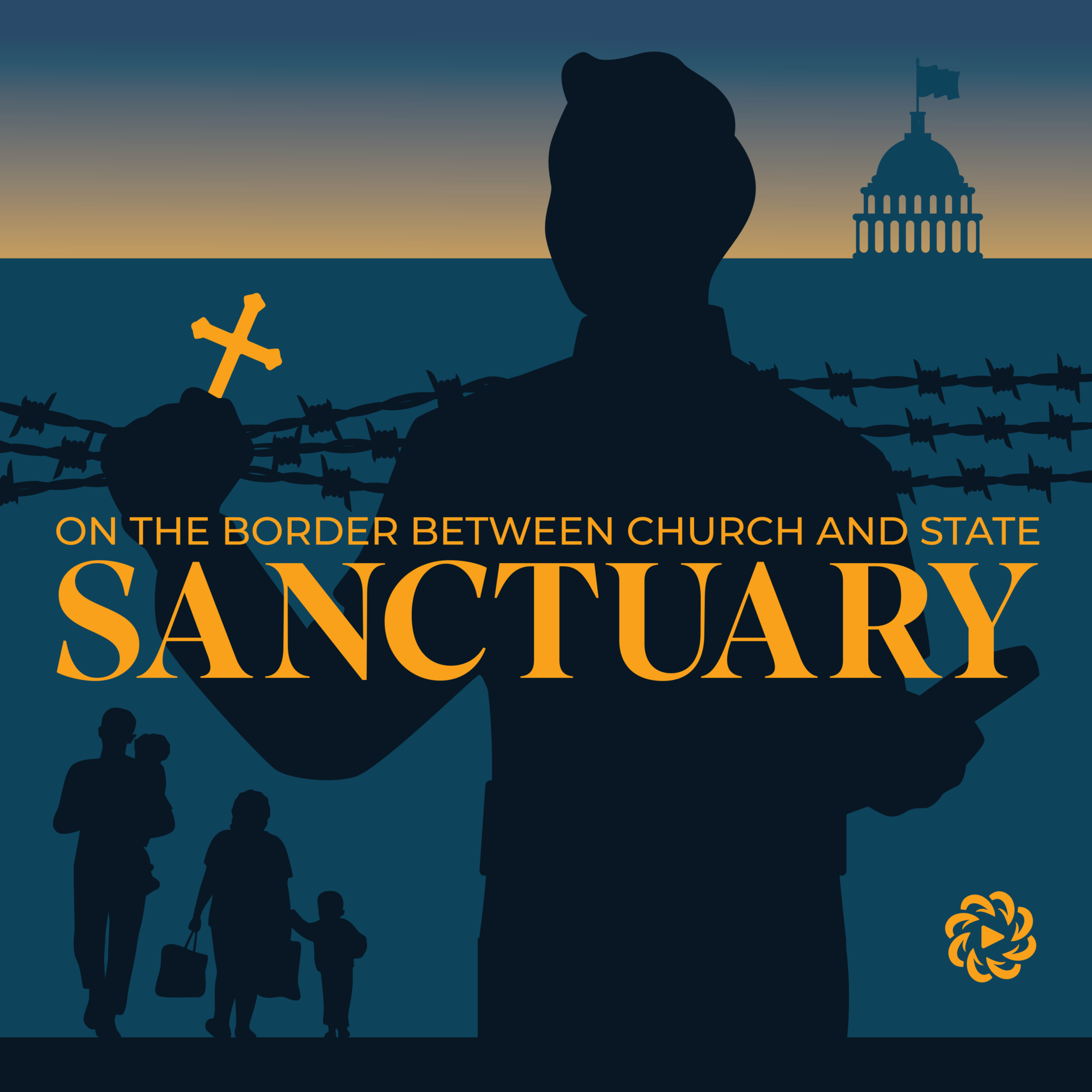
“Build the wall! Build the wall!” How about building sanctuaries instead? The 2016 election of Donald Trump shook the nation. But in the days following his unprecedented victory, sanctuary organizers got to work, not waiting until Trump stepped foot in the White House to develop the networks necessary to protect immigrant communities. In this episode, Barba and González track the immigration politics that played a central role in Trump’s 2016 campaign, and examine how faith organizations and houses of worship revamped the nascent New Sanctuary Movement to meet the historical moment. Churches and synagogues, however, weren’t the only locations where sanctuary could be nurtured; immigration activists took sanctuary to the streets, declaring college campuses, cities, and even entire states sanctuary spaces that would serve as bulwarks against Trump’s draconian immigration policies.
Transcript
Media Clip: [Chanting in support of Jeanette Vizguerra]
Dr. Lloyd Daniel Barba: On February 15, 2017, Jeanette Vizguerra made one of the most difficult decisions of her life.
Media Clip (Speaker 1): Today, outside Immigrations and Customs Enforcement Offices in Washington DC, and near Denver, [chanting] chants in support of undocumented immigrant Jeanette Vizguerra. This morning, Vizguerra was supposed to show up to the Colorado office for a scheduled check-in.
Media Clip (Speaker 2): Is your client showing up today?
Media Clip (Speaker 3): Our client is not showing up today.
Media Clip (Speaker 1): Instead, she has decided to seek sanctuary in a Denver church. For years, it has been government policy to avoid enforcement actions in sensitive areas, like schools, hospitals and places of worship. Vizguerra, now among the first to seek refuge in a church during Trump's presidency. She has three children born in the United States...
Dr. Barba: Vizguerra felt like she had no other option when she entered into sanctuary at First Unitarian Society of Denver. She had been living in the US since 1997 when she fled her native Mexico because of violence and persecution. Her husband, working as a bus driver, had been kidnapped three times. Fearing for their lives, they crossed the border into the US before settling in Denver.
Dr. Sergio M. González: In Colorado, Vizguerra found work as a custodian. At her work site, however, she experienced repeated discrimination. This led her to turn to her union- the Service Employees International Union, or SEIU- for help. She eventually became an organizer for SEIU, and in time, she started her own cleaning business. Vizguerra and her husband had begun to make a life for themselves in the United States. In 2009, however, the precarity of their legal situation became starkly clear when she was stopped for a minor traffic violation and was arrested for driving without a license.
Dr. Barba: This was Vizguerra's first interaction with the police, but it also led her to her first interaction with the country's growing punitive immigration system. She was held in detention for not having legal documents to live in the country. Vizguerra left that detention center with a stay of deportation. But she also left determined to become an immigration justice organizer and an activist.
Dr. González: So, over the course of the next several years, Vizguerra helped found a number of organizations, including Metro Denver Sanctuary Coalition, Abolish ICE, and MUJERR, which stood for Mujeres Juntas, Ejercen Resistencia y Recursos, or Women Together Exercise Resistance and Resources. Fortunately for Vizguerra, that original stay of deportation had been renewed several times over the next few years.
Dr. Barba: But in February 2017, those legal reprieves ended. She now faced an order of deportation, which meant that she was supposed to turn herself over to the Immigration and Customs Enforcement also known as ICE. That would mean certain removal from the country, from her family, and from the community that she had called home for years.
Dr. González: Instead, the mother of four decided to take the remarkable step of entering into sanctuary in the basement of the First Unitarian Society of Denver. So on the morning that Vizguerra was supposed to turn herself in, her support network instead rallied outside Denver's ice offices.
Media Clip: [Singing Protestors outside of Denver's ICE offices]
Dr. González: There, Reverend Anne Dunlap, the pastor of the Unitarian Church where Vizguerra was taking sanctuary, recounted to protesters the events of that morning:
Media Clip (Rev. Dunlap): We walked in, and the lobby was full of armed ICE police. Her officer, higher ups from him, they denied her stay. Their reasoning is because she didn't appear today, that's why they denied her stay. But we know that that's not true because they've had 69 days to respond to her application, which they could have done at the beginning. They know her case, she's not a stranger to them. There's a simple yes or no. What is very clear from their conversation, they waited until the new administration came into power and are making this choice now to cause her more suffering, to her and to her family.
Dr. Barba: Over the next few months, Vizguerra became one of the national faces for a burgeoning sanctuary movement, one that combined the power of faith with a direct challenge to state power.
Media Clip: [Vizguerra giving interviews in Spanish]
Dr. Barba: She spoke to national outlets about her case, and became a vocal critic of the sitting President. Here she is on the news show Democracy Now!, making clear the consequences of the country's immigration policy. You'll hear Vizguerra speaking in Spanish via live-feed from the church, followed by a translator.
Media Clip (Vizguerra with Translator Voiceover): My message for President Trump is that he's doing a bad job administrating the country. The decisions that he's making are a big mistake, and not only with the immigrant community from Latin America, but also communities from around the world: the Muslim community, Southeast Asian communities, and other communities. What would happen to this country if you lost the labor force of immigrants here in the United States? Who would pick crops, work in your hotels, restaurants and construction? Who would keep the engine of the economy moving forward? If he continues to target the immigrant community, it's the whole country that will suffer the consequences economically.
Dr. Barba: Vizguerra was also quick to question why immigrants were considered criminals and such a threat to the nation, when the sitting president had his own legal troubles to answer for.
Media Clip (Vizguerra with Translator Voiceover): The other thing that I want to ask is, supposedly I'm a criminal because I drove without a license, because I had expired stickers on my car, because I had false documents to work and put food on the table for my children. But what should we call you, Mr. President Trump? When you've been evading taxes for years, when the way that you've been acting is not in keeping with good conscience?
Dr. González: Just months after entering sanctuary, Vizguerra was named one of Time Magazine's 100 Most Influential People. Actress America Ferrera penned the Time article accompanying Vizguerra's inclusion on the esteemed list. Ferrera had this to say about Vizguerra quote, "She shed blood, sweat and tears to become a business owner, striving to give her children more opportunities than she had. This is not a crime. This is the American dream."
Dr. Barba: Listeners might remember, Sergio, that the actress had of late become an outspoken advocate for immigration justice. Speaking at the Women's March in Washington DC, just weeks before Vizguerra entered into sanctuary. Ferrera struck a defiant tone in support of women and immigrants across the nation.
Media Clip (Ferrera): It's been a heart-wrenching time to be both a woman and an immigrant in this country. Our dignity, our character, our rights, have all been under attack, and a platform of hate and division assumed power yesterday. But the president is not America. We are America.
Dr. Barba: Her speech, as well as Vizguerra's decision to take sanctuary, came just days after the presidential inauguration of Donald Trump.
Dr. González: I still remember that speech vividly, Lloyd. Speaking in front of the Capitol building on that cold January day, Trump spoke about the "American carnage" that had ripped the nation asunder. It was a form of carnage, according to the new president, that could be traced directly to the nation's open borders. And only he, Trump promised, could restore the nation's sovereignty and bring the country back to its halcyon days.
Media Clip (Trump): America will start winning again, winning like never before. We will bring back our jobs. We will bring back our borders. We will bring back our wealth. And we will bring back our dreams.
Dr. González: Those dreams that Trump spoke of, however, left out a lot of people living in the United States. Among them were people like Vizguerra.
Dr. Barba: And remember, Trump's call for enhanced border security at his inauguration mirrored the messaging from his run for the presidency. But it wasn't just nativism and xenophobia that stood at the center of Trump's immigration politics. The new president had risen to power through his direct attack on the very concept of sanctuary. One of his favorite targets on the campaign trail were so-called "sanctuary cities," those municipalities around the country that stood in the American imagination as a liberal bulwark against federal anti-immigrant policies.
Media Clip (Trump): Number four, block funding for sanctuary cities. We blocked the funding. No more funding. We will end the sanctuary cities that have resulted in so many needless deaths. Cities that refuse to cooperate with federal authorities will not receive taxpayer dollars, and we will work with Congress to pass legislation to protect those jurisdictions that do assist federal authorities.
Dr. González: Now, if nothing else, Trump would make good on this campaign promise. In his first week in office, the newly inaugurated president targeted sanctuary cities in a series of executive orders. Those executive orders marked the beginning of four years of a showdown against the very concept of sanctuary and everything that it stood for.
Dr. Barba: Vizguerra's entry into sanctuary within a month of Trump's inauguration heralded a new era for the sanctuary movement. From Trump's election onward, there began a period of robust organizing by and for those living in the country without legal documentation. A second wave of the New Sanctuary Movement was sweeping over the country.
Dr. González: Welcome to Sanctuary, a limited podcast series about immigration faith and the borders between church and state. Sanctuary was created by me, Dr. Sergio González
Dr. Barba: and me, Dr. Lloyd Barba.
Dr. González: In conjunction with the Institute for religion, media and civic engagement and Axis Mundi Media.
Dr. Barba: Sanctuary was produced by Dr. Bradley Onishi and engineered by Scott Okamoto. Kari Onishi provided production assistance. Sanctuary was made possible through generous funding from the Henry Luce Foundation and with support from the religion department at Amherst College.
Dr. González: Additional support was provided by the American Academy of Religion. And before we get started, we just want to warn listeners that this series contains infrequent depictions of violence and sexual assault that may not be suitable for all listeners.
Dr. González: Now, listeners will remember that in our previous episode, we examined the major shifts in immigration law initiated by Congress and presidents in the 1990s and the post 9/11 era. These new laws were the legislative outcome of a rising tide of anti-immigrant sentiment bubbling across the nation.
Dr. Barba: And listeners will probably also recall that both parties, Democrats and Republicans, played a role in the advancing laws that made it harder and more dangerous to cross into the US, and made it nearly untenable to live in this country without legal documentation.
Dr. González: The 2016 presidential election, however, represented a new chapter in immigration politics in this nation. Donald Trump set a stride in tone. He opened his campaign in June 2015 by clearly targeting immigrant communities, particularly those coming from the nation, directly south from the United States.
Media Clip (Trump): When Mexico sends its people, they're not sending their best. They're not sending you, they're not sending you. They're sending people that have lots of problems, and they're bringing those problems with us. They're bringing drugs, they're bringing crime. They're rapists, and some, I assume, are good people...
Dr. Barba: Um, a new chapter? Of course. But it was one that had strong antecedents. That's to say that, as historians, we need to point out that Trump and his xenophobic rhetoric didn't appear out of nowhere. Republicans, as we examined in our previous episode, had been moving further to the right on immigration since the mid aughts. Representative Jim Sensenbrenner 2005 bill, which threatened to criminalize even the most basic forms of charity towards undocumented immigrants, was one clear mark. And in 2006, when President George W. Bush attempted to push forward comprehensive immigration reform, the right flank of his own party doomed the effort. Those legislators faced the ire of conservative radio hosts and pundits, who egged on voters to reject any form of compromise on toughening the border or extending what they called, quote, "amnesty" to undocumented residents.
Dr. González: Now Lloyd, Trump positioned himself as the only candidate who had the stomach to rein in runaway immigration. Only he, Trump said, had the political independence and wherewithal to finally address the crisis that was bedeviling our nation's borders and it transformed America's sovereignty into a joke. Build a wall? But of course. How else are we going to keep out those jihadists who are threatening to rush across the border and terrorize our nation? End birthright citizenship? Well, sure, we shouldn't just be giving away citizenship to anybody who steps foot in the country and has a child. Compassionate conservatism towards undocumented people? How in the world could you be compassionate towards killers and drug dealers?
Dr. Barba: And, Sergio, it was that last point- that our country had been overrun by real criminal immigrants, some "bad hombres," if you will- that fueled a good chunk of Trump's political rhetoric. Nowhere was this more evident than how Trump attacked what he called one of the gravest dangers facing their nation: sanctuary cities. And one city in particular, San Francisco, came to stand in for just all of this, just as a 2016 Republican presidential primary was heating up.
Dr. González: So, let's go back to the summer of 2015, when Kate Steinle was shot and killed while walking with her father in San Francisco. The bullet that killed her was fired by a man, at the time unhoused, who had found a gun wrapped in a cloth beneath a bench. The gun went off accidentally in his hands, shooting off the single bullet that killed Steinle. The shooter was eventually acquitted by a jury. But for Trump and his ilk that mattered little. It was the man's immigration status that instigated a national firestorm. You see, the man was in the country illegally at the time of the shooting, and had been deported five times previously. This all happened in San Francisco, a city that had a clear policy on how local government officials should interact with federal immigration enforcement. And it was a policy that stretched back to the successful efforts by 1980 sanctuary activists to make the city a more welcoming space for everyone, regardless of their immigration status.
Media Clip: Local governments have also lent their support to the Sanctuary Movement. 17 cities have voted to declare themselves cities of refuge and instructed their employees not to cooperate with the INS. There are 8 aye's, and 3 no's.
Dr. Barba: As listeners will remember, critics of sanctuary, and more specifically, sanctuary cities had been attacking this concept since the 1980s. But in the midst of the heightened anti-immigrant rhetoric of the early 21st century, that criticism took on a renewed resonance. One that was nastier and more politically potent.
Dr. González: Yeah, let's key in on one of the leading voices in this arena. Colorado Congressman Tom Tancredo, today considered one of the early purveyors of the nativist rhetoric that would make Trump famous, threw out some of the most blatant examples of this during his 2008 run for the presidency. Now listen into this political ad played across images of Latin American gang members, bloody violence, and the profiles of the victims of these crimes.
Media Clip (Tancredo Ad): [Tancredo] Hi, I'm Tom Tancredo, and I approve this message because someone needs to say it. [Narrator] Mothers killed, children executed, the tactics of vicious Central American gangs now on US soil. Pushing drugs, raping kids, destroying lives thanks to gutless politicians who refuse to defend our borders. One man dares say what must be done: secure the borders, deport those who don't belong, and make sure they never come back.
Dr. Barba: As a congressman, and later anti-immigrant activist, Tancredo made it his mission to end the sanctuary cities. That, he argued, would be the only way to root out the nation's criminals and undocumented element. Tancredo obviously didn't win the 2008 Republican primary, but his rhetoric eventually did. And it found the perfect spokesperson in Donald J. Trump. As the Kate Steinle trial continued in San Francisco, Trump pounced on the case. He turned his sights on the municipal policy that had allowed an undocumented immigrant to be in the city in the first place.
Media Clip (Trump): Another victim is Kate Steinle, gunned down in the sanctuary city of San Francisco.
Dr. Barba: Trump primarily used the Steinle case as a bludgeon against his political opponents. We see this clearly in his attack ad against Jeb Bush. Sergio, can you walk us through that major turning point here?
Dr. González: Definitely, Lloyd. So, in August 2015, Trump's campaign kneecapped, rivaled Jeb Bush's bid for the White House with one of the most potent ads of the Republican primary. Like his brother, the former president, Jeb Bush attempted to thread the needle on immigration. He acknowledged that people may have broken the law when they entered the US without proper documentation, but the action was, according to Bush quote, "an act of love." Now Trump seized on that phrase. He ran an ad with Bush's quote as images of two convicted murderers who were immigrants, as well as the mug shot of the man who was charged with murdering Steinle flashed across the screen.
Media Clip (Trump Ad using Bush's "Act of Love" quote): Yes, they broke the law, but it's not a felony. It's an act of love.
Dr. González: The ad badly damaged Bush's chances for the White House. Critics, meanwhile, noted that this new attack ad struck similar tones to the notoriously racist Willie Horton ads that torpedoed Democrat Michael Dukakis' presidential bid in 1988. And racist or not, the message was clear, compassionate conservatism was out.
Dr. Barba: And it's clear, Sergio, other Republicans got the message. That same year, Senator Ted Cruz and Congressman Matt Salmon of Arizona introduced HR 3011, the Establishing Mandatory Minimums for Illegal Reentry Act of 2015, also known as Kate's Law.
Media Clip (Ted Cruz): Now, in March, when you were testifying, before the house, you were asked about sanctuary cities. Cities like San Francisco that defy federal law, and because of their defiance of federal law, Kate Steinle is no longer with us. She was murdered because of the refusal of local officials to recognize federal law.
Dr. Barba: Neither chamber of Congress ever held a vote on this legislation, but that summer the House passed a different piece of legislation; the Enforce the Law for Sanctuary Cities Act, that basically covered similar ground. And since 2015, we've seen a continuous stream of proposed legislation from Republican congressmen to withhold federal funding from so-called sanctuary cities.
Dr. González: And Trump, ever the salesman, knew that he'd come across a winning strategy. Attacking sanctuary cities could just be key to making it to the White House. So, on the campaign trail, he began bringing on stage the families of victims of sanctuary cities. The mothers, the fathers, the sisters, the brothers of individuals who had been killed by undocumented immigrants. He called the mothers of the slain, "Angel Moms."
Media Clip (Trump): The result will be millions more illegal immigrants, thousands of more violent, horrible crimes, and total chaos and lawlessness. That's what's going to happen as sure as you're standing there. I'm going to ask all of the Angel Moms to come join me on the stage right now. These are amazing women.
Dr. Barba: These "Angel Moms" would flank Trump on stage as he recounted, in visceral detail, the most odious crimes one could imagine. And as he began to describe how he'd bring down the sanctuary cities, the women served as a form of cover for his nativist messaging and most outlandish proposals. For many listeners, an invocation of Trump and immigration politics will bring to mind 'the wall.' But it was sanctuary cities that served as the most fertile site for Trump to unroll his anti immigrant platform.
Media Clip (Trump): Now, we're going to defund sanctuary cities, because sanctuary cities are a disgrace. They're a disgrace. I have property, I have a great property in San Francisco. The Bank of America building. I love San Francisco. When Kate was brutally killed, shot in the back, by an illegal immigrant who was probably here more than five times. They say five times. We're not going to let that happen again. When a wonderful veteran, 66-year-old woman, was raped, sodomized and killed in Los Angeles. Not going to let that happen anymore. Not going to let it happen anymore by illegal immigrants.
Dr. González: Now we all know Trump rode this high tide of anti-immigrant sentiment into the White House. And once there, he pledged to make good on his campaign promises.
Media Clip (Trump): America must put its own citizens first, because only then can we truly make America great again.
Dr. González: In his first week in office, Trump signed a series of executive orders aiming specifically at immigration policy. Lloyd, tell us what happened in that first week.
Dr. Barba: Well, most probably recall, Sergio, Executive Order 13769, more popularly known as the "Muslim ban." That's the one that brought out thousands of Americans to protest at US airports. Less familiar to many, however, was another one he signed earlier that same week. Trump put pen to paper for Executive Order 13768, or Enhancing Public Safety in the Interior of the United States. The Order addressed, well, you probably guessed it, sanctuary cities.
Media Clip (Trump): Enhancing Public Safety in the Interior of the United States. Public safety in the interior of the United States, what can be important?
Dr. Barba: The Order commanded that any "sanctuary jurisdiction" that refused to comply with immigration enforcement laws would now be ineligible to quote, "receive federal grants, except as deemed necessary for law enforcement purposes" end quote, by the Department of Homeland Security or DHS. Or as then-Press Secretary Sean Spicer put it more plainly, the Federal spigot was closed for sanctuary cities.
Media Clip (Spicer): We're going to strip federal grant money from the sanctuary states and cities that harbor illegal immigrants. The American people are no longer going to have to be forced to subsidize this disregard for our laws.
Dr. González: And to go along with the signing of this executive order, DHS announced the creation of a new unit called the Victims of Immigration Crime Engagement Office or VOICE. DHS Secretary, John Kelly, ordered the reallocation of any department resources previously set aside to advocate for undocumented immigrants to now be used to serve victims of crimes committed by undocumented residents. And like many Trump policies, this is really all just a shell game. In fact, there's already an Office for Victims of Crime in the Department of Justice. And in fact, it is not even clear that this office actually did anything during Trump's term.
Dr. Barba: But really, that was all secondary to the performance of the signing of the executive order. At the announcement, Trump was flanked by three guests whose family members were allegedly killed by criminals living in the US illegally. These were the famous Angel Moms that had followed him around the campaign trail just months earlier. Among them was Laura Wilkerson.
Media Clip (Speaker 1): Now this. President Trump speaking at the Department of Homeland Security. Talking about families who lost loved ones. Killed by illegal immigrants. Watch this.
Media Clip (Speaker 2, Trump): Laura Wilkerson, who lost her 17 year old son. Beautiful Josh. Josh was special. Where's Laura? Good. Laura, thank you.
Dr. González: So pervasive was Trump's message of violence and undocumented immigration that his supporters connected the issue to sanctuary cities. So, let's hear from Laura Wilkerson, who we just heard about in that last clip, when she made one of her regular visits on Fox News to talk about the evils of illegal immigration.
Media Clip (Wilkerson): If I can share one more thing, I'd like your viewers to go to enforcethelaw.org and it'll explain a little bit about what we're going to do this year with sanctuary cities. [Anchor] Enforcethelaw.org, duly noted. Laura Wilkerson, thanks for joining us.
Dr. Barba: The lamentable murder of Wilkerson's son occurred in Pearland, Texas... which, we do have to note, Sergio, is not a sanctuary city.
Dr. González: Yeah. But again, Lloyd, that didn't really matter. The ties between immigrant criminality and sanctuary cities had already been firmly established in the minds of many, especially among Trump supporters. And as we'll describe in a bit, there is no correlation between crime and sanctuary cities. Nor are more crimes, by any measure, committed by undocumented immigrants. The very painful, high-profile cases mentioned here are the targets of huge national spotlights because they visually and emotionally support a decades-old canard regarding crime and immigration.
Dr. Barba: In some ways, Trump's full-throated and full-throttled anti-sanctuary rhetoric had exactly the consequences he'd hoped for. Undocumented immigrants and the people who loved and supported them were certainly afraid of what was coming down the line. And that was especially true in the first weeks of Trump's presidency as he rolled out executive order after executive order geared toward enacting his xenophobic vision of what could make America great again.
Dr. González: But, if his material goal was to dismantle the structures of sanctuary that allowed people not only to organize, both at the faith based and secular level, but also to envision a different future for the country? Well, in that regard, he certainly lost. Immediately after Trump's election, and really, even before his inauguration, sanctuary networks across the country began a massive remobilization to begin to protect undocumented residents.
Dr. Barba: And, chief among them, not surprisingly, were religious communities. In December 2016, faith leaders of various traditions came together to take up the question of sanctuary. They had their eyes set on what might happen after the inauguration.
Media Clip (Speaker 1): Well, the prospect of a Muslim registry, of mass deportations under the Trump administration continue to spark fear and anger.
Media Clip (Speaker 2): You may remember in the early 80s, the Sanctuary Movement, providing a safe haven for refugees from Central America during a civil conflict. And while the roots of sanctuary proceed us all, the movement is alive, and it has a lot of support here in Cincinnati as we move toward the presidency of Donald Trump.
Media Clip (Speaker 3): Mount Auburn Presbyterian, Cincinnati Mennonite Fellowship...
Media Clip (Speaker 2): At least six different faith traditions and dozens of denominations all in one room, many of the world's religions represented, from Unitarian to Evangelical, from Muslim to Jewish communities, and everyone in between.
Dr. Barba: In light of the threats of Trump establishing the Muslim registry, a Mosque in Ohio also took up the question of sanctuary.
Media Clip: And after his election, a Mosque in Cincinnati announced it intended to become a sanctuary congregation. It was ready to shelter asylum seekers or migrants in need, whether they were Muslim or not.
Dr. González: Now, more than 20 faith leaders in the suburbs surrounding the Twin Cities, meanwhile, pledged to open their congregational doors for sanctuary to their undocumented neighbors. With more than 90,000 undocumented residents in the state of Minnesota, these faith communities promised to be prepared should mass deportations begin.
Media Clip (Speaker 1): There is a very real threat to those coming into power to tear apart homes and families, deporting millions of people, millions.
Media Clip (Speaker 2): Pastor Mark Vinge and other church leaders say this isn't a political move, but a stance on faith. Churches like House of Hope in New Hope would allow refugees to reside in the worship space until another safe place can be found. Meanwhile, other congregations are taking on the role of supporting sanctuary churches, providing food, clothing and legal support.
Media clip (Speaker 1): If anything, we should be welcoming people instead of threatening them. Like my colleagues and their congregations, House of Hope has declared itself to be a sanctuary congregation for those under threat of deportation. Immigrants and refugees are the most vulnerable people among us. They are here because they hope that the American Dream is true.
Dr. González: Efforts continue to ramp up in the following month, days before the presidential inauguration.
Media Clip: With inauguration day fast approaching, sanctuary churches like Judson are gearing up, fearful that President-Elect Donald Trump will act on his November pledge to deport 2 to 3 million undocumented immigrants who, in his words, have criminal records.
Dr. González: Listeners might recall, however, that it wasn't just houses of worship that responded in the days after Trump's election. Cities, too, got in on the solidarity action. Mayors across the country began to stake out their positions immediately following the November 2016 election.
Media Clip (Reporter): Defiance to the White House's executive order on sanctuary cities comes not just from the streets, but from City Mayors. Chicago.
Media Clip (Emmanuel - Chicago Mayor): But I want to be clear, we're going to stay a sanctuary city.
Media Clip (Reporter): Boston.
Media Clip (Walsh - Boston Mayor): If necessary, we'll use City Hall itself to shelter and protect anyone who's targeted unjustly.
Media Clip (Reporter): Los Angeles.
Media Clip (Garcetti - Los Angeles Mayor): You can't use federal money as a gun to the head to change some other policies.
Dr. Barba: And pretty soon, it wasn't just cities getting involved. Entire states ramped up their efforts as well. In the 1980s, New Mexico and Wisconsin had been outliers as quote, "sanctuary states." But now states like California, New York and Illinois were pledging their support for undocumented residents.
Media Clip: And Illinois, with a Republican governor, just became a sanctuary state. The bill was signed by Governor Bruce Rauner yesterday. It prohibits local police from making an arrest based on immigration status. It mandates that local police ignore immigration detainers, and says they can only hold an undocumented immigrant if a court order is obtained. Members of the Hispanic community were on hand as the bill was signed into law, and there was representation from the Illinois law enforcement community. Governor Rauner said he consulted with local police before signing it.
Media Clip (Illinois Gov.): They all said to me, Governor, this is a reasonable compromise. It will help us do our jobs better. It will help us keep our communities safer.
Dr. González: The challenge to state power also moved into educational spaces. Across the nation, students demanded that their university presidents and chancellors declare their institutions "sanctuary campuses."
Media Clip: The student government at Florida Gulf Coast University is among several across the country that wants to label the university what they call a 'sanctuary campus' for immigrants.
Dr. González: And amid all this organizing, others took sanctuary to new heights. They were testing out, shall we say, innovative forms of sanctuary all in the name of supporting undocumented neighbors.
Media Clip (Quita Culpepper): President Trump and Governor Abbott have talked about penalties or reducing funding for sanctuary cities. But what about a sanctuary restaurant? Haven't heard of that before? Well, the night-beat's Jason Puckett joins us now to introduce you to one right here in Austin. Jason?
Media Clip (Jason Puckett): Yeah, Quita. L'Oca d'Ora is a restaurant in the Miller neighborhood. They serve traditional Italian food. Don't accept traditional tips, and they're one of the first self-called 'Sanctuary Restaurants.' The sign next to their door tells the story before you even enter.
Media Clip (Adam Orman): We signed a letter to the President talking about the anxiety in the restaurant industry and how we wanted some sort of certainty about what was going to happen to our employees; 'til we had that certainty we were going to- we were declaring ourselves a sanctuary restaurant.
Media Clip (Jason Puckett): They're now part of a growing group. Sanctuary Restaurants here in Austin and across the country, wanting to send a message to President Trump.
Media Clip (Adam Orman): The customers and employees, regardless of race, religion, gender or immigrant status, should know that they are safe and secure here.
Media Clip (Jason Puckett): And so far, the results seem positive.
Dr. González: Now, that's it for the end of part one. Part two is available now.
Straight White American Jesus
The flagship show examining Christian nationalism and democracy.
Listen Now
Axis Mundi Daily Brief
Short, focused analyses of the most important daily developments in religion and politics.
Listen Now