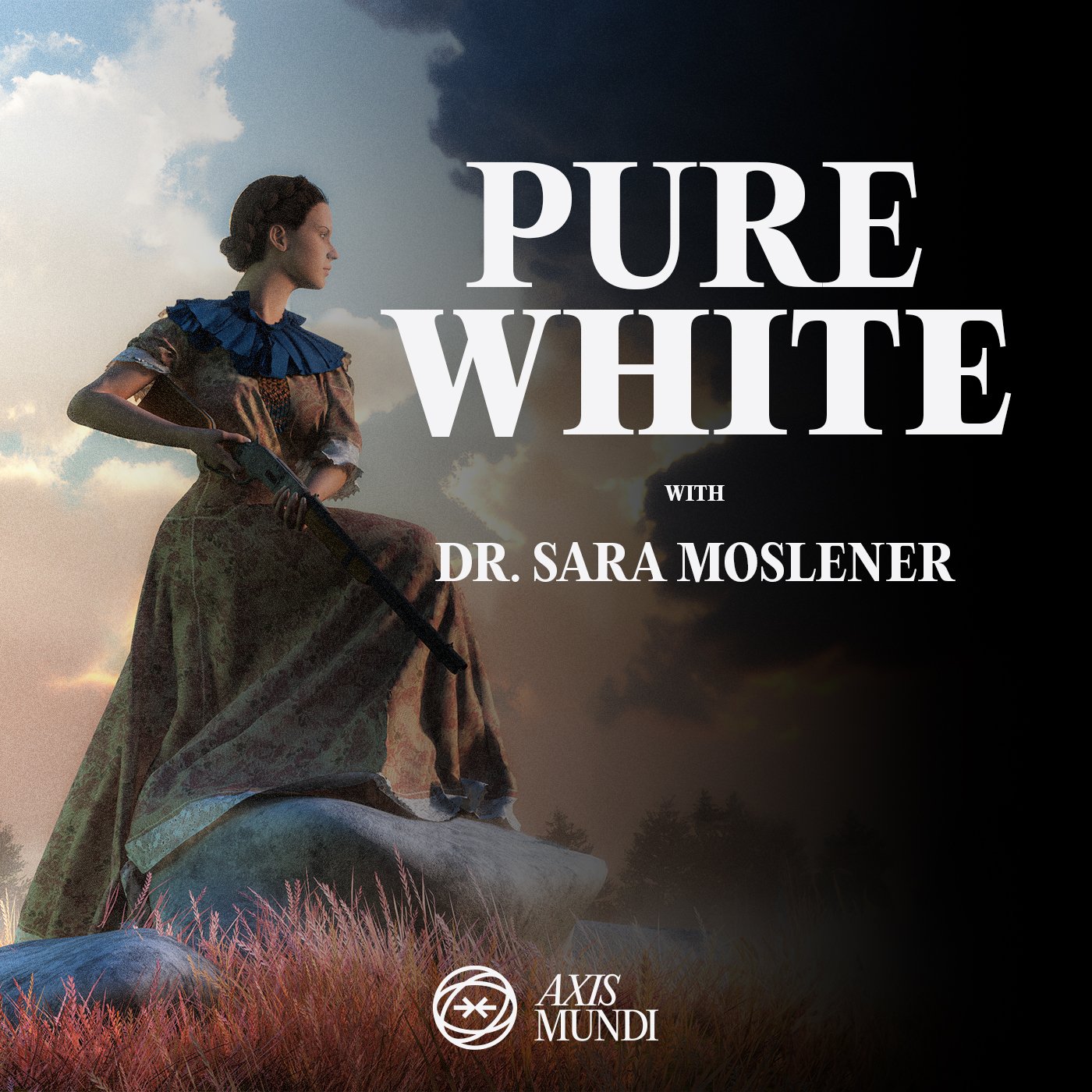
True Womanhood
Summary
First coined by US gender historian Barbara Welter, the cult of true womanhood is a concept that describes Victorian gender ideologies of the 19th century cultural elite. An analysis of these ideals reveals efforts by white Protestants to create a seemingly providential connection between sexual purity and white womanhood. This episode will draw on primary sources (including popular magazines, sermons, articles and speeches by 19th century purity advocates) and expert interviews with religious and cultural historians.
Transcript
Media Clip (News segment with Mary Alice Parks reporting on Moms for Liberty battle over schools): [Mr. Reiderer] There you go. Perfect. All right. You ready, Ainsley?
Media Clip (News segment with Mary Alice Parks reporting on Moms for Liberty battle over schools): [Janelle Reiderer] Well, I think it's, again, the different perspectives. I think it's important we know the different perspectives. But at the same time, like I said, I'm white, and, you know, just because I'm white doesn't mean that we were slaveholders. And the way some of the newer curriculum had been worded had been kind of more of those leading topics to kind of make it more guilt-ridden.
Media Clip (News segment with Mary Alice Parks reporting on Moms for Liberty battle over schools): [Parks narrating] It's the first day of school at the Reiderer house in West Bend, Wisconsin.
Media Clip (News segment with Mary Alice Parks reporting on Moms for Liberty battle over schools): [Janelle Reiderer] So Wednesdays is when Dad's going to help us with our religion curriculum.
Media Clip (News segment with Mary Alice Parks reporting on Moms for Liberty battle over schools): [Parks] Janelle Reiderer is a former teacher who took her kids out of school and is now homeschooling. All six of them.
Media Clip (News segment with Mary Alice Parks reporting on Moms for Liberty battle over schools): [Janelle Reiderer] So we're going to do some of our social studies stuff...
Media Clip (News segment with Mary Alice Parks reporting on Moms for Liberty battle over schools): [Parks narrating] With the kids now playing outside, she shows me the textbooks she chose. [Parks to Janelle] Did you see something or read something about how U.S. history is being taught around the country that concerned you?
Media Clip Intro: ...country, very courageous young people who say, 'I'm willing to stick to my claim, make a pledge, and I will abstain until I'm married.' I'm not married yet. I made a claim a long time ago, but I want to recommit myself to say that I will wait until I'm married. So I'm going to do it with them. I'm very proud of y'all. They're so awesome in number, I'm looking at an ocean of young people. And not only do they represent themselves, but each teenager out here, each young person, represents pundits back home that couldn't make it. As they stake their individual claims, their individual commitment cards and drive them to the ground here in the National Mall.
Sara Moslener: Welcome to Pure White. A podcast about sexual purity and white supremacy. A co-production of Axis Mundi Media and the After Purity Project. I'm your host, Sarah Moslener. Welcome to episode three: True Womanhood. Moms for Liberty is a new political organization of mostly white women that is reiterating something from the 19th century called moral motherhood.
Media Clip (News Segment, Speaker 1): Look at the rise of a far right political group stirring up a lot of controversy.
Media Clip (News Segment, Speaker 2): They're called Moms for liberty. ABC News, Mary Alice Parks with a deeper dive:
Media Clip (News Segment, Mary Alice Parks): The week of the first Republican presidential primary debate in downtown Milwaukee. This group of conservatives has more local races on their mind. It's an activist training focused largely on what they want to teach their children. In Florida, moms for Liberty worked with Governor Ron DeSantis to pass what critics call the 'don't say gay bill' that bans any discussion of sexual orientation or gender identity until the eighth grade.
Sara: As you just heard, these are white mothers rescuing their children from what they see as the corruption of the public school system, which they believe is mis-educating their children about US history, in particular, the history of slavery. The organization has grown very quickly in just two years gaining significant influence in the Republican Party. Their authority is conveyed in a voice of maternal concern and enthusiasm for childhood development. But their tactics include banning books and conversations about difficult topics, including racism in the US and LGBTQ identity. Their nurturing, caring and religious piety obscures the political authoritarianism at work, not to mention the racism. In many ways, Moms for Liberty is similar to the white women Harriet Jacobs was writing to. Both groups claimed moral authority based on their innate connection to child bearing and child rearing. In the 19th century, moral motherhood developed out of the belief that white women's intentions are always pure and always above reproach, especially when they claim to be advocating for their children.
Sara: In this episode, we look more closely at the set of beliefs around white womanhood and how the concept of sexual purity gave white women the exclusive right to assert their moral authority and the ability to disguise the racial animus as innocence. It begins with a small moral panic, as many of these things do, over the changing role of young women's labor.
Shoshanna: I'm Shoshanna Ehrlich, and I'm a professor in the Women's Gender and Sexuality Studies Department at UMass Boston.
Sara: Professor Ehrlich is also the author of the book, 'Regulating Desire: From the Virtuous Maiden to the Purity Princess.' In it, she explains why many in the 19th century felt young white women, in that time, needed special protections, especially when they had few rights and opportunities. And where everything could be ruined by an ill-fated sexual encounter with the wrong man.
Shoshanna: But it was young women who were leaving the supervision of their families and moving to the cities which were seen as these kinds of places of corruption. And so you begin to see this sort of seduction narrative about these young girls who are innocent, pure, and they're sort of entrapped, ensnared by wolves in sheep's clothing. Vile, lustful men who kind of lead these innocent girls in a way to their slaughter.
Sara: The first half of the 19th century was full of change. Factory work was readily available to young women who left home. Cities were growing and drawing young people into an exciting new world, which also stoked a lot of anxiety about young white women moving away from their families for the first time.
Shoshanna Ehrlich: But I think a lot of what galvanized this is this kind of fear of the urbanization and the city. And this idea of country living as pure, as unsullied. And young people began to leave for the city.
Sara: These fears created what Ehrlich and other historians call a 'seduction narrative.' A story about young, vulnerable women leaving the safety of their homes and families to brave the dangerous city. Whether or not this was an accurate description of young women's experiences, didn't matter. What was more important is that it created a new set of expectations for gender behavior. Ideals that were rooted in the norms of Protestant Christianity and white racial identity. Created to protect young women from vile men in the city. This set of ideals became a recipe for social respectability and so much more. What's curious about the seduction narrative is that it completely reversed almost two centuries of Christian theological teachings that describe women as spiritually inferior, jezebels, who use their sexuality to gain power over men. In Puritan New England, women like Anne Hutchinson, who claimed her own spiritual authority, including the right to preach the gospel to whomever would listen, was referred to as a Jezebel and expelled from the community, even though her transgression wasn't sexual in nature. Women's faults and failures were always credited to their sex and sexual delinquency. In the 19th century, Victorian gender roles reversed this configuration to allow white families to gain middle class status and respectability. The belief in female duplicity wasn't erased, rather, it was shifted onto non white women, in particular, enslaved women. This served to justify the enslavement of a presumably inferior race, even after the Atlantic slave trade was outlawed in 1808. But of course, slavery wasn't outlawed in the US until the 1860s. And in the meantime, the slave population continued to grow because of Black women's forced reproduction. As we saw in Harriet Jacobs' autobiography, her path to salvation and security came through obedience to her master, which she refused. Jacobs and other enslaved women would never be perceived as sexually innocent nor deserving of physical protection, because they were not 'true women,' but female bodies serving the institution of slavery.
Dr. Kathryn House has studied the history of sexual purity and how racism and white supremacy informed the construction of the concept in the 19th century. Here she is talking about how the theological shifts around gender gave white women tools for claiming a new form of agency.
Dr. House goes on to explain how the rhetoric of sexual purity precipitated the earliest women's rights movement.
Kathryn House: The use of the idea of purity, sort of becoming an option, a theological option, for women to be able to claim an agency as a Christian identity. So in the sort of theological trajectory, kind of coming, you know, into the 1830s and 40s, when these groups are around, you start to see the theological shift of the Second Great Awakening, is one where women are not only evil and bad and temptations and temptresses and terrible, but they're actually the pious and domestic and pure, and they are the ones who are helping to bring about the salvation of the United States.
Kathryn: The way that they were making the argument was that actually women are capable of being pure. And that sort of inspires, ignites, makes possible their agency and power and their equal rights. I mean, that's how you begin to see the arguments that women are actually capable of being citizens.
Sara: But the revivalist optimism of these early moral reformers was not immune to the form of racial biological essentialism that declared white women morally superior to white men and people of color. Historian Barbara Welter named this 'the cult of true womanhood.' Because it was an attempt to persuade white women to use their presumably natural instincts toward domesticity and maternalism to secure middle class respectability for their white families.
Kathryn: You know, one of the things that has been important to me to notice is, you know, that not all women were granted this privilege and equality that was framed within what 'true womanhood' was supposed to be about. So if purity was definitive of womanhood, then the virtues of womanhood were not conferred on women who were deemed sexually excessive and impure.
Sara: So here is where we need to begin talking about white purity culture as distinct from other racialized contexts, which we'll get into in a minute. Sexual purity allowed white women to become a protected class. White purity reformers used this to attempt to change men's behavior. It also meant shifting traditional Christian views of women as sexual Jezebels away from white women and onto women of color, exclusively, including enslaved Black women. Reasserting the hypersexuality of Black women justified the perpetuation of their forced reproductive labor. Work that the institution of slavery was fully dependent on after the Atlantic slave trade was outlawed in 1808. The virtues and protection of true womanhood were not available to Black women, both before and after emancipation. Black women led sexual purity campaigns, when they were able to, within their own communities toward the goal of racial betterment for their entire community.
Dr. Monique Moultrie is a womanist ethicist at Georgia State University. She's written a book entitled 'Passionate and Pious: Religious Media and Black Women's Sexuality.' Black purity culture, as she explains, has some important distinctions from white purity culture. To understand Black purity culture, we need to look at how Black communities adopted practices of sexual purity as a way to promote a politics of respectability within Black churches and other institutions. I asked Dr. Moultrie to talk about the origins of the politics of respectability.
Monique Moultrie: Yeah, so the term got coined and used most frequently, by historian Evelyn Brooks Higginbotham. And she's writing using the term about Black Baptist women in the 1920s and the 1910s who are part of the club movements, as the social organizing in the earliest 20th century around racial uplift. So these are the groups that built schools, built institutions, built hospitals, provided mutual aid societies like insurance. You know, they were the gofundme's of their day, and the logic of those groups-- this keeping in mind is right after reconstruction ends-- so slavery has ended in the country, reconstruction has largely failed. There is a populace that just wants what they were told they would get, you know. The 13th Amendment is passed. The 14th amendment is passed. They were promised these things. And on every hand, they're denied the basic human rights, the basic human dignities. And so the politics of respectability really shows up as a way of saying, like, 'I deserve dignity.' I deserve to be treated as human. I deserve to, like, ride on the bus, to ride on the car, and, you know, in the train and not be subjugated by doing so. And so the framing was, if we can prove we're upstanding humans, if we can prove we are respectable people, that you shouldn't mind sharing a train car with, that you shouldn't mind buying peaches with at the same peach stand. Then maybe we will get these things that we were promised and a lot of energy was put into policing people into respectable norms. If outward society says we are hypersexual, we are, you know, there's no such thing as a virtuous Black woman. Black women are just sexually debased, then the counter to that is to be supremely holy, to be overly demonstrated on your ability to show restraint, to have sexual restraint.
Sara: What I've learned from scholars like Dr. Moultrie, who study Black purity culture is that sexual purity takes on a very different meaning in different racialized contexts because it was created to give white women power. Numerous Black women in the 19th century strenuously objected to this because they knew that they in their communities, not white women, needed to be able to demonstrate the virtue of sexual purity for their own safety and well being. For them, sexual purity was about racial uplift for the entire community, not about exerting racial power over another group.
Moving into the 20th century, Black moral reformers used the virtue of sexual purity to denounce racist stereotypes of Black sexual deviance. White women use sexual purity to exert racial power. Black women used it to cultivate racial and gender empowerment. Today, there is a robust conversation among Black scholars and activists about sexual purity in the politics of respectability. As Dr. Moultrie demonstrates in her book, Black women are drawn to chastity groups and messaging coming from Black churches because the sexual stereotypes created by the white imagination persists and have significant impact on the lives of Black church women, even today. To the outsider, the politics of respectability may appear as if Black people are perpetuating harm on one another, but that is more about what Dr. House sees as white people's inability to see the wrong a habit of white racial identity that originated with true womanhood.
Kathryn: So, one of the legacies of true womanhood is not only that women are dehumanized and that women of color are dehumanized in this framework, but it also is that it created an unwillingness to see the wrong.
Sara: An unwillingness to see the wrong. I want to pause on that a moment, because I think there's something important about white racial identity more broadly in that statement. White racist attitudes come in many forms. The unwillingness to see the wrongs of our past is, at present, a very common racist habit of white people, along with it, the willingness to point to Black on Black harm. A habit of whiteness that emerges in many conversations about police brutality and even slavery. In the United States, historical education has been guided by the white racial imagination, which means we've been socialized into seeing the past as a place where the problems of racism have been solved. But as more white people are exposed to the buried truths of our national past, the more they experience cognitive dissonance, a psychological response to learning something that upsets your view of reality. Groups like Moms for Liberty may be telling the truth about students and their parents feeling discomfort. Cognitive dissonance is unsettling, but it is also necessary for learning for our minds to become and remain flexible enough so that we can absorb new information and adjust our commitments and beliefs to more accurately reflect the circumstances we have inherited from the past. This is the process of learning.
DARVO, is a concept introduced by trauma specialist Jennifer Freyd in her article, 'Violations of Power: Adaptive Blindness and Betrayal Trauma Theory.' While it describes the tactics of an abusive individual, it also provides us some insights into how white vulnerability and discomfort are deployed to justify white racist attitudes. The white imagination makes us perpetrators of racial violence. It tells us to deny accusations of racism, accuse our accusers of being racist against us, and allows us to situate ourselves as the victims, in lieu of those who have experienced actual harm. So let's go back to those vulnerable, innocent white women leaving their bucolic homes and farms to live and work in the dangerous city. The seduction narrative that cast them as lost sheep just waiting to be seduced and ruined by licentious men. What purpose does this narrative serve? If we view it as an artifact of true womanhood, we can decode the ways that sexual fears reinforce myths of both sexual and racial vulnerability. These in turn, establish the need for protective measures which secure white women's safety, but it also creates the illusion that 'whiteness' itself is innocent and must be protected from contamination. A racial reality that will come to fruition quickly after the emancipation of slavery. Fears of race mixing were heightened in the late 19th and 20th century, as social barriers between the races shifted. Protecting white women's sexual purity became a way to re-establish those racial barriers, especially with new myths circulating about Black men. More on that next time on Pure White, a podcast about sexual purity and white supremacy. Pure White has been made possible by generous grants from the Louisville Institute and the Luce Foundation Project on Religion and Sexual Abuse. Special thanks to Dr. Shoshanna Ehrlich, Dr Kathryn House, and Dr. Monique Moultrie for so generously sharing their expertise with me. Next week, we'll examine another development in the myth of white women's sexual purity: the lynching myth. It is a painful and violent part of US history, but one that helps us see more clearly how white women's sexual purity became a form of racialized power. Pure White is a co-production of Axis Mundi Media and The After Purity Project. Created by me, Sarah Moslener, executive produced by Brad Onishi, editing, audio, and music by Scott Okamoto and production assistance from Kari Onishi, see you next time.
Straight White American Jesus
The flagship show examining Christian nationalism and democracy.
Listen Now
Axis Mundi Daily Brief
Short, focused analyses of the most important daily developments in religion and politics.
Listen Now