Yoga And the Wellness to Conspirituality Pipeline
Summary
What can’t yoga cure? Low back pain? Check. Hip soreness? Check. IBS? No problem. Infertility? Probably.
In this episode, we focus on wellness through one of its most well-known practices: yoga. Philip Deslippe from UCSB and journalist Stacie Stukin, a former Yoga Journal editor, talk about the expansive health claims surrounding yoga. We learn how yoga emerged as an industry, the strategies of yoga influencers, and how they use social media. The big question this week is why conspiracy theories are rife in the yoga world. We analyze the idea of a ‘wellness to conspirituality’ pipeline, challenging the idea of radicalisation as an inevitable result of wellness practices like yoga.
Further Reading
-
Deslippe, Philip, “Yoga Landed in the U.S. Way Earlier Than You’d Think—And Fitness Was Not the Point,” History, June 20, 2019, https://www.history.com/news/yoga-vivekananda-america
-
Deslippe, Philip, “Forgotten histories: Yoga’s popularity in the US long predates hippies and bead-wearing hipsters,” Scroll.in, May 21, 2018 https://scroll.in/magazine/878928/yogas-popularity-in-the-united-states-long-predates-hippies-and-mala-bead-wearing-hipsters
-
Stukin, Stacie, “Yogi Bhajan Turned an L.A. Yoga Studio into a Juggernaut, and Left Two Generations of Followers Reeling from Alleged Abuse,” Los Angeles Magazine, June 15, 2020, https://lamag.com/featured/yogi-bhajan
-
Foxen, Anya P. Inhaling Spirit: Harmonialism, Orientalism, and the Western Roots of Modern Yoga. New York: Oxford University Press, 2020.
-
Jain, Andrea R. “Who Is to Say Modern Yoga Practitioners Have It All Wrong? On Hindu Origins and Yogaphobia.” Journal of the American Academy of Religion 82 (2014): 427-71. https://doi.org/10.1093/jaarel/lft099
-
Jain, Andrea R. Peace Love Yoga: The Politics of Global Spirituality. New York: Oxford University Press, 2020.
-
Singleton, Mark. Yoga Body: The Origins of Modern Posture Practice. Oxford: Oxford University Press, 2010.
-
Yoga in the Modern World: Contemporary Perspectives. Edited by Mark Singleton and Jean Byrne. London: Routledge, 2008.
-
Alter, Joseph S. Yoga in Modern India: The Body between Science and Philosophy. Princeton: Princeton University Press, 2004.
-
Ward, Charlotte, and David Voas. “The Emergence of Conspirituality.” Journal of Contemporary Religion 26 (2011): 103-21. https://doi.org/10.1080/13537903.2011.539846
-
Nguyen, Terry, “The wellness world’s conspiracy problem is linked to Orientalism,” Vox, July 16, 2021, https://www.vox.com/the-goods/22577558/wellness-world-qanon-conspiracy-orientalism
-
Lau, Kimberly J. New Age Capitalism: Making Money East of Eden. Philadelphia: University of Pennsylvania Press, 2000.
-
Beres, Derek, Matthew D. Remski, and Julian Walker. Conspirituality: How New Age Conspiracy Theories Became a Health Threat. New York: PublicAffairs, 2023.
-
Yoga Alliance. “2016 Yoga in America Study,” Highlights from the 2016 Yoga in America Study
-
Cheetham, Joshua. “Does yoga have a conspiracy theory problem?” BBC News, February 19, 2021, https://www.bbc.co.uk/news/world-55957298
Transcript
Dr. Susannah Crockford: If you spend any amount of time on Instagram looking at wellness accounts, you are likely to come across yoga influencers. You probably already know the aesthetic: a gorgeous sunset in the background; in the foreground, a beach or maybe a cliff or mountain top; and in the center, an athletic, white body contorted into a gymnastic pose such as a headstand or handstand. For many, this is the image that comes to mind when thinking about yoga. And yoga is held as synonymous with good health. Looking at social media, you can find any number of health claims made.
Media Clip: Any form of yoga helps focus the mind, concentrate the body, and actually, for that time when I'm on my mat, all I'm doing is thinking about myself, and my breathing, and my posture. And, as many of you know who practice yoga, as soon as your mind starts drifting, your practice is not the same. So I do ashtanga yoga at least twice a week. I go through the primary series. If I'm indulgent enough, then I will do it three times. But it works really well for me. And as a lot of you know, our muscle tone and strength reduces during the perimenopause and menopause. Our bone density reduces, our risk of cardiovascular heart disease increases, and also our risk of dementia increases. So it's quite doom and gloom for us as menopausal women. But doing regular exercise, such as yoga, will improve all that and reduce those risks. Is very important...
Dr. Crockford: An Instagram post I found under the hashtag #yogaisgoodforhealth has the title "Health Conditions That Get Better with Yoga," and underneath lists thyroid problems, menstrual problems, obesity, cholesterol and fatty liver, poor appetite, weak muscle tone, back and neck pain, menopause, anger management, and stress and anxiety. Maybe we should just ask, what doesn't yoga help with? While the scientific literature on the health benefits of yoga is largely inconclusive, the image of yoga as healthy and beneficial is firmly affixed in the popular imagination. Last week we asked: when we talk about wellness, what are we talking about? Yoga is often what people talk about when they talk about wellness. It's beneficial, but most of the benefits are felt subjectively. It makes you feel better, and sometimes it makes you look better too. It's an ideal practice for the slippery, subjective claims of wellness advocates and companies.
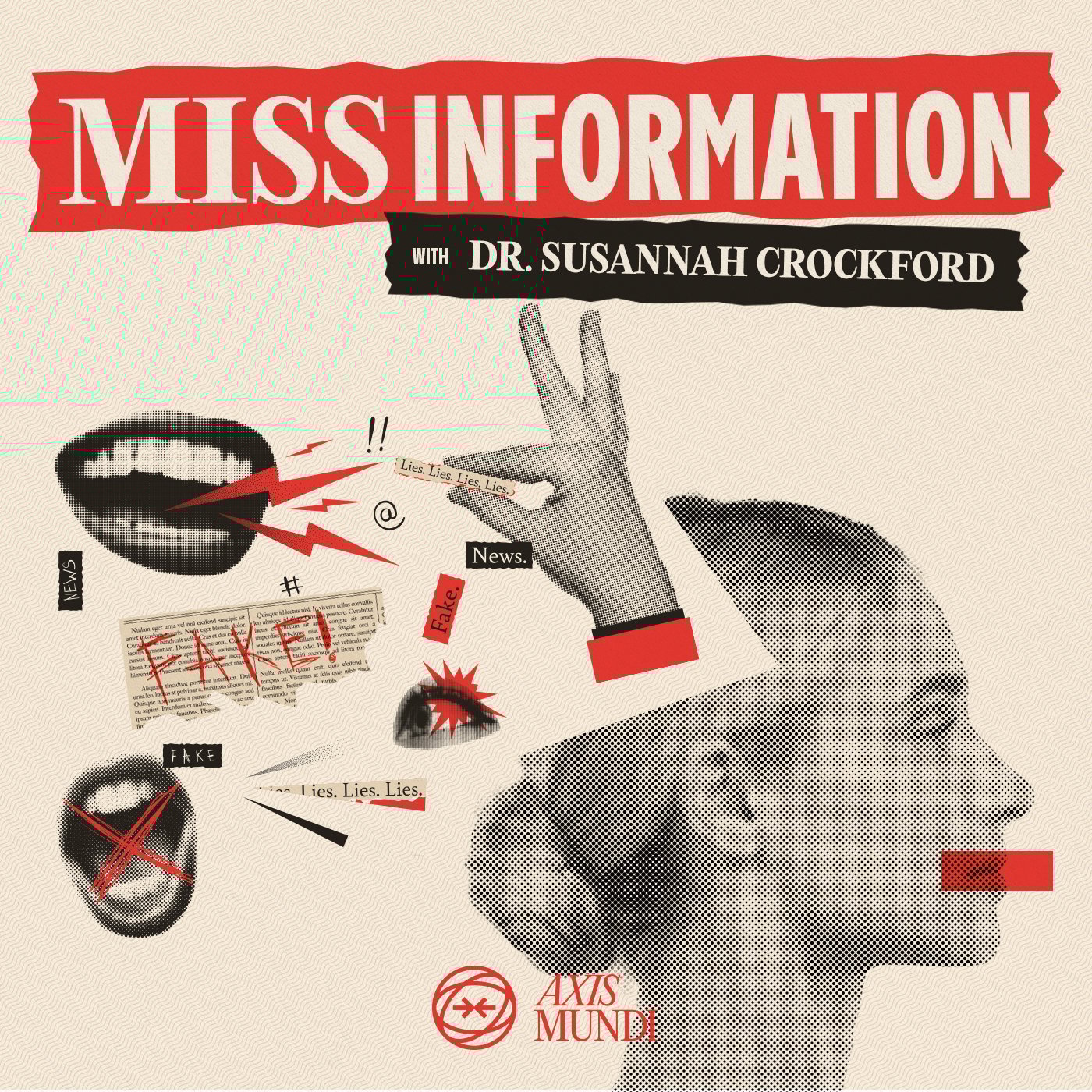
Dr. Crockford: Welcome to Miss Information, a limited podcast series by me, Dr. Susannah Crockford, in conjunction with the Institute for Religion, Media and Civic Engagement and Axis Mundi Media. Miss Information was produced by Dr. Bradley Onishi and engineered by Scott Okamoto. Kari Onishi provided production assistance. Miss Information was made possible through generous funding from the Henry Luce Foundation.
Dr. Crockford: In episode three, we talked about Bryan Johnson, who wants to live forever and uses wellness practices to try and do so, optimizing his health with tech to try and achieve immortality. Today, we're continuing the theme of wellness by talking about yoga and its potential health benefits. But yoga isn't just about health, it's also about spirituality. I started practicing myself 12 years ago. When I was starting my PhD studying new age spirituality in Sedona, Arizona, I wanted to participate in popular spiritual practices. Yoga was an obvious candidate. I thought that through practicing yoga and attending classes, I would meet people involved in new age spirituality. And I was right. I attended three to four classes a week at Seven Centers Yoga in Sedona, which put more emphasis on spiritual associations than other yoga classes I've been to elsewhere. The teachers would use Sanskrit terms for poses, there were statues of Buddha and Hindu deities decorating the yoga studio, and the name of the studio was a reference to the seven chakras. They even taught a 'chakra balancing' intensive course. But yoga's spiritual associations are loose in the American context. Sometimes it's more Indian influence, like at the studio I attended in Sedona, although they pointedly called yoga a Vedic practice not a Hindu practice. Andrea Jain has written about the problematic associations between yoga and Hindu nationalism in contemporary India in her book Peace, Love, Yoga. It seemed like calling it Vedic– a reference to the ancient Sanskrit texts, the Vedas– was a way to sidestep these associations. But other yoga studios had no references to Hinduism or India beyond calling what they did 'yoga.' There's a breathtaking variety of yoga forms, from ashtanga and vinyasa to hot yoga and yin yoga. Even holy yoga for suburban Christian moms who want to do yoga but don't want to seem like they are doing something unChristian. Much of what is taught in America and Europe is influenced as much, or more, by Western gymnastics than the ancient meditation practices called 'yoga' in India, as argued by Anya Foxen in her book Inhaling Spirit. Most yoga scholars refer to what is taught in the West as 'modern postural yoga' to make this difference clear, following the work of Mark Singleton and Joseph Alter. Nonetheless, in the West, yoga is a billion-dollar industry, situated as both a wellness practice and a spiritual practice. Because yoga is so pervasive, for many it is their first step into the wider world of spirituality, as it was for me when I started my research. And in spirituality, there's a lot of claims beyond wellness. Yes, practices like yoga are intended to heal your body, mind and spirit– but heal from what?
Media Clip: The root of all problems in your body comes down to one word, toxins. And all of yoga is designed to flush out these toxins from your body, am I right, Usha? Yes, actually, toxins are just infiltrating everything these days. It's there in your water, it's there in the food, you know, it's also there in the air you breathe. So you just can't help it, there will be toxins flowing in your blood. So what you have to do is keep doing those dynamic yoga postures, and that's how you get rid of them and flush them out of your system. What actually happens is, between the intercellular space, these toxins go and lodge themselves. And when enough toxic material collects in a particular spot, it becomes pain. You feel intense pain in that region of your body. So what you need to do– and it becomes hard and rigid also– so what you have to do is stretch it, pull it, work it out, and then all these toxins get mobilized and get into your bloodstream and flow out and get eliminated naturally, right? Yeah, so this is...
Dr. Crockford: Going to a yoga class will likely introduce you to the wild world of toxins, claimed to be found in everything from food to water to the air we breathe. And claim to cause all sorts of ailments, from stress and fatigue to cancer. Why are there toxins in our environment? Well, you might hear some apposite critiques of corporate malfeasance in cleaning up pollution created by heavy industry, but you might also hear about chemtrails, fluoride and vaccines as sources of toxins. Then you might also hear about the source of these toxins as the 'deep state,' who are also alleged to be responsible for international child trafficking conspiracies by political elites. This is the wellness to conspiracy pipeline. The overlaps between spirituality and conspiracy theory have been named 'conspirituality' by scholars based on an article by David Voas and Charlotte Ward. For many, their first experience of spirituality comes through wellness. As we heard last episode, wellness practices often leverage spiritual as well as health claims. You have to feel the practice working and spirituality often covers the gap between measurable effects and experience. But does yoga really lead to conspiracy theories?
Dr. Crockford: During the COVID-19 pandemic, like so many other businesses, many yoga practitioners were out of work. They went online and developed themselves as influencers instead. Posts about conspiracy theories get a lot of engagement on social media, and so yoga influencers were incentivized to spread them. But for many, they were voicing ideas and beliefs that have been common among yoga and spiritual communities for a long time. In spirituality, health is maintained through individual effort. You eat clean– which can mean any combination of vegan, gluten-free, paleo or keto, even raw food diets– you exercise right– do your yoga! And you meditate– go out in nature, avoid conflict or 'drama' that might lower your vibe. Doing this boosts your immunity and maintains health and wellness, in the spiritual way of thinking.
Media Clip: If you are committed to constantly becoming the best version of yourself, then you care about what you're putting in your body. You care about the people you're surrounding yourself with. You care about the soil that you're putting your hands in on a daily basis. You care about the things that are bettering you as a person in every single challenge in life. Aloha, my friends. My name is Kristina, otherwise known as Fully Raw Kristina, and I'm so happy to be here...
Dr. Crockford: Then COVID-19 happened. Now, here was a disease spread by droplets in the air, and the recommended mitigation was staying inside, away from others, wearing masks, and your yoga studio got closed because of government mandates. For many involved in spirituality, these mitigation practices were anathema to their way of thinking about health and immunity. They thought all they had to do was eat right, exercise and go out in nature, as well as detox from all the toxins, and they were going to stay well. Now the government, of all people, was telling them to stay inside, and part of this was motivated by helping others keep well, not just yourself. It was public health, not individual. On top of this, vaccines were being developed to prevent further spread of COVID. Anti-vaccination beliefs have been common among yoga and spiritual communities for a long time. When I was in Sedona for my research, I was told that vaccinations were bad, even for pets, and many would proudly say they did not vaccinate their children against common childhood infectious diseases. People talk about mercury in vaccines and links to autism. And they weren't alone making those links. Some celebrities question the safety of vaccines, such as Jenny McCarthy and Robert De Niro.
Robert De Niro: There's a lot of information about things that are happening with the CDC, the pharmaceutical companies. There's a lot of things that are not said. I, as a parent of a child who has autism, I'm concerned, and I want to know the truth. And I'm not anti-vaccine. I want safe vaccines. When you get– some people can't get a certain type of shot, and they can die from it, you know, even penicillin. So why should that not be with vaccines, which it isn't.
Dr. Crockford: We've heard many of these vaccine beliefs about different health ideologies in episode two, where we discussed the history of vaccine resistance in the US. And many of the ideas discussed in that episode were present amongst wellness and yoga communities for a long time. So now fast forward to 2020, and they're being told they have to get a vaccine. Many were suspicious and delved deeper into the conspiracy theories already popular among their social networks, online and offline. In July 2021, Vox reported "the wellness world's conspiracy problem." They reported that yoga teachers and crystal healers were online talking about more than ayurvedic diets. They were also talking about child trafficking, election fraud, and QAnon. Spreading pre-existing conspiracy theories that found new audiences online, QAnon became notorious during the pandemic. It began in November 2017 on 4chan, a dark web image board, where anonymous posters claimed that Hillary Clinton was being arrested for multiple crimes, including treason. Clearly, this never happened. But the idea that some politicians– Democrats, Republicans that opposed Trump– were corrupt and involved in nefarious schemes spread well beyond Qanon's roots on 4chan. Some of the wildest claims involved child trafficking, that the so-called 'traitors' of the 'deep state,' QAnon's version of the baddies, were abducting children to harvest adrenochrome, a substance synthesized from adrenaline, which allegedly they took to get high and stay young. The Vox article cites Kimberly Lau's book, New Age Capitalism, to argue that Orientalist appropriation is the problematic root of conspirituality. Westerners cherry-pick East Asian traditions and medical practices without understanding the context, and think they found a secret Western medicine was hiding from them. A bit like when we discussed the jade eggs that Goop was selling in episode three. Yoga and conspirituality researcher Matthew Remski even reads fascist undertones in ideas of a perfectible individual body under attack from an impure environment, fueling the paranoia and perfectionism that he associates with many involved in yoga. Yet in the book, Remski co-authored with Derek Beres and Julian Walker, "Conspirituality: How New Age Conspiracy Theories Became a Health Threat," they report that politics was not welcome in yoga communities, so the fascist associations were left unacknowledged by participants. Claiming to be apolitical or anti-political is a form of politics, of lifting oneself above such earthly concerns. It also meant, according to Remski, Beres and Walker, that yoga could become a petri dish for conspiracy theories without acknowledging that that was what was happening. Today we question the idea of the wellness to conspirituality pipeline and talk about yoga with Philip Deslippe of UC Santa Barbara and Stacie Stukin, a journalist and former editor of the Yoga Journal.
Stacie Stukin: My name is Stacie Stukin, and I'm a journalist based in Los Angeles, and I've covered the yoga world for many years. I was a contributing editor at Yoga Journal for, I think, 12 or 13 years, and I've continued to write about yoga and wellness for all kinds of newspapers, magazines, and online outlets.
Philip Deslippe: Hi. My name is Philip Deslippe. I'm a doctoral candidate in the Department of Religious Studies at UC Santa Barbara. I've written on the history of yoga in the United States for academic journals. For popular venues such as Yoga Journal and Tides: The Journal of the South Asian American Digital Archive. And I've taught courses on the history of yoga in America for Naropa University and the online platform Yogic Studies.
Dr. Crockford: Let's start with wellness. What sort of claims do people make about yoga?
Stacie: Well, what health claims have people not made about yoga maybe is the better question! I mean, for many years, people attribute it as a cure-all for everything, from stress, anxiety, low back pain, neck pain, depression, weight loss, menopause, irritable bowel syndrome. And, you know, I'm not a medical expert, so I don't promote it one way or the other, but it certainly is in the kind of public zeitgeist as something that can really help you, as an alternative therapy for what you may be struggling with.
Philip: And I think, an important aspect of the various health claims that people make about yoga is that those kinds of health claims are really at the genesis of yoga as we know it today. So most scholars on modern yoga, people like Mark Singleton and Joseph Alter, they point to a series of events and key reformers in the early 20th century who kick started what we know as the 'Hatha Renaissance' as really being the origins of yoga as we we do it today, And these reformers are very insistent on the practical, medical health applications of the practice of yoga. So people like Swami Kuvalayananda and Tri Yogendra, they are not only codifying Hatha Yoga, but they are connecting it to a whole host of medical claims. And very explicitly tying it to scientific study and medical anatomy. So you don't just have a posture, but you have the parts of the body that this posture is affecting, and the various cures and remedies that this posture can invoke. And they really set the mold a hundred years ago. So their work is very similar to the work of people like B.K.S. Iyengar, whose extraordinarily influential book Light on Yoga, does many of the same things that Swami Kuvalayananda did decades earlier. You have a pose with specific instructions, a photograph of a model perfectly demonstrating the pose, and a host of medical and physical benefits that can come from that pose. So it really is something that is dyed into the wall of yoga.
Dr. Crockford: So, what kind of basis are there to these claims? If I do lots of yoga, is it really going to, I don't know, cure my irritable bowel syndrome? Should I have such a thing...
Stacie: You know, there is legitimate peer reviewed research on yoga, and some of that research does demonstrate improvement in certain conditions. But also some of that research, if you take a deeper dive and look at it, will say, well, other kinds of exercise can be good for low back pain as well. Other exercises can be good to help with your insomnia. And I think there was kind of this real rush of research, particularly in the late 90s, when the NIH established the National Center for Complementary and Integrative Health. So it was a government entity that started funding these kinds of research, because all the big institutions– Duke University, Harvard, Stanford, you know, Memorial Sloan Kettering in New York, the Cancer Institute– they were starting to incorporate integrative practices into their health care. But if you really take a deeper dive, and you can go to the NCCAM website, they'll show you all the research, but they'll give it, um... not a disclaimer, per se, but they'll say, 'Oh, this was a small sample,' 'Oh, you know, it's important to realize that these studies were mostly done on white, affluent, well educated women.' So there's a lot of different factors that come into analyzing these studies and taking the results, you know, on face value. And I, you know, and I'm not here to say, yoga doesn't help these things. It has helped me for certain, you know, things that I may have struggled with in my life. But at the same time, it is not the cure-all that some people might promote it to be, based on the academic and scientific research.
Dr. Crockford: So Yoga is not a cure all. That may not be too surprising, because most health practices claimed to be a universal panacea generally turn out to be snake oil. And yoga is still beneficial, it can help people. Like Stacie, I've also found yoga beneficial as a practice, especially for the joint pain that comes from sitting at a desk for hours at a time. But any exercise could likely have the same benefit. Why does yoga have such a cachet? You can't separate the health claims from the spiritual claims. Yoga isn't just about stretching. It's also about following a spiritual path. And for the most committed, it also grants access to the yoga community. What's often missed in discussions of how conspiracy theories follow from wellness practices is the importance of the community that develops around people doing that practice as a group. Being in the yoga community is so much more than just attending yoga classes or doing the poses at home. Even though I have practiced yoga for 12 years now, I would not consider myself in the 'yoga community,' because I haven't been to an actual class in years since I finished field work in Sedona, and I practice at home by myself. Being in the yoga community is a whole way of living and thinking. It's your diet, it's who you hang out with. Like all social groups, membership in the yoga community involves more than just the practice it forms around. It can mean training as a yoga teacher. It can mean reading Yoga Journal. It can also mean subscribing to a way of thinking about health and wellness that rejects, or at least treats suspiciously, Western biomedicine. Biomedicine is the technical term for the Western system of modern medicine. It is predicated on a hard line between the body and the mind and a mechanistic worldview attributed to philosopher Rene Descartes. Since the mind and the body are separate, physical problems have physical causes and are best solved with surgical and pharmacological interventions. Psychological problems are caused in the brain and are, also, best solved with pharmacological interventions. This system of medicine has been fantastically successful at fixing broken bones and failing organs, curing and preventing infectious diseases, but it has had less success in treating chronic and mental illnesses. Leaving people with, for example, autoimmune disorders or chronic pain, searching for answers, feeling unheard by doctors and betrayed by the medical system that can often treat their hard to categorize symptoms, suspiciously. Chronic pain forms part of the spiritual healing narrative of conspiracy theorist David Icke, discussed in episode one, and also medical doctor turned wellness influencer Kelly Brogan.
Kelly Brogan: I'm here tonight to tell you that the only path to true and lasting wellness is leaving conventional medicine behind. Because this is not just about symptom suppression, it's about health freedom. But first, I have to admit that I was once a conventional doctor and a regular American. I can still remember my last two slices of pepperoni pizza on 33rd and 3rd, and this was after about eight years of forced sleep deprivation through my residency and fellowship, I was a VIP candy purchaser at the Bellevue gift store, I took birth control, I never exercised, I dyed my hair black, and I never took time to meditate. The price that I paid was Hashimoto's thyroiditis. So what follows isn't coming from on high. It's coming from literally thousands of hours of research, and my own personal journey back from what could have been a chronic autoimmune disease. And what I have to tell you is that I believe that we've been duped. That my entire training was predicated on a disease care model that offers patients only one solution, and that's a prescription and never a shot at true wellness.
Dr. Crockford: This journey led Brogan not only to wellness, but also to spreading conspiracy theories alongside wellness practice. Alternative medicine can become seen as superior to biomedicine by those who have felt untreated and dismissed by biomedical doctors. The question becomes, why is biomedicine seen as all knowing when it doesn't have all the answers? 'Doctors are misguided' turns into 'doctors are corrupt' turns into 'there's a conspiracy to hide the truth from us.' People who find relief in alternative medicine often become suspicious of healthcare and pharmaceutical corporations, but also suspicious of the ideas behind biomedicine. The way the body and immunity work. The ideologies of health and wellness that we talked about in episodes two and three. Here's Kelly Brogan speaking again:
Kelly Brogan: Western medicine is killing us. And we have to start considering that despite the fact that our doctors are probably very well intentioned people who put blood, sweat, and tears into their training, we have to start asking who is funding that training. Because some of us are speaking out about the fact that our training and medical education are bought. 'Unfortunately, in the balance between benefits and risks it is an uncomfortable truth that most drugs do not work in most patients.' So before I read this condemning quote in the British Medical Journal, I had already taken a very deep dive into ghost written, suppressed and manipulated data that essentially undermined all of gold standard practice in psychiatry and obstetrics, my specialties. And even the Mayo Clinic begrudgingly agrees that 40% of practice should be discarded. But unfortunately, according to data, it takes 17 years for this science to trickle into your doctor's hands. So this is how modern medicine is not reflecting modern science. And by modern science I mean concepts like the microbiome, like epigenetics, like toxicant exposure and like biochemical individuality. We are still using a model that employs a one gene, one ill, one pill system of understanding. And the problem is that this model is totally ill-equipped to tell you, as an individual, how you will react with regard to efficacy and safety to a given pharmaceutical intervention.
Dr. Crockford: It's not irrational to question the motives of healthcare and pharmaceutical corporations, especially in a for-profit system, like in the US, where they really are making billions of dollars of profit from sickness. But alternative medicine practitioners are making money too. We're all in the same capitalist system. Yet for some, because of a combination of personal symptoms and demographics, alternative medicine becomes more appealing. Okay, so let's talk about those demographics a bit more. The 2016 yoga in America survey by the Yoga Alliance and Yoga Journal found that of the 36.7 million people who said they practiced yoga, 72% were women. 43% were 30 to 49 years old. The highest concentrations of people who practice yoga were in the Pacific Northwest and New York State. This data supports a common perception of who does yoga: white, college educated, middle class, women. There's a similar demographic perception of people involved in spirituality as well. This demographic may find that as women, their medical problems are dismissed, or at least not treated very seriously compared to men's. Yet, they have the economic and educational ability to search for alternative forms of medicine. Being knowledgeable about alternative medicine also forms a type of social capital for white middle class college educated women. They can use their knowledge of essential oils or acupuncture or yoga to impress their friends and claim an alternative form of authority about health concerns. But let's return to that figure, 36.7 million, which is 16% of Americans. That would be a sizable community. But are most people who do yoga, in the yoga community? And how has yoga emerged to this level of cultural prevalence?
Philip: In the 60s and 70s and 80s, you not only have the counterculture that's engaging in yoga, but you have very, kind of, straight laced normal popularizers of yoga on public broadcasting in America. Teachers who are teaching at health clubs, trying to make yoga as mainstream and unthreatening as possible. And then yoga, kind of, dovetails with the fitness revolution in the 1980s when you start to have health clubs all over the country, and yoga finds a home there. And then with the technological revolution of VHS tapes and DVDs. Yoga suddenly can be in people's homes, and you have these celebrity yoga teachers who are teaching millions of students through DVDs and VHS tapes. So we know from surveys and statistics that through the 80s and 90s and 2000s, yoga is just doubling again and again in size and having this massive foundation of practitioners. But there's, I think there's something else interesting that's going on. We also know through those surveys that the vast majority of people who are doing yoga, it's an occasional thing. It's just like a weekly yoga class, or a couple times a month I go to the local rec-center or health club. There, within those large numbers of practitioners, there is a very small but intense core of people who are professional yogis, professional yoga teachers, who do yoga daily, many times a day. Yoga is part of their career. It's part of their identity. And in the 90s and 2000s, you start to see schools of yoga taking credentialing more seriously. And you start to have yoga teachers who are very much reared in a particular style and system, who are accredited by that system. And you have growing numbers of people who see yoga, not just as a form of exercise, but as a spiritual path. A huge component of who they are.
Stacie: But it's also a spiritual path that has a lot of stuff you can buy, right? You know, yoga mat companies, yoga clothing, yoga props, yoga blankets. And, as Philip mentioned: the tapes, the DVDs. And you know, now, if you look at, you know, just fashion in general, you know, yoga wear is just part of every day. It's like Levi's. Yoga pants are, much to my chagrin– I have a saying like, "Wear real pants, people!" You know?!-- but you know, you can't go anywhere without seeing many people in yoga clothes. Whether or not they are serious practitioners or not. It's a fashion statement.
Philip: And I think that's a testament to how yoga won the day. Like other forms of once marginal, alternative, complementary medicine and spirituality, it's now ubiquitous. So you, kind of, don't even hear the word yoga anymore when you're talking about yoga pants. In the same way that you don't give a second look to an aromatherapy spray at Target. And I think those two things go hand in hand. That, I think, this huge industry of yoga creates a space for this intense core of yoga devotees and teachers and enthusiasts.
Dr. Crockford: The small but intense core, professional yogis, for whom yoga forms an important part of their careers and identity, this is what you might broadly call the 'yoga community.' Not people like me who just practice the stretch. There's a whole elaboration beyond the postures in the yoga community of health and wellness, sure, but also diet, immunity and spirituality. But as Stacie pointed out, it's a spiritual path that also has stuff you can buy. Yoga is a $105.9 billion industry according to market research estimates. There's yoga classes in studios, but also clothing, mats, equipment, teacher training and accreditation, resorts and experience vacations. And this business has been building up over decades. It was popular in the 1990s before social media, with yoga teachers making fitness videos on VHS. But with the advent of social media, the medium has changed the practice. With the migration to Instagram and YouTube and Tiktok, yoga teachers have to have a social media presence as part of their resume. Platforms like Instagram and Tiktok reinforce the visual emphasis of yoga. Yoga teachers are also 'yoga influencers,' and their body is part of their marketing. They demonstrate the efficacy of their practice in the physical form of their body and the complexity of their postures. It's a crowded marketplace. They are competing with thousands of other yoga teachers online. If you're going to make a living out of it, you need to stand out and grab followers. One way to do this is to try to establish a personal connection or rapport with their audience. They are not just doing yoga, they are on a healing journey, on a spiritual path, and this often involves oversharing on social media. Depicting every aspect of life in intimate detail to establish that connection. They emphasize the overwhelm of modern living. Their posts reiterate that we are living in difficult, stressful times with the environment and COVID and everything, and yoga can help with those stresses. That's the pitch. Successful yoga influencers are both like us and also not like us. They're doing what we're doing: dealing with this stressful time. But also, they look fabulous and can contort into ridiculous postures on the beach in an amazing swimsuit. They are relatable but also aspirational. The emphasis is on doing incredible acrobatic and gymnastic poses which are not accessible to everyone. The more complex poses are more attractive on Instagram, especially inversions and handstands. Focusing on those postures specifically to look good on Instagram. Yoga injuries are not mentioned. It gives yoga teachers a form of authority. Then what do they do with this authority? The healing journey is part of how that authority is constructed, a model for how others should act, but also a model for understanding illness, the body, and how to heal. Wellness influencer Kelly Brogan, a doctor, talks about how she turned away from mainstream medicine.
Kelly Brogan: ...saw a naturopath, clearly, I was guided, you know, by someone on high, because this was totally out of character for me. Except that I didn't want to take the damn prescription, right? So I was motivated to pursue another paradigm because of that. I saw a naturopath, changed my diet, and within the space of one year, I watched my antibodies in black and white on paper. I needed that, right? I watched my antibodies, you know, resolve. I watched my TSH come into normal range. And instead of feeling so excited, you know, that I got this 'Get Out of Jail Free' card, I was enraged. Like primal rage. It was like coursing through my system, you know. I felt the betrayal of, like, the cardinal betrayal, even of my childhood, but it was personified through the characters of, you know, me as the doctor and the system, you know, that I had trained with. I felt betrayed, and so I took my sword out of her sheath, and I, you know, ran onto the battlefield and published a New York Times bestseller with an exploding pill on the cover. And I waged war for many years against this system in a way that would only reveal itself, later, to be, you know, informed by a lot of adolescent energy, right? And really now what I call the 'erotic caress of the enemy.' I was totally obsessed by all of the ways that I needed this so-called enemy of industry to change and be the way I thought it should be. And I was going to threaten it with terminal dismantling, you know, should they not comply. Like I really thought, like, this book and the hundreds of scientific references in it, no one is ever gonna take psychotropic medicine again, right? And of course, I'd be in a lecture hall, you know, in Australia or something, and some lovely woman would come up to me afterward and be like, 'I loved your book. It was so great. Thank you so much for the work you do. You know, I just, like, I had such a hard time, and I just really didn't have a choice, and I ended up on Lexapro, and then I was also prescribed Klonopin for sleep. And, like, now I don't really know what to do.' Okay, so she read my book, and she went on to take a medication anyway. So that's when I started to become much more interested in the psycho spiritual underpinnings of the behavioral choices that we make around health and the experience of illness and symptoms. And I also, at the time, met my mentor, Dr Nicholas Gonzalez, who opened up a spiritual world for me that I'm not sure would have remained or would have been accessible otherwise. And what he showed me was, in 27 years of his clinical practice, that faith was a neuro-regenerative state, right? So when he could help his patients access faith in themselves. Which now I look, you know, psychologically at that, he helped them to step out of that victim triangle, right? The villain, the victim, the rescuer. The rescuer as the, you know, the doctor who has all the information you don't have, as the victim who's suffering at the hands of what villain? Yourself. Your body, right? Your symptoms. So that war between you and you is an unwinnable war. It's a zero sum game. And so what I watched him do in his practice, and what he ultimately conferred to me energetically, I believe, is what it is to resolve that fragmentation and to come into alliance with yourself, with the fierce conviction that your body does not make mistakes. That there is no such thing as an illness that needs to be beat into submission, and won over. That your symptoms are you telling you about you. Everything is okay. It's more than okay. It's about to get amazing. And so I watched, you know, through this paradigm, when applied to my own practice like I've published...
Dr. Crockford: If your symptoms are 'you telling you about you,' what does COVID-19, a respiratory illness caught from the air, tell you about yourself?
Stacie: Yes, it was very prevalent during the pandemic and continued to be. And I think it was a pretty smooth transition, because, you know, a lot of the language of QAnon was, you know, light workers, or they use, kind of, some of the similar kind of music. This idea of being in charge of your life, being sovereign, that word was thrown around or continues to be thrown out around a lot. Seeking your truth, following your intuition, doing your own research. You know, all these things were very easy connections. And then there was something that– there was something that was a term I was, kind of, like throwing around just on my own– but it's kind of like a spiritual supremacy, right? So, 'I do yoga. I'm a vegetarian. I eat well. I meditate. So, I'm kind of immune to what's going on,' without making the connection that other people don't have that kind of access to good food. They don't have time to meditate. So it was like this kind of really big blind spot– not making the economic and privileged connection between who was really suffering during the pandemic.
Philip: Yeah, one of the things that I found really interesting about the pandemic is: I immersed myself in a lot of the scholarships on new age practitioners, and there were a lot of demographic conclusions. We know from the 70s onward, your new age practitioner, they're going to be disproportionately white and female and college educated and middle class. I think something that only the anthropologists and the ethnographers and a lot of social critics knew was that beneath the demographics, new age spirituality was very much centered on the self. It was all about your desires, your experience, your path. New age spirituality was also very cut off from any kind of social responsibility. It's you and your personal path, and then the universe. And new age spirituality was also very teleological and eschatological. It was all about there's a purpose for things. There's a meaning for things. Everything, including my personal path, is leading to this big conclusion, whether it's cataclysmic or, you know, everything's going to be fine in the end. So I think when the pandemic came along, that kind of sense of what I want and what I feel is very important. It's more important than maybe what the people around me, or society at large needs. I think that really came to the forefront. And also, I think in the yoga world, you know, there's no, despite all the medical studies in Harvard and Duke, there really is no accreditation. There's really no governing body for yoga, like there is for other things– for teaching school or for being a medical doctor. So I think without realizing it, the yoga world is really awash in these kind of fuzzy credentials and anecdotal evidence. And this, I think the yoga world also had this general skepticism. You know, you're doing something that's not like what everyone else is doing, and you have this certainty in the healing power of your yoga practice. I think this was a perfect storm when the pandemic hit, for people to not trust medical experts. To trust people with fuzzy credentials. In many cases, it's literally some guy on YouTube telling me stuff. And if you felt uncertain, if you felt skeptical, if you personally didn't like wearing a mask, that was a lot for yoga people. That was enough to take action or to shape your worldview.
Dr. Crockford: Yoga is a broad community, and some are troubled by QAnon's increasing popularity among their peers.
Media Clip (Speaker 1): Once the pandemic led to lockdown and life was forced online, QAnon spread like wildfire from the dark web and into the mainstream.
Media Clip (Speaker 2): It felt like this odd trauma bond. How is something that I thought was so alt-right affecting a population that I presumed was progressive alt-left?
Media Clip (Speaker 1): So how does love and light turn dark?
Media Clip (Speaker 3): I recognize that there is a lot of potential political power in, you know, the yoga community.
Media Clip (Speaker 1): Meditation teacher Jay Ponti says he saw firsthand how his close friend Mickey Willis went from a Bernie Sanders supporter and New Age luminary to the front steps of the Capitol on January 6, and the disinformation mastermind behind the movie Plandemic.
Media Clip (Speaker 3): He went on and essentially takes very complex problems and reduces them to very simple sources. It's just pedophiles, it's the Hollywood elite, it's the Democrats.
Media Clip (Speaker 1): Seane Corn, a seasoned Yogi with a massive online following...
Media Clip (Speaker 2): People that I would know would reach out to me, telling me how misinformed I was and that I didn't understand, or accusing me of being a pedophile.
Media Clip (Speaker 1): She began to lose those she loved...
Dr. Crockford: Not everyone who does yoga gets into conspiracy theories, not even those within the small but intense core. Seane Corn, featured in the clips just now, is a yoga teacher in Los Angeles with over 110,000 followers on Instagram. She has spoken out about the prevalence of QAnon and conspiracy theories about COVID among the yoga community. She issued a joint statement with other yoga teachers, saying that QAnon and hate speech do not reflect the true values of yoga. In an interview she gave with the BBC, she offered the opinion that many yoga teachers just focus on their practice and let everyone figure out what they believe on their own. The everyone-has-their-own-truth principle in spirituality. But this neglects the influence that yoga teachers, especially those with large social media followings, can have on their students. The relationship between the intense core and the wider industry, between the star teachers and the many followers- is that the pipeline? Ideas traveling from this intense core through the wider industry to many more people, like some form of contamination? The problem with the pipeline idea is that it's one way and implies everyone is equally vulnerable to it. It envisions yoga as a gateway drug to conspiracy theory. But just like with so-called gateway drugs, not everyone who tries the weak stuff moves on to the strong. Many who do yoga are not in the intense core of the yoga community. Even those within that core are able to stand against ideas like QAnon, like Seane Corn, or even the authors of the conspirituality book, who describe themselves as living deep within the 'yoga world.' The idea of a pipeline suggests a flow of less to more radical ways of thinking. People do change their views over time, and when this change leads to a more extremist position, especially within communities en masse, political scientists call this 'radicalization.' It's a way of explaining the social problem of extremism. People who take radical action– like trying to overthrow the government on January 6th, for example– are often surrounded by communities of people who share similar views but don't take action on them for whatever reason. From a law enforcement perspective, extremists are the problem. But the concept of radicalization often means that communities become problematized with them. The group is blamed for the actions of a few.
Dr. Crockford: An example of how this can happen can be seen in the response to 9/11. After a small group of Muslims attacked the Twin Towers, all Muslims became seen as potential terrorists. And then Islam became a 'risk factor' for radicalization, and this remains deeply problematic. It may be easier to see this when talking about the example of Islam and terrorism. But Yoga does not predispose people to conspiracy theories any more than Islam does to terrorism. Some within those communities will become more extreme, but many won't. And isolating communities as the source of 'the problem' underplays the complex socio-political dynamics at work. You can do yoga and never once think about conspiracy theories. The same goes for spirituality. Yoga does not sit at the high point of a wellness to conspirituality pipeline from which unsuspecting victims are helplessly flung down with the slurry of bad beliefs and misinformed views. While there is overlap between yoga, wellness, spirituality and conspiracy theories, the relationship between these currents is not causative, but one rather of association. Conspiracy theories are part of the culture of the yoga community, and if we think back to the first episode, what you call a conspiracy theory, will depend on your own epistemic commitments and positions. It's not a clear category with a specific definition. And to what extent is yoga associated with conspiracy theories, because it is excluded from more socially legitimate categories like religion and belief. Religious belief can also run contrary to biomedical practice, and yet we don't talk about a pipeline to conspiracy theory in these cases. Being part of a community means hearing about and often sharing the views and ideas of that community, but not all of a community's views, beliefs and practices accord with the best practice in biomedicine.
Dr. Crockford: Next time, we will talk more about conspiracy theories and COVID-19, but among what may seem like a very different type of community, evangelical Christians. For now, thank you so much for listening. I've been Susannah Crockford. And remember misinformation matters.

Straight White American Jesus
The flagship show examining Christian nationalism and democracy.
Listen Now
Axis Mundi Daily Brief
Short, focused analyses of the most important daily developments in religion and politics.
Listen Now